 Equipment
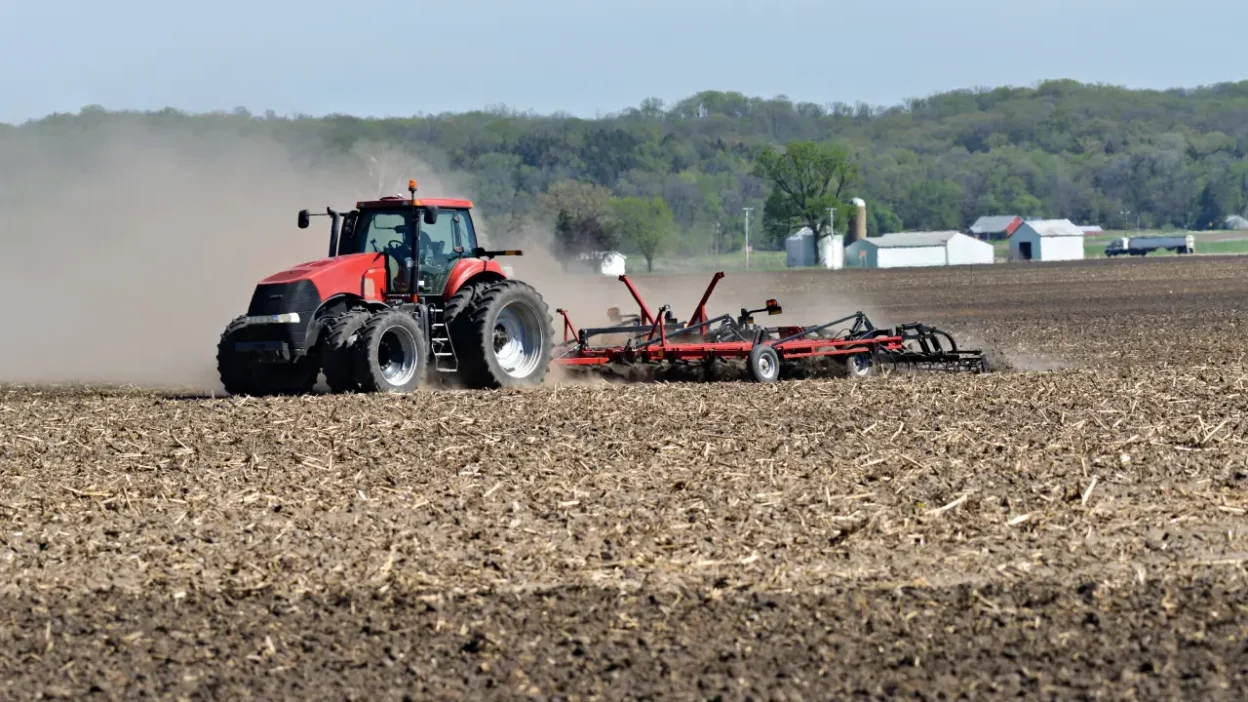
Tillage is the mechanical working of soil to prepare it for planting: breaking and loosening it, mixing in crop residue, and leveling a seedbed for the drill or planter. It happens in two stages. Primary tillage is the first deep pass that breaks the ground; secondary tillage is the shallower work that follows to crumble clods and finish the surface. Which implements you need depends on your tillage system, your soil and the tractor you own, and you can browse tillage equipment by type and width as you work through the choice.
- Tillage is the mechanical preparation of soil for planting: breaking, loosening, mixing in residue and leveling the seedbed.
- Primary tillage works deep and breaks the soil; secondary tillage works shallow and finishes the seedbed.
- Main primary implements are moldboard, disc and chisel plows, subsoilers and rotary tillers.
- Main secondary tillage implements are disc harrows, field cultivators, tine and power harrows, rollers and vertical tillage tools.
- Conventional tillage uses the most passes; USDA puts it below 15 percent residue cover and conservation tillage above 30.
- Size by field window and power: a field cultivator needs about 7 hp per foot, a clay-soil moldboard plow about 25.
- On used equipment check the frame, shanks and points, discs and bearings, folding hydraulics and wear part supply.
- JumboBee lists tillage equipment from verified sellers in many countries, with support for international shipping.
What Is Tillage?
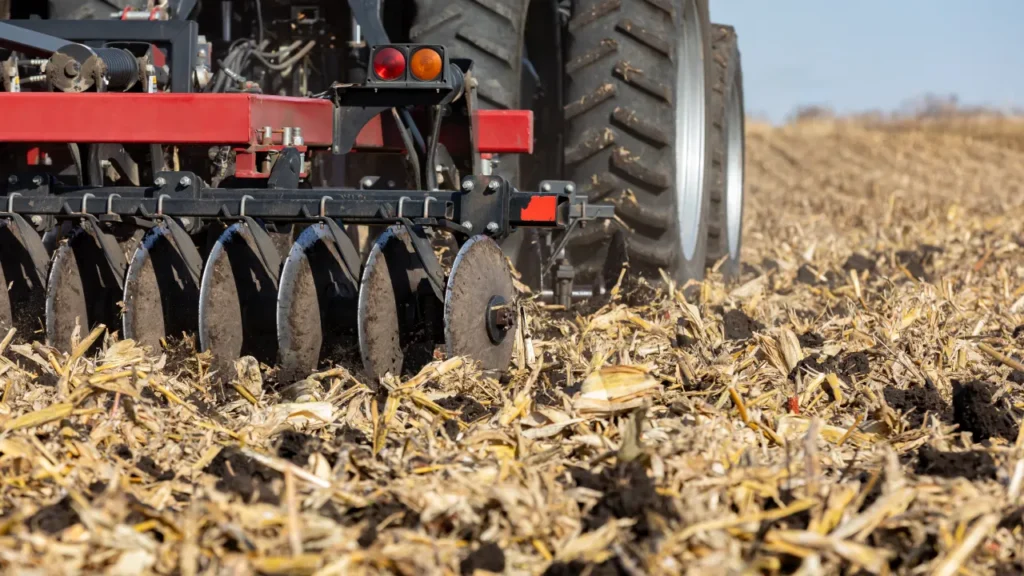
Tillage is any mechanical operation that disturbs soil to grow a crop. The tillage meaning farmers work with is broad: it covers everything from a moldboard plow inverting a furrow slice to coulters slicing residue ahead of a planter. Farmers till to make a seedbed, kill weeds, handle residue, break compaction and mix in fertilizer or manure. A seedbed is the loose, level top layer that seed goes into; crop residue is the stalks, stubble and leaves left after harvest.
Each of those gains has a cost on the other side:
- Erosion. Purdue Extension figures show bare soil losing 12.4 tons an acre (about 28 t/ha) against 1.4 tons (about 3 t/ha) where 71 percent of the surface stays covered by residue.
- Moisture. Each pass opens the soil and lets more water evaporate.
- Structure. The USDA NRCS notes that moldboard plowing and excessive tillage break down soil aggregates.
- Fuel and time. Every pass is another trip across the field, and the field window is usually what binds.
That trade-off is why tillage systems differ so much from farm to farm.
Primary vs Secondary Tillage
The split between primary tillage and secondary tillage is about depth and order rather than size or brand: primary breaks the ground, secondary finishes it.
| Primary tillage | Secondary tillage | |
|---|---|---|
| Goal | Break and loosen soil, bury or mix residue | Break clods, level, prepare seedbed, control weeds |
| Working depth | 7 to 10 in (18 to 25 cm) for a moldboard plow, 16 in (41 cm) for a subsoiler | 3 to 5 in (8 to 13 cm) for a field cultivator, 1 to 3 in (2.5 to 8 cm) for a power harrow |
| Typical implements | Moldboard, disc and chisel plows, subsoiler, rotary tiller | Disc harrow, field cultivator, tine or power harrow, roller |
| Power need | High. A moldboard plow in clay pulls 1,200 lb per foot of width (17.5 kN/m) | Lower. A tandem disc pulls 200 lb per foot (2.9 kN/m) |
| When | After harvest, or before spring work | Just before planting |
Draft is the pulling force an implement needs, given here in pounds per foot of working width, the strip of ground the implement covers in one pass.
Depths and draft figures are from Iowa State University’s Farm Machinery Selection, revised January 2017, from Purdue’s tillage chapter, and from the USDA NRCS organic tillage guide for the power harrow.
Primary Tillage Equipment
Primary tillage equipment breaks ground that has not been worked since the last crop, at depths from about 7 in to 16 in (18 to 41 cm), and apart from the PTO-driven rotary tiller, it is the heaviest-pulling machinery on the farm. Five implements cover almost all of it.
| Implement | How it works | Working depth | Power need | Best for |
|---|---|---|---|---|
| Moldboard plow | Cuts and inverts the soil slice | 7 to 10 in (18 to 25 cm) | 320 lb of draft per foot in light soil (4.7 kN/m), 1,200 in clay (17.5 kN/m) | Burying residue, sod breaking |
| Disc plow | Concave discs cut and turn soil | Varies by model; check the maker’s spec | 325 lb per foot for a heavy or offset disc | Hard, stony or root-filled soil |
| Chisel plow | Shanks loosen without inverting | 7 to 9 in (18 to 23 cm) | 500 lb of draft per shank (2.2 kN) | Reduced tillage, leaving residue |
| Subsoiler and ripper | Deep shanks break hardpan | 16 in (41 cm) in Iowa State’s table | 1,500 lb per tooth in light soil (6.7 kN), 2,600 in heavy (11.6 kN) | Compacted layers |
| Rotary tiller (rotavator) | PTO-driven blades mix soil | About 4 to 8 in (10 to 20 cm) on standard models | Driven by the PTO, so sized by PTO power | Small fields, vegetables, fine tilth |
A hardpan is a dense layer below the worked depth that roots and water struggle to cross. A shank is the steel leg that carries a point or sweep into the soil.
Moldboard Plow
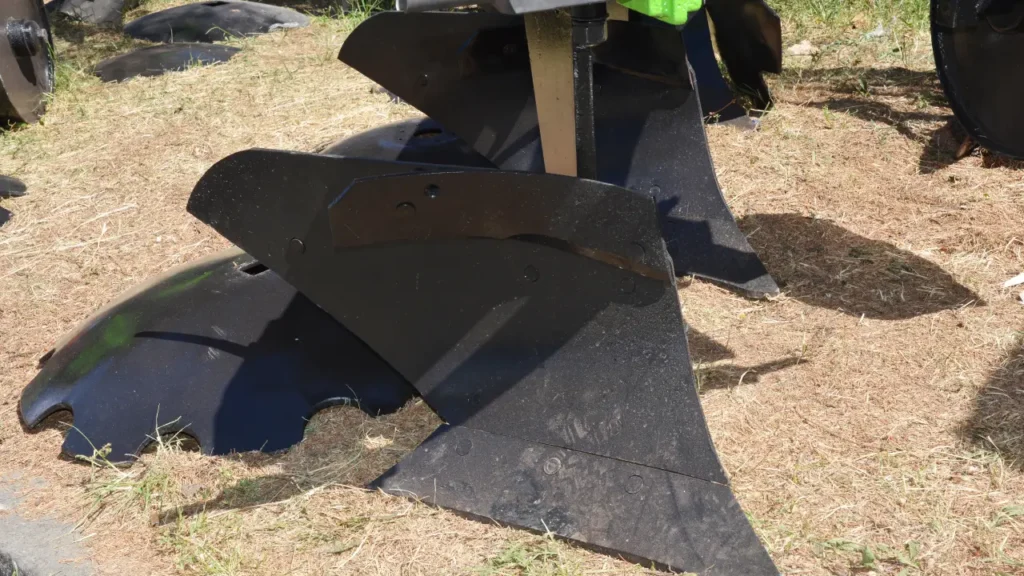
A moldboard plow cuts a slice of soil and turns it over, burying residue and leaving bare ground. It is the most thorough way to break sod or clear heavy trash, and the most intensive: the NRCS rates moldboard plowing 8 in deep at a tillage intensity at 65 on its soil tillage intensity rating (STIR), a score for how much each pass disturbs the soil.
Disc Plow
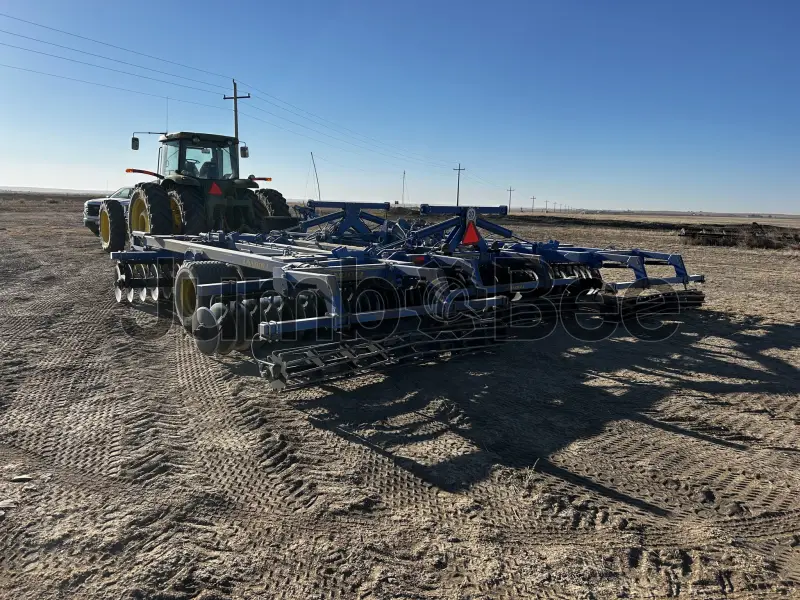
A disc plow uses large concave discs, each on its own arm, to cut and roll soil sideways rather than lifting a continuous slice. It rolls over stones and roots instead of catching on them, which is why it survives in hard, dry, stony ground where a moldboard plow would break.
Chisel Plow
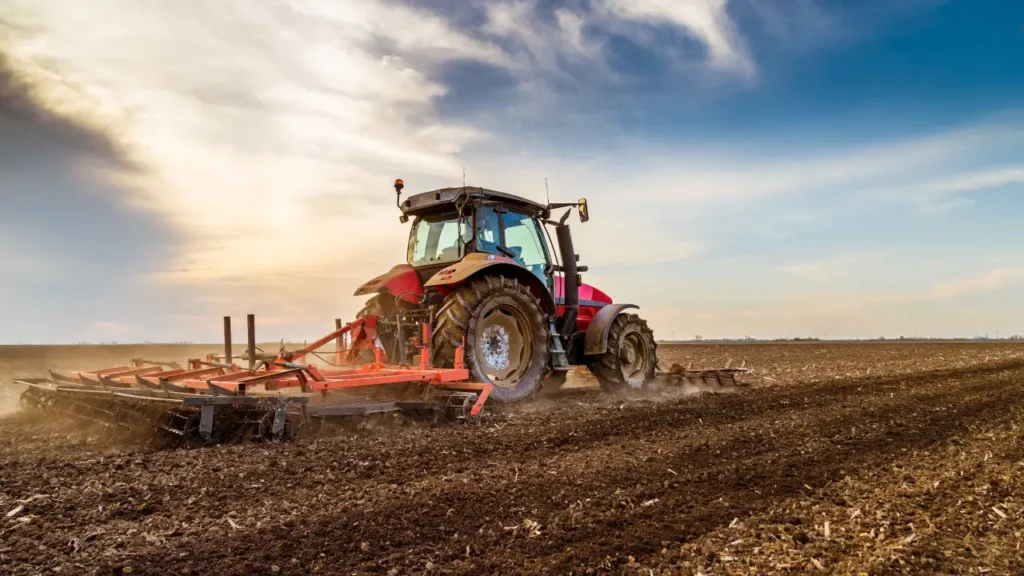
A chisel plow pulls narrow shanks through the soil to loosen it without inverting it, so residue stays on top. That makes it the usual primary tool in reduced-tillage systems. Purdue advises 8 to 10 in (20 to 25 cm) in autumn but only 4 to 6 in (10 to 15 cm) in spring, to stay out of the wetter layers below.
Subsoiler and Ripper
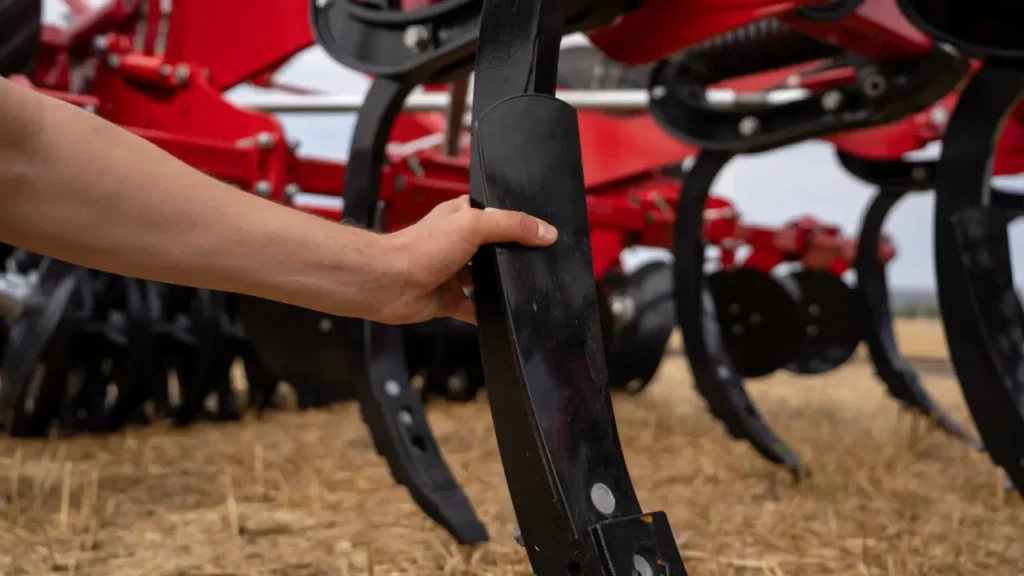
Subsoilers and rippers work deeper than anything else on the farm, breaking a compacted layer without turning the profile over. Because the pull is so heavy, manufacturers rate these by shank rather than width: Great Plains asks 50 engine horsepower per shank for its inline sub-soiler. Deep tillage pays only where compaction is confirmed, because the pull is expensive and the benefit does not last.
Rotary Tiller (Rotavator)
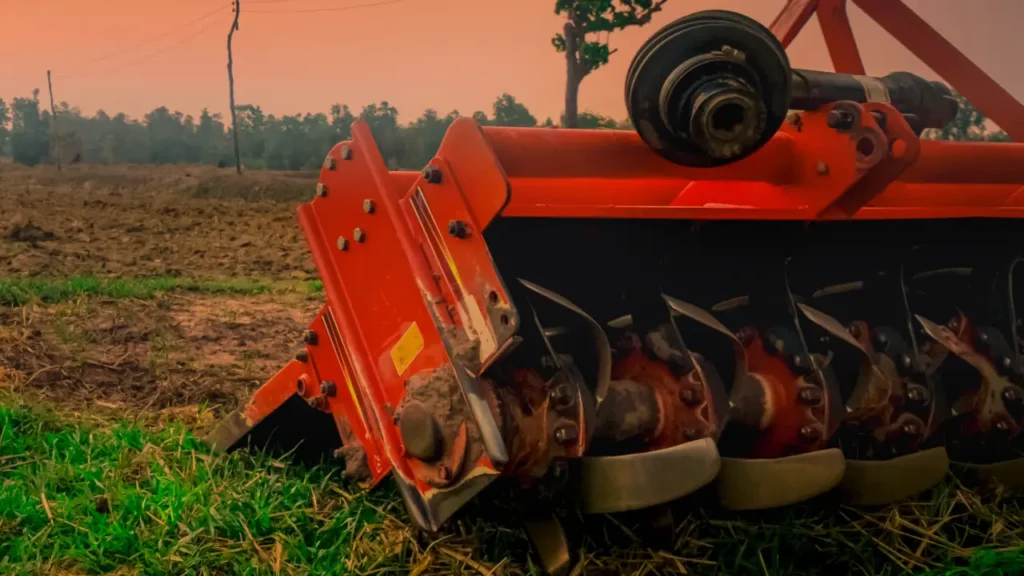
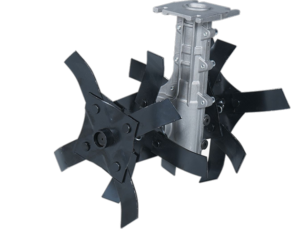
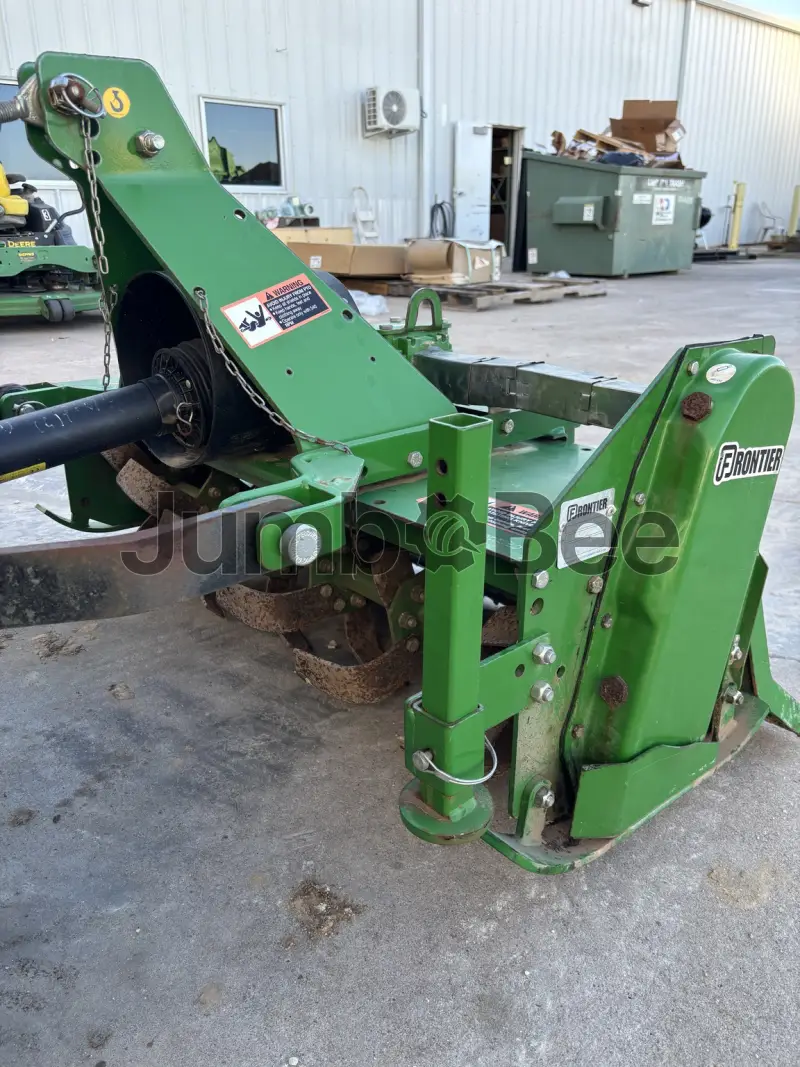
A rotary tiller is the one primary implement driven by the power take-off (PTO) rather than pulled. Blades on a horizontal shaft chop and mix the soil for a fine tilth in a single pass, which suits vegetable ground and small fields. Standard models work about 10 to 20 cm (4 to 8 in) deep; shallow mulching versions such as Kuhn’s EL 162-300 BIOMULCH stay in the top 3 to 6 cm (1.2 to 2.4 in). The NRCS rates a full-field rototiller at 18.2, well below a moldboard plow, but repeated use breaks soil structure down.
Secondary Tillage Equipment
Secondary tillage equipment works the top few inches to break clods, level the surface, kill small weeds and firm the seedbed. It follows primary tillage rather than replacing it, and pulls far less, so these are usually the widest implements on the farm.
| Implement | How it works | Working depth | Power need | Best for |
|---|---|---|---|---|
| Disc harrow | Angled disc gangs cut and mix | Up to 12 cm (4.7 in) on Lemken’s Heliodor 9 | 200 lb per foot tandem, 325 heavy or offset | Residue, clods, after plowing |
| Field cultivator | Spring tines and sweeps loosen topsoil | 3 to 5 in (8 to 13 cm) | 250 lb of draft per foot | Seedbed preparation, weeds |
| Tine and chain harrow | Tines drag and level | Shallow. No published general range | 50 lb per foot spike-tooth, 200 spring-tooth | Leveling, spreading residue |
| Power (rotary) harrow | PTO-driven tines crumble soil | Top 1 to 3 in (2.5 to 8 cm) | Driven by the PTO | Fine seedbed in one pass |
| Roller and cultipacker | Firms and levels soil | Works the surface rather than a depth | 100 lb per foot | Seed-to-soil contact |
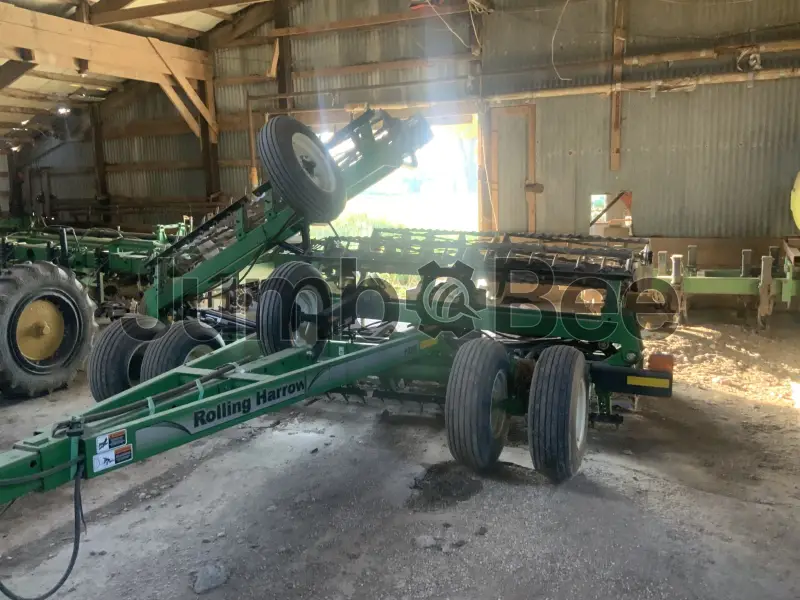
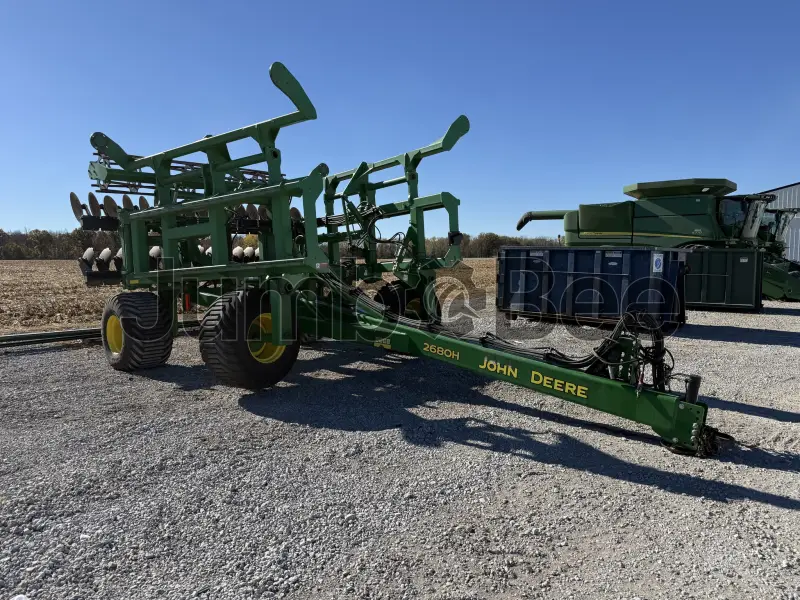
| Vertical tillage tool | Shallow coulters size residue | About 4 in (10 cm) on the John Deere 2660VT | At least 10 hp per foot of width | Residue management, minimal disturbance |
A disc gang is a row of discs on one shaft. A sweep is the wide, flat wearing part that cuts a continuous strip just under the surface.
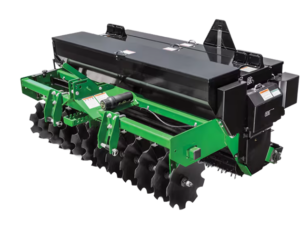
Disc Harrow
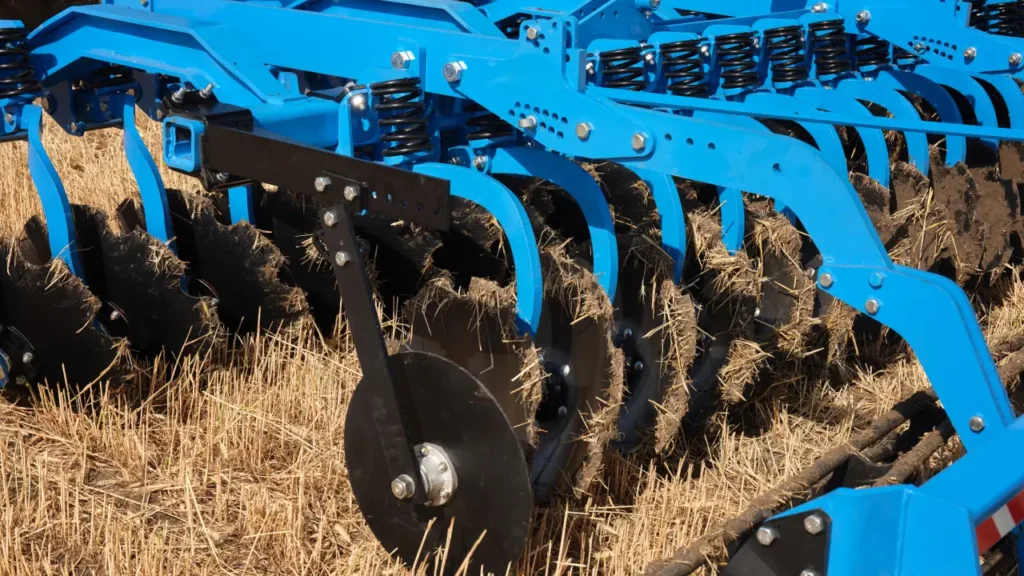
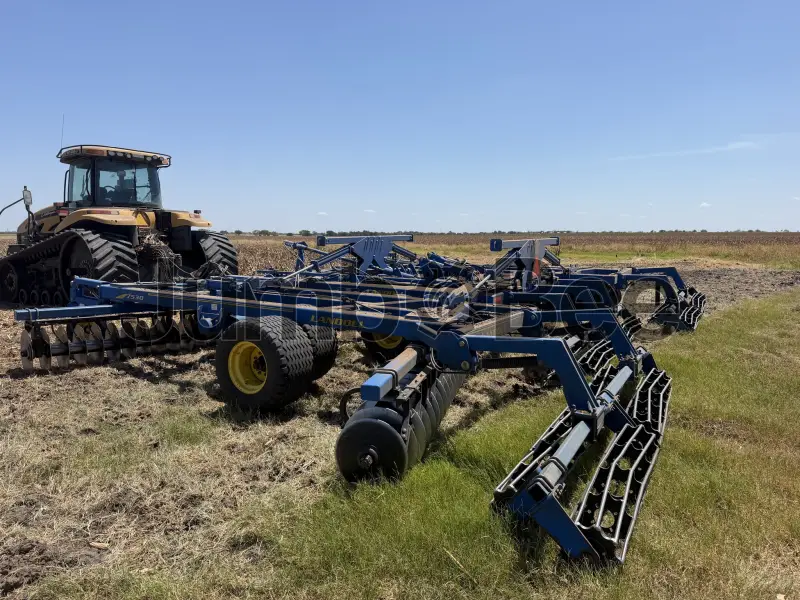
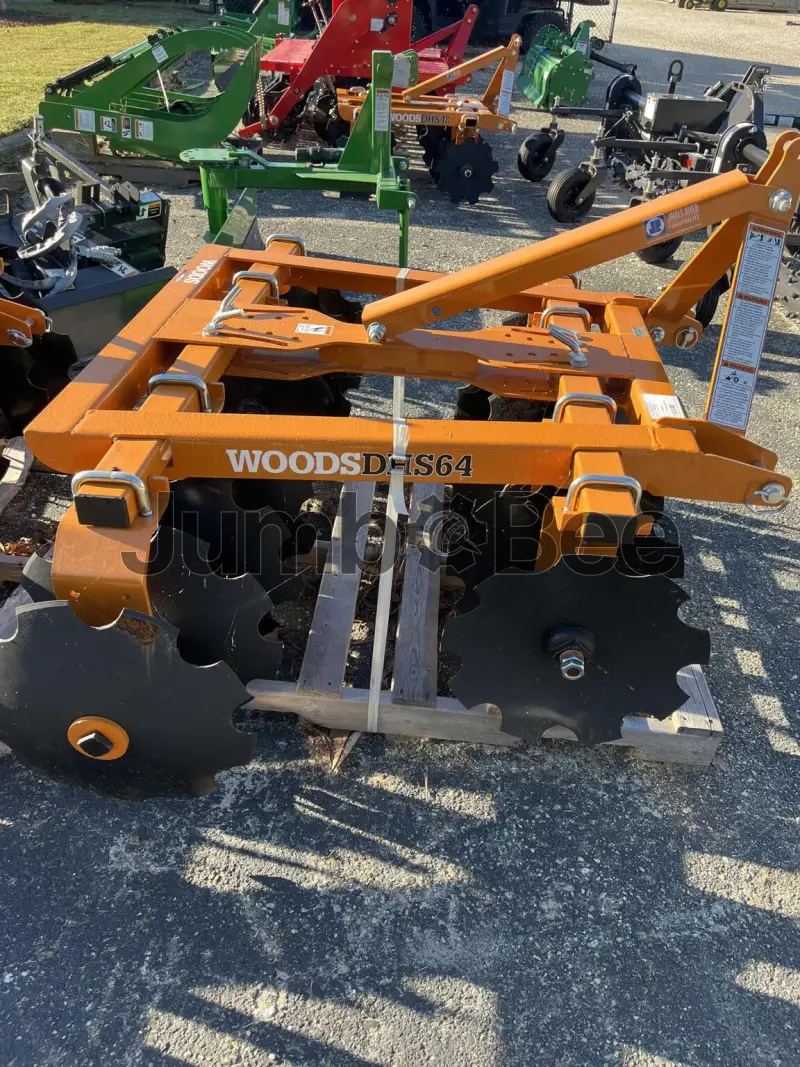
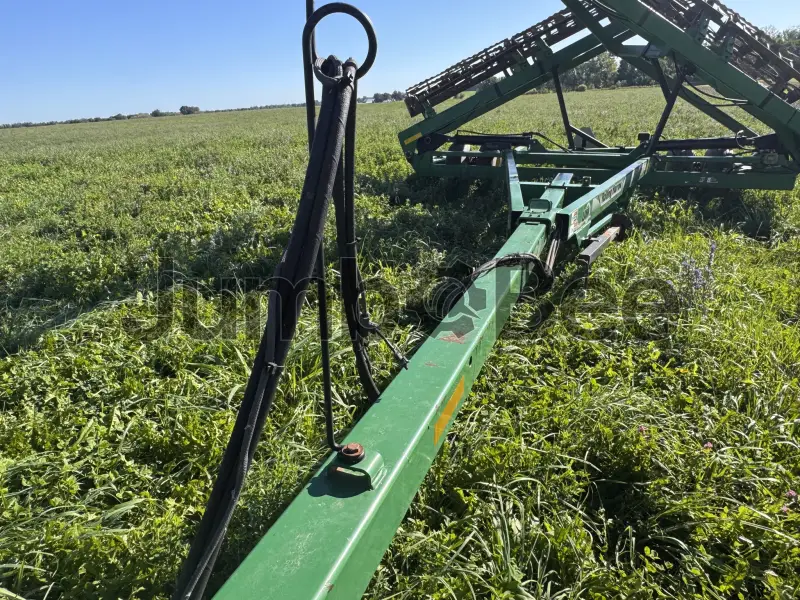
A disc harrow carries gangs of concave discs set at an angle, cutting residue and mixing it into the topsoil. It handles trash better than tines because it cuts through rather than dragging. The depth is shallow, but a tandem disc with a rolling basket still rates 41 on the NRCS intensity scale, above a field cultivator.
Field Cultivator
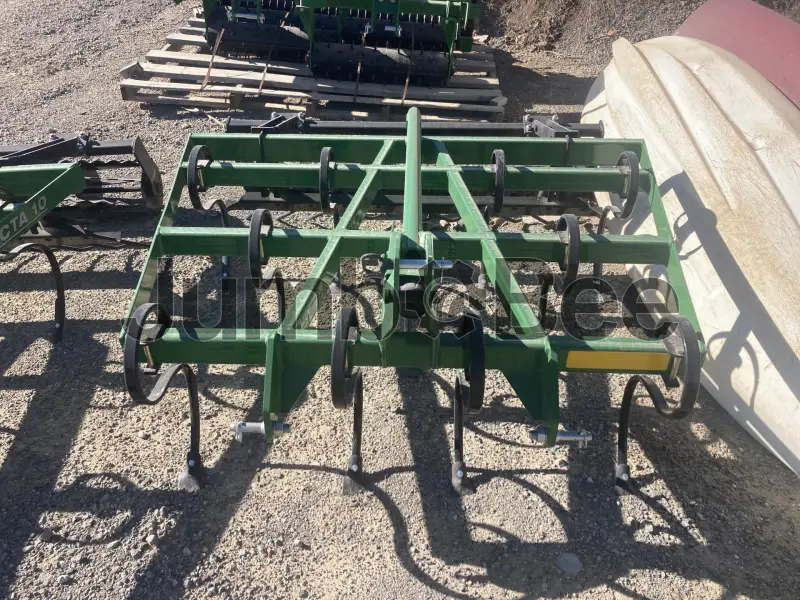
A field cultivator carries rows of spring tines with sweeps and is the standard seedbed-finishing tool. Widths run from a few feet on a compact tractor to over 50 ft (15 m) on a trailed folding frame. Our guide to types of cultivators covers the five types and how to match one to a tractor.
Tine and Chain Harrows
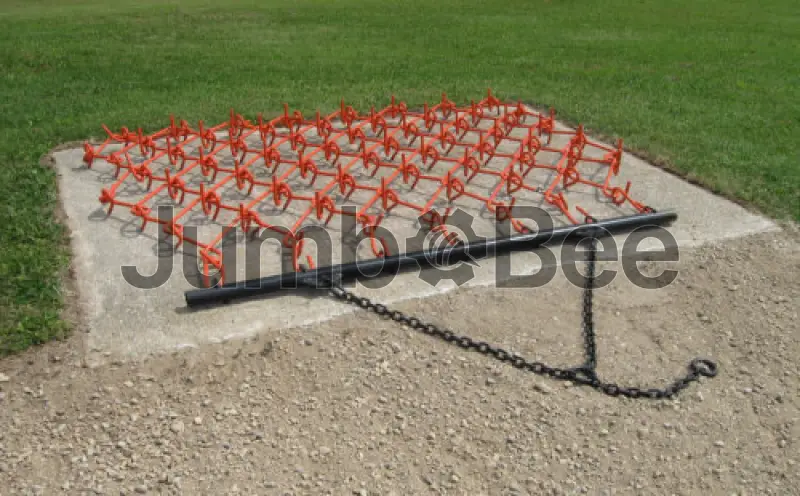
Tine and chain harrows drag tines or linked chain mats across the surface to level it, break small clods and spread residue. They pull very lightly, 50 lb per foot for a spike-tooth harrow in Iowa State’s table, so they are often wide and sometimes towed behind another implement.
Power Harrow
A power harrow drives vertical tines in a horizontal arc from the PTO, crumbling the top layer without the aggressive mixing of a rotary tiller. The NRCS organic tillage guide has a rotary harrow working the top 1 to 3 in to take out small weeds, prepare a seedbed and mix in amendments, with a low intensity rating of 10.24.
Rollers and Cultipackers
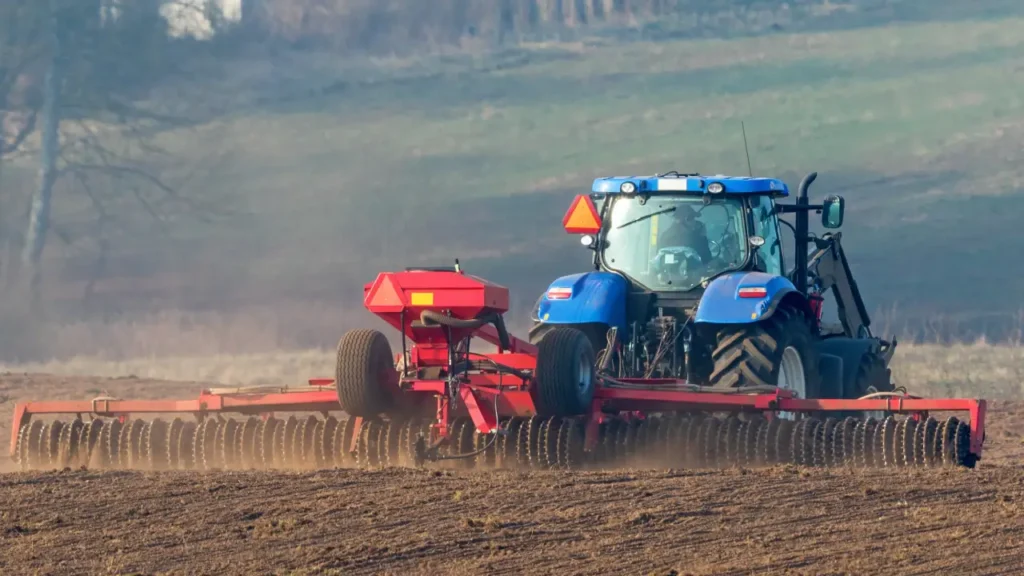
Rollers and cultipackers do not till. They firm loose soil, press down stones and restore the capillary contact between seed and soil that germination depends on, often saving a pass when mounted behind a cultivator.
Vertical Tillage Tools
A vertical tillage tool runs shallow coulters or low-concavity blades almost straight through the soil, sizing residue and opening the surface with little sideways movement, so it avoids the smeared layer a disc can leave. John Deere specifies the 2660VT at 14 ft 4 in (4.37 m) wide and 4 in (10 cm) deep, for a tractor of about 138 hp (103 kW).
Tillage Systems and the Equipment Each Needs
The tillage system decides how many machines you buy and how big the tractor has to be. Conventional tillage needs three or more implements and the most power; no-till needs none, but asks a great deal more of the planter.
| System | Typical passes | Equipment lineup | Residue left | Fits |
|---|---|---|---|---|
| Conventional | 3 or more | Moldboard plow, tandem disc harrow, field cultivator | Under 15 percent | Sod breaking, heavy trash, poorly drained ground |
| Reduced tillage | 2 | Chisel plow or disc, then field cultivator | 15 to 30 percent and up | Most arable farms wanting cover without going no-till |
| Vertical tillage | 1 to 2 | Vertical tillage tool, sometimes a light cultivator | Above 30 percent | Sizing heavy residue, leveling ruts, spring warm-up |
| Strip-till | 1, in fall or spring before planting (sometimes combined with the planter) | Strip-till bar and planter | Most residue stays between the rows; 70 to 80 percent of the surface is left undisturbed | Row crops where fertilizer goes in the band |
| No-till | None | No tillage equipment. A heavier planter or drill instead | Typically 70 percent or more | Erodible or dry ground, where weeds can be managed |
Residue bands follow USDA ERS: conventional below 15 percent cover, reduced 15 to 30, conservation above 30.
Which System Fits Is a Question of Soil, Climate and Crop
Reduced tillage keeps cover on the surface while still giving a worked seedbed, and is where most arable farms sit. Keeping residue on the surface is what cuts erosion and evaporation. Strip-till and no-till cut passes and fuel hardest but shift the burden onto the planter and onto weed control. Switching changes every tillage machine you buy and sell: a chisel plow replaces a moldboard plow going to reduced tillage, while going no-till puts a plow, a disc and a cultivator on the market at once. The tillage equipment catalog shows how those machines are specified before you commit either way.
How to Choose Tillage Equipment for Your Farm
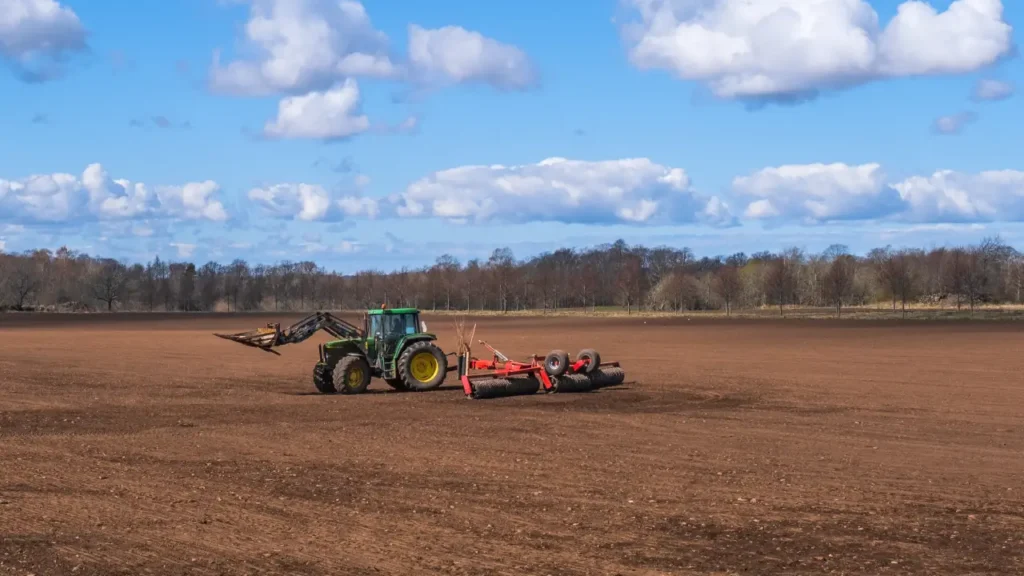
Choose by tillage system, soil and the time window you have, then match working width to the power you can put in front of it. The field window is usually what sets the size: acres to cover, divided by the days you can realistically work, gives the rate per day, and the rate gives the width.
| Implement | Power needed per foot (per metre) of width | Notes |
|---|---|---|
| Moldboard plow | 7 hp/ft (23 hp/m) in light soil, 10 (33) in medium, 25 (82) in clay | At 5 mph (8 km/h); rated per foot of cut |
| Chisel plow | About 12 hp per shank | Shank count, not width, sets the total |
| Subsoiler | 31 hp per tooth in light soil, 53 in heavy | The heaviest draw on the farm |
| Disc harrow | 5 hp/ft (16 hp/m) tandem, 7 (23) heavy or offset | Heavy and offset discs work deeper and pull harder |
| Field cultivator | About 7 hp/ft (23 hp/m) | Iowa State’s default of 7 mph (11 km/h) |
| Vertical tillage tool | 10 hp/ft (33 hp/m) minimum, 15 to 20 (49 to 66) in rough terrain | Iowa State guidance, not a draft figure |
Those come from Iowa State’s draft table, converted with its own formula: PTO horsepower = width (ft) x speed (mph) x draft (lb per ft) x soil factor / 375, taking the firm-soil factor of 1.54 for a tractor with front-wheel assist. On looser ground the factor climbs to 2.13.
A worked example. Take 1,000 acres (405 ha) needing one field cultivator pass, with ten suitable field days of ten hours. That is 100 acres (40 ha) a day, or 10 acres (4 ha) an hour. Iowa State multiplies width in feet by speed in miles per hour, divides by 8.25 and multiplies by field efficiency, which it puts at 78 to 88 percent for field cultivators. At 7 mph (11 km/h) and 85 percent, 10 acres an hour needs about 14 ft (4.3 m) of width, and at 7 hp per foot that is roughly 100 PTO horsepower.
Four more things decide the purchase:
- Mounted or trailed. Mounted implements are lighter and simpler but need lift capacity at the back of the tractor. Trailed machines carry their own weight and go much wider.
- Folding and transport width. Anything over about 3 m (10 ft) folds for the road, and folding wings mean hydraulics, pins and hinges to maintain.
- Soil type and stones. Stony ground needs auto-reset or spring-trip shanks that lift over an obstruction and return to depth instead of shearing a bolt.
- Wear parts and service. Points, sweeps, discs and bearings are consumables, so check they are stocked for that brand in your country. Our tractor buying guide covers the power side of the same decision.
Modern Tillage Equipment Features Worth Paying For
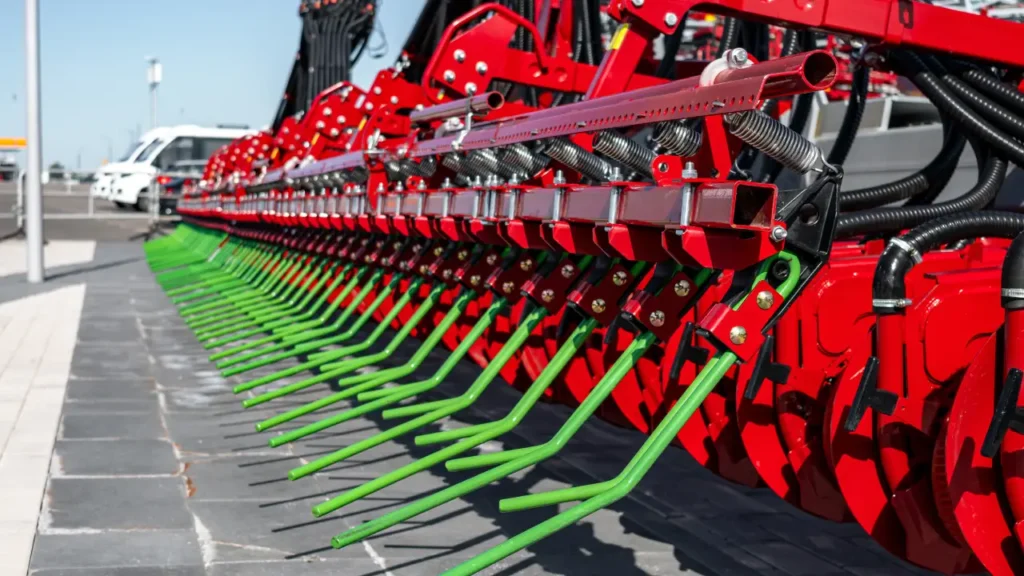
The features that pay back fastest remove a pass, cut downtime or slow down wear, because those are the three places tillage costs money. The rest is comfort.
Hydraulic depth and gang angle adjustment from the cab. Changing depth or disc angle used to mean stopping and moving pins on every gang. In-cab control matches depth to a wet headland or a hard knoll without losing time. In a listing, check whether depth control is single-point mechanical or hydraulic from the cab, and whether the monitor comes with the machine.
Auto-reset or spring-trip shanks. On stony ground a rigid shank shears its bolt or bends the frame, while an auto-reset shank lifts over the stone and springs back to depth without stopping. It costs more up front and pays for itself in one stony field. Check the trip moves freely on every shank, not just the ones at the end.
Folding wings. Folding lets a 12 m (40 ft) implement travel within a 2.5 m (8 ft 2 in) road width, which is the difference between one machine for the farm and one per block. The cost is hoses, cylinders, pins and transport locks, all of which wear.
Rolling baskets and finishing attachments. A rear basket, crumbler or levelling harrow does the clod-breaking and firming that would otherwise be a separate trip. One pass saved across a farm is the largest fuel saving on this list.
Carbide and hardened wear parts. Points, sweeps and discs wear out on a schedule, and harder metal stretches it. The gain is fewer stops in season, not a cheaper part. Buying used, measure disc diameter against a new one: a worn disc is a smaller disc and no longer holds depth.
Depth monitoring and ISOBUS control. ISOBUS is the standard that lets any compliant tillage machine talk to any compliant tractor terminal instead of needing its own box in the cab. Systems such as Lemken’s iQblue let depth and gang-angle settings to be saved and recalled by field. Confirm on the maker’s own page that a system is ISOBUS compliant, because the badge is used loosely.
Leading Tillage Equipment Brands
Not a ranking. These are the ranges you meet most often in international listings, under the names each maker uses on its own site.
| Brand | Main tillage lines | Known for |
|---|---|---|
| John Deere | Chisel plows and coulter chisels, field cultivators, rippers, disks, mulch finishers | TruSet in-cab depth control across the range |
| Case IH | Speed-Tiller, True-Tandem disc harrows, Tiger-Mate field cultivators, Ecolo-Tiger disc rippers, Nutri-Tiller | High-speed discs and strip-till with nutrient placement |
| Great Plains | Turbo-Max and VT1100 Turbo-Max, Turbo-Chisel, Max-Chisel, Inline Sub-Soiler | Vertical tillage, with gangs adjustable from 0 to 6 degrees |
| Kuhn Krause | Excelerator vertical tillage, Landsman and Landstar finishers, Dominator disc rippers, Gladiator strip-till | One-pass finishers and strip-till |
| Horsch | Joker disc harrows, Terrano cultivators, Tiger deep cultivators | Deep mixing, with the Tiger MT rated to 35 cm |
| Lemken | Juwel and Diamant ploughs, Rubin and Heliodor disc harrows, Karat and Kristall cultivators, Onyx subsoiler | A full range from plough to seedbed, plus iQblue electronics |
| Väderstad | Carrier disc cultivators, TopDown combination cultivators, Cultus and Opus tine cultivators, NZ tine harrows, Rexius rollers | Disc cultivators and rollers at large working widths |
| Amazone | Catros and Certos compact disc harrows, Cenio and Cenius cultivators | Shallow to medium-depth stubble work, with the Cenio cultivator reaching 30 cm |
| Salford | Independent Series I-1100 to I-4200, HALO VRT and HALO HSD | High-speed vertical tillage and variable rate |
| Sunflower | Disc harrows and fallow tillage, now sold under Massey Ferguson | Wide disc harrows for large acreages |
Specifications and power requirements for individual models sit on the tillage equipment models hub, which lists width, weight and power side by side.
Buying Used Tillage Equipment: What to Check
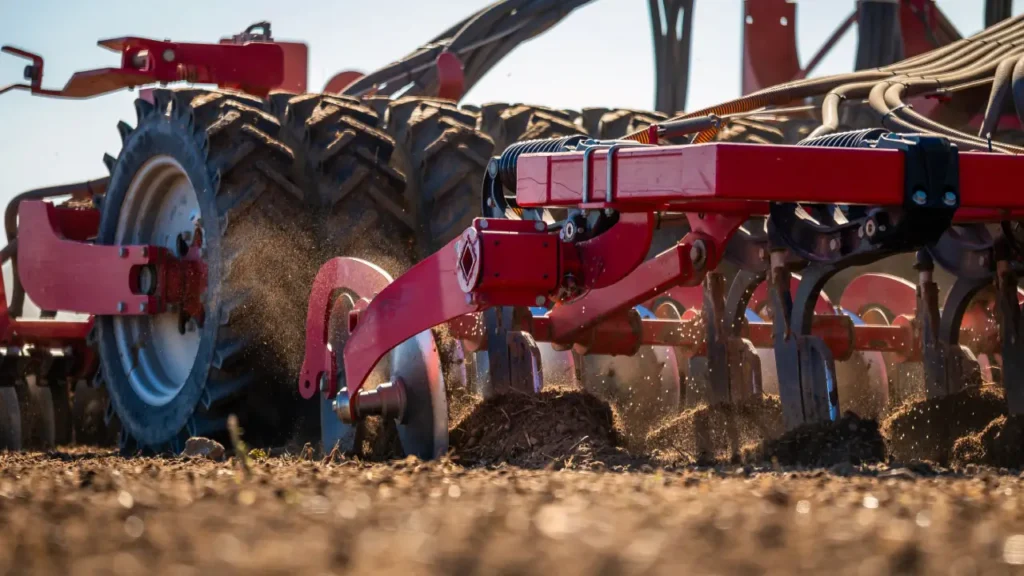
Tillage equipment is simple and long-lived, with no engine and most of its wear in parts built to be replaced, so a used machine with a sound frame and good bearings is often better value than a new one. Price follows type, width, folding system, wear part condition, brand and region. Check the frame first, because that is the one thing you cannot replace.
| Area | What to check | Warning sign |
|---|---|---|
| Frame and welds | Straightness along the length, welds at every joint, signs of past repair | Fresh paint over a weld, a frame that sits twisted on level ground |
| Shanks, points and sweeps | Metal left on points and sweeps, bent or missing shanks | Points worn to stubs, shanks replaced in only one section |
| Discs, blades and bearings | Disc diameter against a new one, play in every bearing hub | Side-to-side rock in a hub, a gang that will not spin freely |
| Springs, trips and auto-reset | Even tension across the machine, each trip moving freely | Seized or broken springs, shanks sitting at different heights |
| Hydraulics and folding wings | Cylinder and hose condition, pin and bush wear, how the wings sit folded | Weeping cylinders, elongated pin holes, wings that will not lock |
| Gearbox and PTO | Oil level and leaks, shaft guards, noise through the range | Oil on the casing, a noisy gearbox, missing guards |
| Wheels, tires and rollers | Tire condition, bearing play, roller bars straight and turning | Flat spots, seized rollers, bent bars |
| Wear part availability | Whether points, discs and bearings are stocked for that brand near you | No local dealer and no published parts list |
Our remote inspection checklist sets out what to ask a seller to photograph and measure when you cannot walk around the machine yourself.
Buying Tillage Equipment from Another Country
Before paying for a tillage machine abroad, confirm its folded dimensions, that it will arrive clean, that wear parts are available locally and the correct HS code. Buying abroad widens the choice considerably, and these four things decide whether it goes smoothly.
- Folded transport dimensions. Folded width, height and weight set the trailer, the container choice and the cost, so get all three before agreeing a price.
- Cleaning before shipping. Soil and plant material caught in shanks, discs, frames and wheels is what import inspections look for, and many countries require machinery to arrive free of both. Wash the parts you cannot see from standing height.
- Wear parts in the destination country. Confirm dealers there carry points, sweeps, discs and bearings for the brand, or that the seller can send a set with the machine.
- Documents and classification. Agricultural implements have their own customs codes, and the right one changes the duty. Our guide to HS codes for heavy equipment explains how the classification works.
Once the code is settled, the rest is border paperwork, and our customs clearance guide walks through the documents an importer has to produce.
Find Tillage Equipment from Trusted Sellers on JumboBee
JumboBee is a marketplace for heavy equipment, and its tillage equipment catalog lists farm tillage equipment from sellers in many countries: plows, disc harrows, field cultivators and vertical tillage tools.
Every listing comes from a verified seller with specifications and photos, so you can compare working width, weight and power requirements across brands before contacting anyone. Buyers deal with sellers directly, and JumboBee supports international shipping for machines crossing a border. The models hub sets out widths, weights and power needs model by model, and our overview of types of farm equipment puts tillage in the context of the rest of the fleet.
Frequently Asked Questions
Tillage is the mechanical working of soil to prepare it for a crop: breaking and loosening the ground, mixing in residue, killing weeds, and leveling a seedbed. It happens in two stages: a deep primary pass and shallower secondary passes before planting.
Primary tillage is the first deep pass, usually 7 to 16 in (18 to 41 cm), less for a rotary tiller, breaking unworked ground and burying or loosening residue. Secondary tillage follows at 1 to 5 in (2.5 to 13 cm) to crumble clods, level the surface and finish the seedbed. Primary tillage pulls far harder.
Primary and secondary tillage implements differ mainly in depth. The main primary implements are the moldboard plow, disc plow, chisel plow, subsoiler or ripper, and rotary tiller. The first three break and loosen the plow layer, the subsoiler goes deeper to break a hardpan, and the rotary tiller mixes soil into a fine tilth.
The main secondary tillage implements are disc harrows, field cultivators, tine and chain harrows, power harrows, rollers and cultipackers, and vertical tillage tools. They work the top few inches to break clods, level the ground, cut weeds, and firm the seedbed.
That depends on soil, slope, climate, and crop. Conventional tillage suits sod breaking and cold, wet ground. Reduced tillage keeps cover while still giving a worked seedbed. Strip-till and no-till cut passes most but ask more of the planter and of weed control.
Multiply width in feet by speed in miles per hour, by draft in pounds per foot, by a soil factor, then divide by 375. A field cultivator needs roughly 7 hp per foot of width, a tandem disc harrow 5, and a moldboard plow 7 in light soil but about 25 in clay.
Check the frame and welds for twisting and past repair, the shanks, points and sweeps for remaining metal, every disc bearing for play, the auto-reset trips for free movement, and the folding hydraulics for leaks. Confirm wear parts are stocked for that brand where you farm.





Be the first to leave a comment
There are no replies to this post yet. Share your thoughts and help start the conversation.