 Trends
Focusing solely on the sticker price of heavy machinery is a massive financial trap. A low upfront number creates a false sense of savings, hiding the long-term realities that will inevitably eat into your profit margins.
To bid accurately and stay profitable, you must calculate the Lifecycle Ownership Cost. Fuel consumption, unexpected downtime, rigorous maintenance, and final resale value impact your bottom line far more than the initial purchase price. For international buyers, the stakes are even higher — hidden import duties, port fees, and local parts availability can quickly turn a “bargain” into a financial nightmare.
Ultimately, the cheapest machine upfront is often the most expensive machine to own. Let’s break down how to calculate the true lifecycle cost of your equipment so you can make strategic, data-driven purchasing decisions.
What Is Total Cost of Ownership (TCO) in Heavy Equipment?
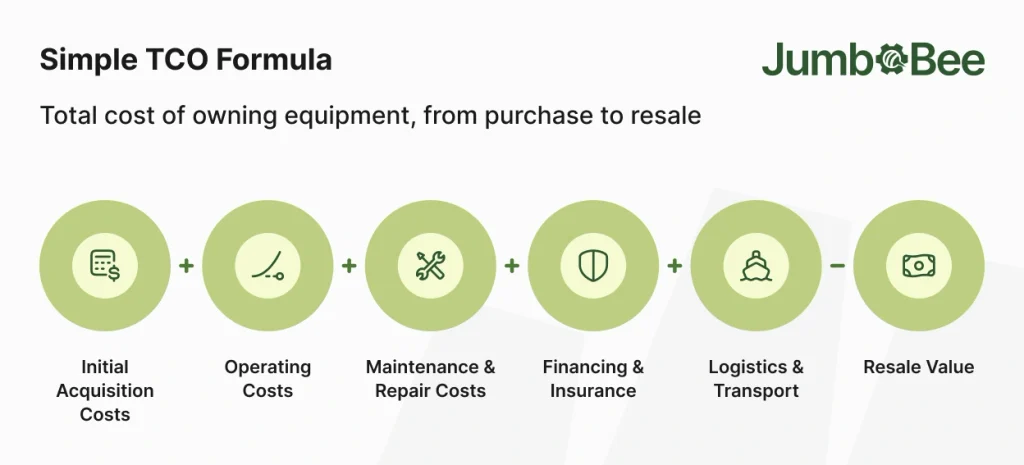
Total Cost of Ownership, or TCO, is a comprehensive financial metric that calculates the total expense of buying, operating, maintaining, and eventually disposing of an asset. Rather than looking only at the acquisition phase, TCO requires a strict lifecycle ownership perspective.
Contractors, fleet managers, rental companies, and international buyers rely on these calculations to evaluate profitability. Without a clear TCO model, fleet managers cannot accurately determine hourly billing rates for their services. Rental companies use these metrics to set daily rental prices that guarantee a profit. International buyers use TCO to decide whether importing a used excavator from the United States makes financial sense compared to buying locally.
Understanding TCO in construction terms means recognizing the vast difference between purchase price and actual ownership cost. Purchase price is a one-time capital expense. Actual ownership cost is an ongoing operational reality. By evaluating both, TCO improves purchasing decisions, steering buyers away from poorly maintained machines that will bleed money through repairs.
Why Purchase Price Alone Does Not Reflect Real Equipment Cost
Cheap equipment frequently creates higher long-term costs. When buyers prioritize the lowest possible listing price, they often inherit someone else’s deferred maintenance. This leads to immediate operational friction.
Downtime impact is the most severe consequence of buying based solely on price. When a cheap machine breaks down on a job site, you are not just paying for parts and labor. You are paying for idle operators, missed project deadlines, and potential contractual penalties.
Fuel inefficiency also plagues older, cheaper machines. A loader that burns three extra gallons of diesel per hour will cost tens of thousands of dollars more over a five-year period than a modern, fuel-efficient equivalent.
Frequent repairs, weak dealer support in your specific region, and delayed parts availability compound these financial losses. Furthermore, off-brand or heavily worn machines suffer from poor resale value, meaning you recover almost nothing at the end of the lifecycle.
Consider a standard Machine A versus Machine B comparison scenario.
- Machine A costs $100,000 upfront but requires $20,000 in annual repairs, burns $30,000 in fuel annually, and has a resale value of $20,000 after five years.
- Machine B costs $140,000 upfront, requires only $5,000 in annual repairs, burns $22,000 in fuel annually, and retains a resale value of $60,000.
Over five years, Machine A costs $330,000 to own. Machine B, despite being $40,000 more expensive upfront, costs only $215,000 to own. The overall cost of construction equipment is heavily dictated by operational efficiency, not just the initial invoice.
Three Lifecycle Stages of Equipment Ownership
Ownership costs evolve significantly throughout the machine lifecycle. Authoritative frameworks, such as those developed by the European Rental Association (ERA), divide equipment ownership into three distinct phases.
Acquisition Phase
Initial procurement sets the financial baseline. This phase extends far beyond the price tag on the machine.
Key expenses include:
- Purchase price
- Taxes
- Inspections
- Financing fees
- Dealer fees
- Import duties
- Inland transport
- Shipping costs
- Setup and onboarding costs
International buyers must calculate landed cost, which is the total price of a machine once it arrives at their door, including all cross-border logistics. Hidden acquisition expenses, such as currency conversion fees or mandatory safety modifications, often surprise unprepared buyers.
Operations & Maintenance Phase
Spanning the vast majority of the machine’s life, this is usually the largest and longest ownership phase.
Key expenses include:
- Fuel consumption
- Preventive maintenance
- Wear parts
- Operator costs
- Repairs
- Service intervals
- Downtime
- Telematics
- Inspections
- Fleet utilization
Managing this phase effectively requires strict adherence to maintenance schedules. Skipping a minor hydraulic fluid change can lead to catastrophic pump failure later, drastically spiking your total costs.
Divestment Phase
Selling or disposing of the machine concludes the ownership cycle.
Key factors include:
- Depreciation
- Resale value
- Trade-in value
- Auction liquidity
- Export resale opportunities
- Disposal costs
- Recycling
- Storage before resale
Strong brands and well-maintained machines typically retain significantly more value. A machine with complete service records will always command a premium on the secondary market compared to a machine with unknown history.
Main Components of Heavy Equipment TCO
Multiple cost categories combine to determine the real ownership cost of equipment. To calculate TCO accurately, you must break down each component.
Acquisition Costs
These are the foundational expenses required to put the machine on your job site.
- Purchase price
- Taxes
- Inspection costs
- Shipping
- Inland delivery
- Dealer prep
- Customs and duties
- Registration costs
Fuel Consumption Costs
Fuel is often the single largest operating expense. You must analyze hourly fuel burn rates and average idle time. Fuel efficiency differences between a Tier 4 Final engine and an older Tier 3 engine can be staggering.
Simple fuel cost calculation example:
If an excavator runs 1,200 hours annually, spends 20% of that time idling, and burns an average of 4 gallons per hour at $3.50 per gallon, your annual fuel usage costs $16,800. Over a five-year lifespan, fuel alone adds $84,000 to your TCO. Fuel impact across equipment lifetime cannot be ignored during the purchasing phase.
Maintenance and Repair Costs
Keeping machinery functional requires constant capital injection.
- Scheduled maintenance
- Hydraulic systems
- Tires and tracks
- Undercarriage wear
- Engine rebuilds
- Labor rates
- OEM vs aftermarket parts
- Emergency repairs
Maintenance history directly impacts future ownership cost. A bulldozer that received regular greasing and oil changes will cost far less to maintain in its next 5,000 hours than a machine that was neglected.
How Operating Hours Affect Equipment Ownership Cost
Operating hours often matter much more than machine age. A five-year-old loader with 8,000 hours is generally closer to the end of its lifecycle than a ten-year-old loader with 3,000 hours.
Evaluating low-hour versus high-hour machines requires understanding wear acceleration. As components cross specific hour thresholds, they require major overhauls. Engine rebuild intervals typically occur between 8,000 and 12,000 hours depending on the machine type and brand. If you buy a machine at 7,500 hours, you must factor an expensive engine rebuild into your immediate TCO.
You must also distinguish between idle hours versus productive hours. Advanced telematics can reveal if a machine idled for 40% of its life. High idle time means the engine was running, but the undercarriage and hydraulics were not experiencing heavy wear. This impacts maintenance schedules and directly influences resale value. Hidden wear risks, such as internal hydraulic pump degradation, accelerate rapidly after 5,000 hours of heavy productive use.
Downtime Costs
Downtime may cost substantially more than the repair itself. When a critical path machine fails, the entire job site suffers.
Key downtime expenses include:
- Project delays
- Idle operators
- Missed deadlines
- Rental replacement costs
- Subcontractor delays
- Lost revenue
- Emergency service calls
If a specialized pipelayer breaks down, you still have to pay the crew standing around waiting for it. You might have to pay a premium for emergency overnight parts shipping. If the delay pushes the project past its deadline, you could face liquidated damages from the client. These operational realities make reliable equipment far cheaper to own.
Financing and Insurance Costs
Capital is never free. Evaluating financial structures is mandatory.
- Loans
- Leasing
- Interest rates
- Insurance
- Inflation
- Opportunity cost of capital
A 7% interest rate on a five-year loan for a $200,000 machine adds roughly $37,000 to your total cost. Insurance premiums also scale with the value of the machinery and the specific risks of your job sites.
Transportation and Logistics Costs
Moving heavy machinery is incredibly expensive due to sheer weight and dimensions.
- Inland trucking
- Ocean freight
- RoRo
- Breakbulk
- Oversized shipping
- Port fees
- Customs clearance
- Export paperwork
- Delivery delays
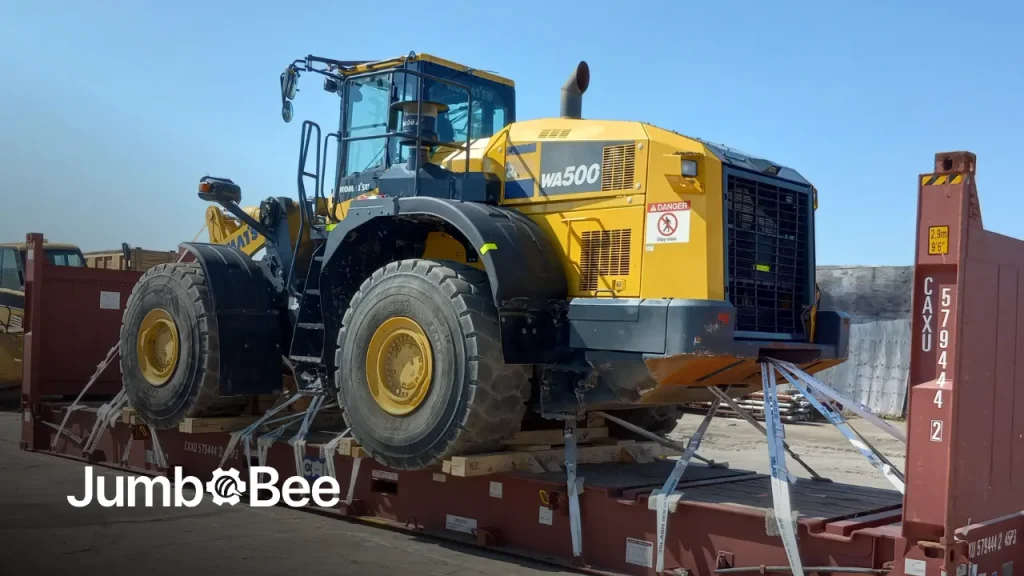
International logistics can dramatically change real ownership cost. Shipping a 30-ton excavator via RoRo (Roll-on/Roll-off) from the United States to Egypt requires inland transport to the port, ocean freight, marine insurance, and destination port handling fees. If customs clearance is delayed due to improper export paperwork, storage fees at the port will accumulate daily.
Resale Value and Depreciation
Recouping capital at the end of the lifecycle lowers your ultimate TCO.
- Depreciation curves
- Brand reputation
- Dealer network strength
- Maintenance records
- Market demand
- Auction value
- Export demand
Depreciation curves are steepest in the first two years of a new machine’s life. Brand reputation plays a massive role here. Manufacturers like Caterpillar, Komatsu, Volvo Construction Equipment, and John Deere enjoy strong global dealer networks. Because buyers know they can easily source parts for a Caterpillar dozer anywhere in the world, that machine retains high export demand and excellent auction value.
Lesser-known brands without global support networks depreciate rapidly.
Hidden Equipment Costs Buyers Often Ignore
Beyond the obvious expenses, several hidden factors quietly inflate overall costs.
- Operator training
- Telematics subscriptions
- Emissions compliance
- Idle equipment
- Theft risk
- Storage
- Attachment compatibility
- Inspection failures
- Import restrictions
- Software updates
- Diagnostic tools
Emissions compliance is a major hidden cost. Meeting 2026 EPA standards requires Diesel Exhaust Fluid (DEF) and complex Diesel Particulate Filters (DPF). These systems require specialized software updates, diagnostic tools, and specific maintenance routines. Additionally, attachment compatibility issues can force you to buy entirely new buckets or hydraulic breakers if your existing tools do not fit a newly acquired machine.
How Contractors Use TCO to Compare Equipment Before Buying
Smart buyers never look at two machines and simply pick the cheaper one. They analyze data to project future expenses.
Comparing Two Similar Machines
When contractors evaluate two used excavators of the same size class, they compare specific historical and operational data.
How buyers compare:
- Fuel usage
- Hours
- Maintenance history
- Resale value
- Logistics costs
- Uptime history
If Machine A is located 500 miles away and Machine B is located 3,000 miles away, inland trucking costs might make the local machine cheaper overall, even if its listing price is slightly higher.
Comparing New vs Used Equipment
Deciding between factory-fresh and pre-owned machinery requires balancing upfront capital against long-term reliability.
| Feature | New Equipment | Used Equipment |
|---|---|---|
| Depreciation Differences | High initial drop in first 24 months | Slower, more stable depreciation curve |
| Warranty Differences | Comprehensive factory coverage | Limited or no warranty available |
| Financing Availability | Lower interest rates, promotional offers | Higher interest rates, shorter loan terms |
| Repair Risk | Minimal risk in early lifecycle | Higher risk of component failure |
| Expected Lifecycle | Full lifespan available | Reduced remaining lifespan |
| Ideal Use Cases | High-hour primary production tasks | Support tasks, low-hour seasonal work |
Comparing Domestic vs Imported Equipment
Global marketplaces give buyers access to better inventory, but cross-border buying requires careful calculation.
- Purchase price differences
- Shipping costs
- Import taxes
- Parts availability
- Resale market
- Delivery time
A buyer in South America might find that the cost of construction equipment is 30% lower in the United States. However, they must calculate ocean freight, import taxes, and delivery time to ensure those savings are not wiped out by logistics.
Sample Heavy Equipment TCO Calculation
To illustrate how TCO works in practice, let us examine a realistic five-year ownership example for a used 20-ton excavator. We will assume the machine is operated for 1,000 hours per year.
| Cost Category | 5-Year Expense Breakdown |
|---|---|
| Purchase price | $120,000 |
| Financing | $22,000 |
| Transport | $4,500 |
| Insurance | $7,500 |
| Fuel | $85,000 |
| Maintenance | $15,000 |
| Repairs | $25,000 |
| Downtime | $10,000 |
| Resale value | -$55,000 |
Total lifecycle ownership cost is calculated by adding all expenses and subtracting the resale value.
- Total Expenses: $289,000
- Minus Resale Value: -$55,000
- Total 5-Year TCO: $234,000
- Annual ownership cost equals $46,800.
- Divided by 1,000 hours per year, the true operating cost is $46.80 per hour.
Short analysis of results:
While the purchase price was $120,000, the actual heavy equipment cost over five years was nearly double that amount before factoring in the resale recovery. Fuel, maintenance, and repairs accounted for $125,000, proving that operational efficiency dictates overall financial success. If this buyer had chosen a machine that burned just one extra gallon of fuel per hour, their TCO would have increased by over $17,000.
How to Reduce Heavy Equipment Ownership Costs
Lowering your TCO requires proactive management and strict operational discipline.
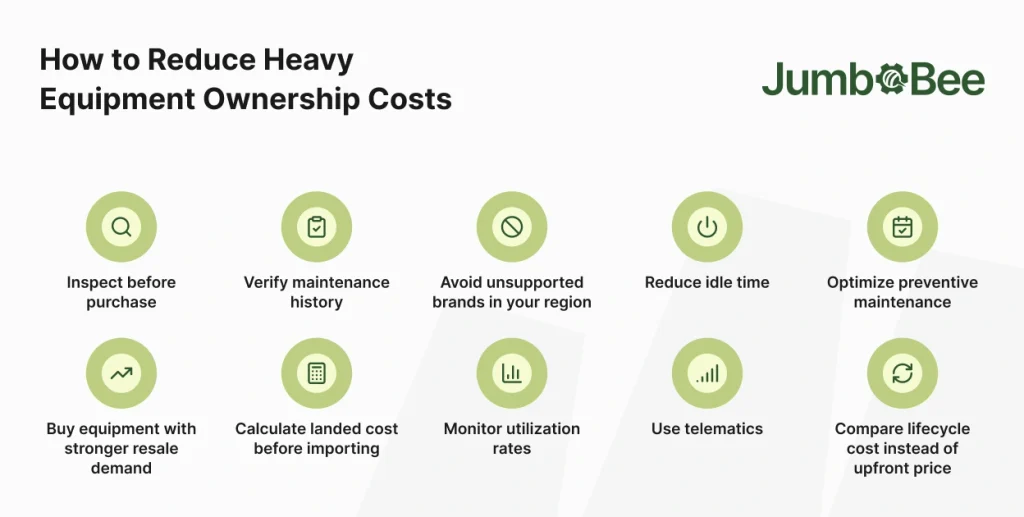
Actionable recommendations:
- Inspect before purchase
- Verify maintenance history
- Avoid unsupported brands in your region
- Reduce idle time
- Optimize preventive maintenance
- Buy equipment with stronger resale demand
- Calculate landed cost before importing
- Monitor utilization rates
- Use telematics
- Compare lifecycle cost instead of upfront price
Reducing idle time is one of the easiest ways to save money. Telematics data often reveals that machines idle for 30% of the workday. By training operators to shut down engines during long breaks, you save fuel, extend service intervals, and preserve resale value by keeping total engine hours low.
Additionally, utilizing independent inspection services before finalizing a purchase prevents you from buying a machine with hidden hydraulic leaks or blown head gaskets.
Why TCO Matters More in International Equipment Purchases
When buying across borders, TCO complexity multiplies. Global inventory access allows buyers to find highly specific machinery that may not be available in their local market. However, without extreme visibility into logistics, international buyers expose themselves to massive financial risk.
Shipping impact alone can alter a TCO calculation by tens of thousands of dollars. Moving a combine harvester from the American Midwest to a port, breaking it down for containerization, and shipping it to Europe requires specialized expertise. Buyers must also navigate parts sourcing challenges in their home country and understand resale differences between markets. Cross-border buying risks include hidden customs fees, delayed shipments, and fraudulent sellers.
Importing used equipment strategically requires a partner who understands these variables. JumboBee helps buyers compare global inventory with complete transparency. By providing instant access to shipping estimates, customs information, and verified inspection reports, JumboBee ensures you know your exact landed cost before you transfer any funds.
JumboBee improves transparency by eliminating hidden fees and connecting verified buyers directly with verified sellers. This ecosystem supports smarter purchasing decisions, allowing you to calculate your international TCO with absolute confidence. You pay only for the equipment and the logistics required to get it to your job site safely.
Conclusion
Operational efficiency, preventive maintenance, and long-term planning are the true drivers of profitability. Keeping machines running efficiently reduces fuel waste, prevents catastrophic downtime, and ensures you capture maximum value during the divestment phase. Always reinforce importance of maintenance, uptime, and resale value when evaluating a potential purchase.
We encourage buyers to compare machines based on long-term value rather than lowest upfront price. Understanding the true cost of construction equipment allows you to bid smarter, operate leaner, and grow your business sustainably.
Browse heavy equipment listings worldwide and compare machines based on long-term ownership value, operating costs, and lifecycle performance.
It is a financial calculation that measures every expense associated with a machine over its entire lifespan. This includes the purchase price, fuel, maintenance, repairs, insurance, financing, logistics, and eventual resale value. It provides a true picture of what a machine actually costs per hour to operate.
A complete calculation must include acquisition costs (purchase price, taxes, shipping, import duties), operating costs (fuel, operators, wear parts), maintenance and repair costs (preventative service, emergency fixes), financial costs (interest, insurance), downtime penalties, and the final resale or salvage value.
Downtime stops production but does not stop your fixed expenses. When a machine breaks, you still pay your crew, you still pay insurance, and you may have to rent a replacement machine at premium rates. Severe downtime can cause you to miss project deadlines, leading to financial penalties that far exceed the cost of the broken part.
Operating hours indicate how much physical wear a machine has endured. High hours mean major components like engines, hydraulic pumps, and undercarriages are closer to failure and will soon require expensive rebuilds. Machines with lower hours command higher resale values and typically require less immediate maintenance capital.
It depends on the application and maintenance history. Used equipment requires less upfront capital and avoids the steep initial depreciation curve of new machinery. However, used equipment carries higher repair risks and shorter remaining lifespans. For heavy, continuous production, new equipment is often more cost-effective. For support tasks or seasonal work, used equipment usually offers a better TCO.
Fuel is typically the largest daily operating expense. A machine that is highly fuel-efficient or features auto-idle shutdown technology will save tens of thousands of dollars over a five-year period compared to an older, less efficient model.
Resale value acts as a financial rebate at the end of your ownership cycle. If you buy a machine for $100,000 and sell it five years later for $40,000, your actual capital depreciation was only $60,000. Machines with poor resale value force you to absorb the entire purchase price as a permanent loss.
International shipping adds inland trucking, ocean freight, port fees, marine insurance, and import taxes to your acquisition cost. These logistics expenses must be calculated as part of your landed cost. If shipping costs are too high, importing a machine may result in a higher TCO than buying locally.
Top-tier global manufacturers like Caterpillar, John Deere, Komatsu, and Volvo Construction Equipment consistently hold their value better than niche or off-brand machinery. Their strong resale value is driven by global brand trust, proven durability, and massive international dealer networks that ensure parts are always available.
Fleet managers should review their heavy equipment cost metrics at least annually, or at the end of major projects. Continuous monitoring of telematics data, fuel consumption, and repair frequency allows you to identify when a machine becomes too expensive to operate, signaling that it is time to sell.








Be the first to leave a comment
There are no replies to this post yet. Share your thoughts and help start the conversation.