 Trends
The year 2026 marks a turning point for agribusinesses and farmers worldwide. After several years of unpredictable supply chains and fluctuating manufacturing costs, machinery production has finally stabilized. However, local retail prices in many countries remain stubbornly high. This reality is forcing smart buyers to look beyond their own borders to source heavy machinery.
Buying machinery internationally is no longer a complex secret reserved for massive corporate fleets. Today, independent farmers, regional cooperatives, and local integrators are leveraging global marketplaces to find better deals. To do this successfully, you need accurate data. Relying on local dealer quotes gives you a narrow view of the market. You need a comprehensive farm equipment price index to understand true global valuations.
This guide provides a deep dive into global machinery pricing for 2026. We will explore average costs for tractors, combine harvesters, and specialized implements. More importantly, we will break down export logistics, showing you how to calculate total landed cost.
Index Methodology: Where These Numbers Come From
An index is only as good as the data behind it, so here is how this one is built.
Data sources. Pricing is aggregated from active listings on global marketplaces and dealer inventories, completed auction results, and published industry reporting from bodies including the Association of Equipment Manufacturers, the USDA Economic Research Service, and university agricultural economics programmes such as FarmDoc Daily at the University of Illinois.
How ranges are calculated. Machines are grouped by category, then banded by condition and accumulated hours, because a 1,000-hour tractor and a 6,000-hour tractor of the same model are different assets. Within each band we report a range rather than a single average, since specification carries more weight than age on high-horsepower equipment — a tractor with factory guidance, high-flow hydraulics, and dual wheels can sit 20 to 30 percent above a base-spec twin of the same year and hours.
Currency and basis. All figures are stated in USD at prevailing exchange rates. Listed prices are ex-location — they reflect the machine only, and exclude freight, duty, taxes, and inland delivery. Those costs are handled separately in the landed cost section below, because they vary more by destination than by machine.
What the index does not do. It does not predict individual sale prices. Regional scarcity, currency movement, and seasonal fleet turnover all move real transaction values, sometimes sharply. Treat these ranges as a benchmark for judging whether a specific quote is reasonable, not as a valuation of a specific machine.
Update cadence. Figures are refreshed as market data moves; the price bands in this guide reflect the 2026 market.
Global Overview of Farm Equipment Prices in 2026
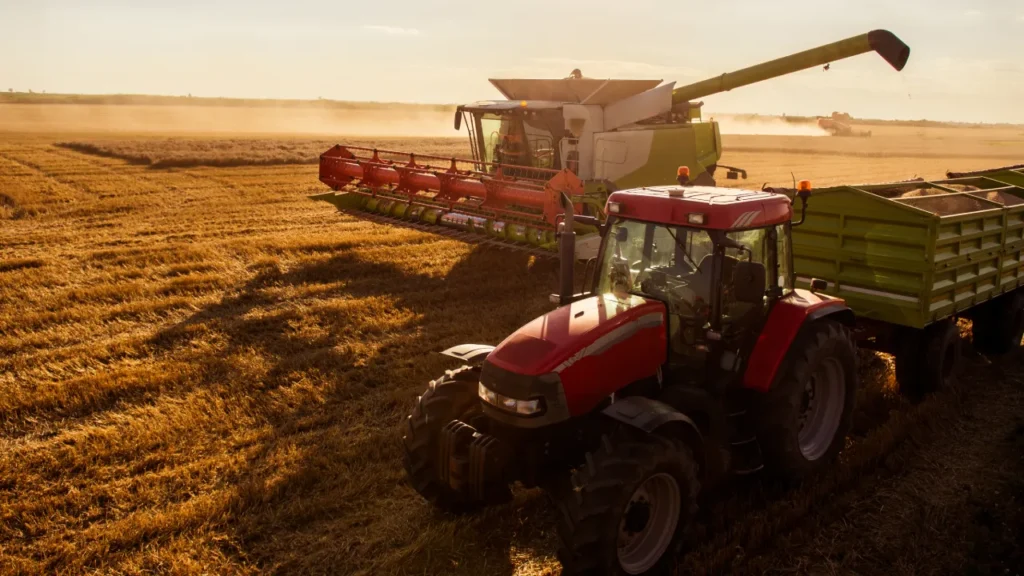
Market conditions in 2026 show a distinct shift from the volatility seen in 2024 and 2025. The global agricultural equipment market size is projected to reach $196.5 billion in 2026, growing at a steady 5.2% CAGR, according to Persistence Market Research. Manufacturers have cleared their pandemic-era backlogs, meaning factory lots are full again.
Despite this recovered supply, retail prices for brand-new equipment have not dropped. Inflationary pressures over the last few years established a higher baseline for manufacturing costs. Consequently, new machinery sales have slumped while the secondary market thrives. Data from Farmdoc Daily (University of Illinois), drawing on Association of Equipment Manufacturers reports, shows a stark reality in the U.S. market: new tractor sales dropped 13.16% to 217,279 units in 2024, and combine sales plunged 24.40% to 5,556 units — with 2025 figures showing an even sharper drop (tractors down a further 9.86%, combines down 35.58%). This U.S. downturn is pushing inventory into the global used-equipment sector that international buyers are now tapping.
Several macro factors are currently shaping global agriculture equipment market trends:
- Currency fluctuations: A strong US Dollar makes American exports slightly more expensive for emerging markets, but the massive oversupply of used machinery in North America offsets this currency premium. (For context, U.S. agricultural exports generated $175.5 billion in direct value in calendar year 2023, per the USDA Economic Research Service. FY2025 came in similarly at $175.6 billion, though USDA’s FY2026 forecast points lower, to roughly $173 billion).
- Regional demand shifts: Subsidies in parts of Asia and the Middle East are driving high demand for water-efficient farming tech and mid-sized tractors. Asia-Pacific holds the largest regional share of the equipment market by most trackers — Grand View Research and Mordor Intelligence both put it around 36–38%, and Fortune Business Insights near 40% — though Persistence Market Research’s own breakdown places North America slightly ahead.
- Production and availability: European manufacturers are strictly adhering to Stage V emissions standards, making their new machines highly advanced but expensive. This drives international buyers toward slightly older, pre-emission or Tier 4 Final models available in North America.
Average Farm Equipment Prices by Type (2026)
Pricing varies wildly based on horsepower, total hours, technology packages, and overall condition. To give you a realistic baseline, we analyzed current global listings to build this 2026 pricing framework.
Below is a breakdown of average global prices for major equipment categories.
| Equipment Type | Condition | Average Global Price Range (USD) | Drivers |
|---|---|---|---|
| High-HP Tractors (300+ HP) | New | $500,000 – $750,000 | Precision ag tech, automation |
| High-HP Tractors (300+ HP) | Used (1000-3000 hrs) | $280,000 – $450,000 | Fleet renewals in North America |
| Mid-HP Tractors (100-299 HP) | Used (1000-3000 hrs) | $90,000 – $190,000 | High demand in emerging markets |
| Combine Harvesters | New | $650,000 – $950,000 | Increased capacity, yield mapping |
| Combine Harvesters | Used (1000-2500 sep hrs) | $250,000 – $500,000 | Upgrades to newer automated models |
| Self-Propelled Sprayers | Used (low hours, 2024-2025 models) | $415,000 – $499,000 | Boom leveling, exact apply systems |
| Large Square Balers | Used | $75,000 – $140,000 | Forage demand, weather patterns |
High-Horsepower Tractors
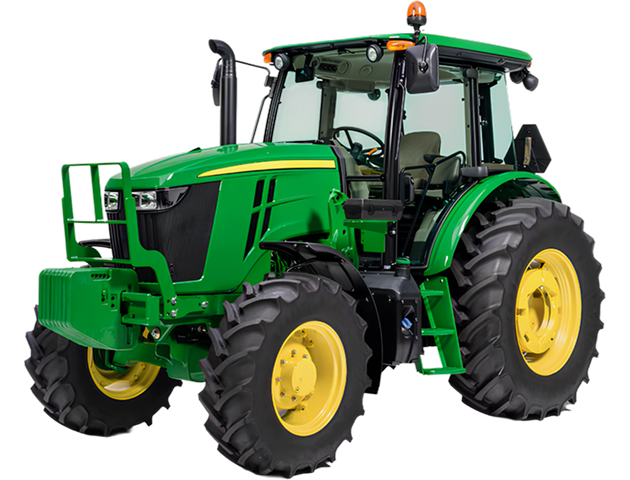
Tractors remain the most heavily traded agricultural commodity across borders. In 2026, demand spans the whole high-horsepower range — from row-crop workhorses like the 370 HP John Deere 8R 370 to fully articulated 4WD units like the Case IH Steiger Quadtrac (typically 470–620 HP), a materially higher horsepower and price tier. Buyers globally are hunting for models with low hours (under 1,500) that already feature modern technology like Gen4 displays and high-flow hydraulic pumps. The fastest-growing sub-category here is articulated four-wheel-drive tractors, heavily sought after by large-scale grain operations in Eastern Europe and South America.
Combine Harvesters
Combines represent a massive capital investment. Because they are used for a very specific, short window each year, depreciation works differently. A five-year-old combine might only have 1,200 separator hours. Buyers in import-driven markets frequently source used Class 8 and Class 9 combines from the United States and Canada, where large corporate farms trade in their fleets every three years.
Sprayers and Balers
Sprayers have seen significant price growth due to the integration of advanced nozzle control and camera-based weed detection. Buyers looking for standard, reliable self-propelled sprayers without the massive price tag of 2026 factory models are actively buying late-model units. For example, 2024 and 2025 self-propelled sprayers like the John Deere 410R consistently list between $415,000 and $499,000 on the secondary market, depending on model year and options like ExactApply systems.
Total Landed Cost: What You Actually Pay
This is the most important number in the entire article, and it is the one most buyers get wrong. The price on a listing is not what leaves your bank account. Total Landed Cost is the final price of the machine standing in your farmyard, fuelled and ready to work — and it is the only figure that makes an international quote and a local quote comparable.
Get this calculation right and international sourcing is straightforward arithmetic. Get it wrong and a deal that looks like a $50,000 saving before tax can shrink to under $14,000 once GST lands on the full freight-inclusive value, not just the machine price.
Full Formula
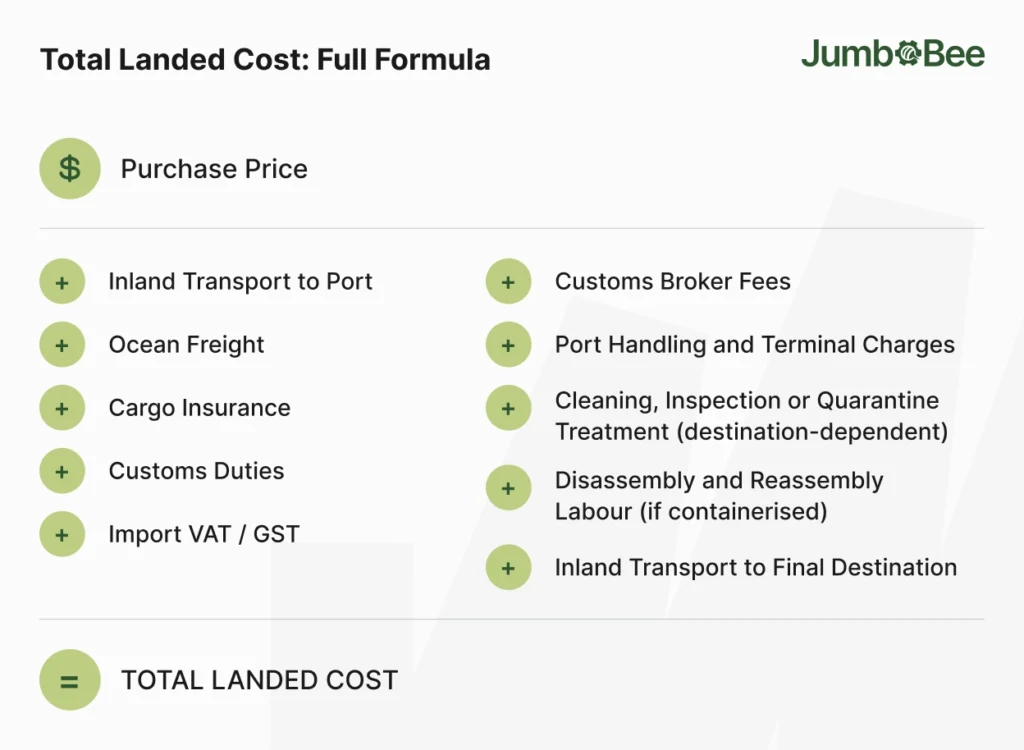
Most published versions of this formula omit VAT and broker fees. Those two lines are frequently the difference between a good decision and a bad one.
Breakdown of Export Expenses
- Purchase price: Negotiated cost of the machine itself.
- Inland logistics: Moving a 40,000-pound tractor from a farm in Nebraska to a port in Texas requires specialized heavy-haul trucking.
- Ocean shipping: Heavy machinery moves four ways. RoRo means driving the machine onto a parking-garage style vessel — fast, no disassembly, but routes are limited and the machine must run. Container requires partial disassembly to fit a 40-foot box, adding labour but often cutting freight sharply. Flat rack carries oversized machines that will not fit a container and cannot drive aboard. Breakbulk handles the largest units, lifted directly onto the deck. Most high-horsepower tractors and Class 8–9 combines move flat rack or breakbulk rather than the first two options.
- Duties and taxes: Every country has a different tariff schedule. Some nations reduce or waive duty on agricultural machinery to stimulate food production — but duty relief is not VAT relief, and the two are separate decisions by separate rules.
- Import VAT or GST: Usually charged on the CIF value, meaning your freight and insurance are themselves taxed. This is the most commonly overlooked line in the whole calculation.
- Cleaning and quarantine: Destinations such as Australia and New Zealand require machinery to arrive free of soil and plant material, and can require offshore treatment. Preparation and inspection are real budget lines, not formalities.
- Insurance: Never ship heavy equipment without comprehensive marine cargo insurance.
For baseline metrics, the global Roll-on/Roll-off shipping market has expanded to handle growing international heavy equipment trade, reaching a valuation of roughly $64.8 billion in 2024 and expanding by nearly 6% annually, according to insights from Strategic Market Research. With modern vessels accommodating over 8,000 car-equivalent units, ocean carriers are heavily prioritizing construction and agricultural machinery, stabilizing freight rates for heavy hauls.
Worked Example: Importing a Tractor to Australia
Imagine you are in Australia looking at a 2021 John Deere 8R 370.
| Cost Line | Amount (USD) |
|---|---|
| Local dealer price in Australia | $415,000 |
| US listing price | $345,000 |
| US inland transport to port | $3,000 |
| Ocean freight (RoRo) to Brisbane | $9,500 |
| Cargo insurance | $1,900 |
| Port handling and broker fees | $3,500 |
| Customs duty (Free — tractors over ~130 kW / 174 HP) | $0 |
| GST value base (customs value + freight + insurance) | $359,400 |
| GST at standard 10% rate | $35,940 |
| Biosecurity cleaning & inspection | $1,500 |
| Inland transport to farm | $1,000 |
| Total Landed Cost | $401,340 |
| Saving vs local dealer | ~$13,700 |
That is still real money, but it is $13,700, not $50,000 — and the difference is a single 10% tax line applied to more than just the machine price.
Australia doesn’t offer a reduced GST rate for agricultural machinery — the 10% rate is flat, full stop. What Australia does offer is duty relief: tractors above roughly 130 kW (about 174 HP), which covers most high-horsepower row-crop and articulated models, enter duty-free regardless of country of origin. So duty contributes nothing to this bill, but GST still applies to the full freight-inclusive value — not just the machine price — which is exactly the gap that catches buyers off guard.
The rule to take from this: a favorable duty class doesn’t remove the tax line — confirm whether GST or VAT applies to the machine price alone or to the full landed value before you commit. And treat biosecurity as the real wildcard: it isn’t a fixed percentage like tax, and a machine that fails inspection for soil or plant residue can face added cleaning, dismantling, or offshore treatment costs that aren’t in any of the line items above until they show up on your invoice.
Farm Equipment Prices by Region
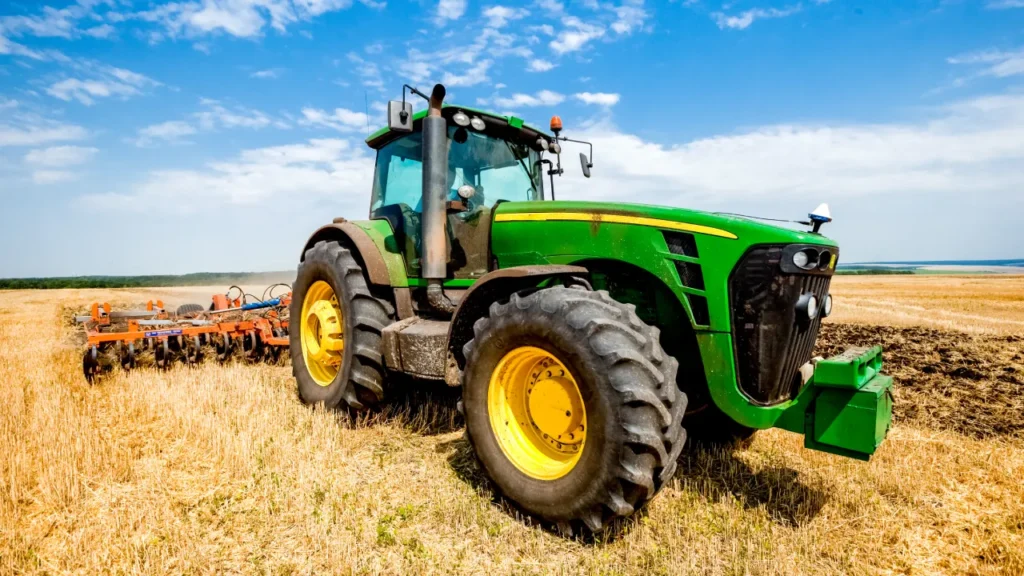
Global pricing is never uniform. A comprehensive farm equipment price index must account for geography. Here is how the major regions stack up in 2026.
North America
United States and Canada represent the largest source of high-quality used agricultural machinery in the world.
- Lower prices for used equipment: Large farming operations lease or finance fleets, turning them over every few years. This creates a massive secondary market.
- High availability: You can easily find dozens of identical models, allowing you to choose the best condition and price.
- Strong resale market: Equipment here is generally well-maintained by authorized dealers under warranty programs.
Europe
European machinery markets are heavily influenced by environmental regulations and land constraints.
- Stricter regulations: Stage V emission standards make newer machines complex and expensive.
- Higher prices but better condition: European farmers often work smaller acreage than North Americans, meaning a five-year-old European tractor might have significantly fewer hours and less structural wear.
- Specialized equipment: Excellent region for sourcing specialized attachments, potato harvesters, and compact tractors.
Asia and Middle East
These regions are experiencing rapid agricultural modernization.
- Import-driven markets: Local manufacturing often focuses on sub-100 horsepower tractors. Heavy machinery is almost entirely imported.
- Mixed pricing: Local dealer markups can be extreme due to lack of competition.
- Subsidized buying: Government programs often help buyers offset the cost of importing modern American or European machinery.
Latin America
Countries like Brazil and Argentina are agricultural powerhouses, but local machinery buyers face severe hurdles.
- High local prices: Import taxes and complex local distribution networks inflate retail prices massively.
- Import opportunities: Because local dealer prices are so high, progressive farmers in Latin America frequently use global market platforms to buy directly from North America, pay the import duties themselves, and still save money.
It is important to understand that local dealers in these high-priced regions are not necessarily trying to exploit buyers. They are restricted by regional supply limitations, expensive local logistics, and strict brand distribution agreements that dictate their minimum pricing.
Data Insights: Three Things the Numbers Show
Pricing tables describe the market. These three findings tell you what to do about it.
Insight 1: The same machine carries a 20–30% premium in import-dependent markets
A high-horsepower tractor listed around $345,000 in the United States lists near $415,000 with an Australian dealer — a 20% premium on identical iron, even before landed costs are added. That gap is not dealer margin. It is the compounded cost of restricted distribution, thin local inventory, and expensive regional logistics baked into a retail price.
Takeaway: If your local market is import-dependent, assume a 20–30% premium exists before you start negotiating. That premium is the budget you are competing for.
Insight 2: Used high-horsepower machines sell at roughly 40% below new
New 300+ HP tractors run $500,000 to $750,000. The same class at 1,000–3,000 hours runs $280,000 to $450,000 — a discount of about 40% on a machine that has used a fraction of its service life. Combines depreciate even faster: $650,000–$950,000 new against $250,000–$500,000 used — roughly a 50% discount, steeper than tractors’ ~40%, since combines rack up far fewer hours before trade-in.
Takeaway: The steepest depreciation happens in the first three years, which is exactly the window North American fleet operators sell into. Buying at the bottom of that curve captures the discount without buying a worn-out machine.
Insight 3: How much you recover depends on the tax regime, not just the premium
Once freight, insurance, duty, tax, handling, biosecurity clearance and inland delivery are counted, a 20% local premium in a market like Australia — flat 10% GST with no reduced rate for machinery, but zero duty on this horsepower class — compresses to roughly a 3% net saving: about $13,700 on a $415,000 tractor. In a market offering genuine tax relief on qualifying equipment, that same size of premium can convert to a 12% net saving or more. The tax regime at your destination, not the headline premium, is usually what decides whether the numbers work.
Takeaway: Importing pays best where your destination gives real duty or tax relief on your specific machine. Where the full landed value gets taxed at the standard rate, even a healthy local premium can shrink to single digits once every line is counted — run the full calculation before you assume the savings are there.
Where Is It Cheaper to Buy Farm Equipment in 2026?
Analyzing current agriculture equipment market trends reveals distinct geographical advantages depending on what you need to buy.
- High-horsepower tractors: United States. The sheer volume of row-crop farming in the American Midwest guarantees a constant supply of used 300+ HP tractors. Fleet renewals push excellent machines onto the secondary market at highly competitive prices.
- Combine harvesters: Canada and Eastern Europe. Canadian wheat farmers and Eastern European grain operations cycle through combines rapidly. You can often find late-model combines here cheaper than anywhere else.
- Specialized attachments and mid-size tractors: Western Europe. Countries like Germany and France produce and trade high-quality, well-maintained implements and mid-range tractors suited for varied terrain.
These price advantages are not random. They are driven by availability surplus. When a massive American corporate farm trades in twenty identical tractors at the end of a lease, the local dealer suddenly has too much inventory. They drop prices to move the metal. If you are an international buyer paying attention to these seasonal sales and fleet renewals, you can capitalize on this local oversupply.
Price Differences Explained: Why Same Machine Costs More in Different Countries
You might wonder why a manufacturer allows such massive price discrepancies for the exact same model across different countries. The answer lies in the architecture of global trade, not in dealer greed.
- Geographic distribution limits: Manufacturers set up exclusive regional networks. A dealer in Australia has a captive market. They cannot legally buy surplus new stock from a US dealer to sell locally. This lack of cross-border competition keeps local prices artificially high.
- Limited logistics capabilities: In some regions, simply moving heavy machinery from a port to an inland agricultural zone requires massive logistical effort, escorts, and permits. Local dealers bake these high operational costs into their retail prices.
- Local demand versus supply imbalance: If a country experiences a sudden agricultural boom, local equipment inventory drains quickly. Dealers raise prices on remaining stock because they know replenishing it will take six months via ocean freight.
- Import dependency: Nations that do not manufacture their own heavy machinery are entirely at the mercy of global supply chains and local import tariffs.
By bypassing the traditional local distribution network and buying directly from a surplus region, you effectively become your own importer, cutting out the middleman markups.
Decision Framework: When Importing Makes Sense, and When It Does Not
Importing is a tool, not a strategy. It works decisively in some situations and loses money in others. Run your situation against both columns before you start searching.
| Import when | Buy locally when |
|---|---|
| Local premium exceeds 20–25% on the same specification | Local premium is under 15% — landed costs will consume it |
| Machine value is high, so fixed freight amortises well | Machine value is low, and freight dominates the total |
| Your destination offers duty relief or a reduced VAT rate on machinery | Duty plus standard-rate VAT applies to your tariff code |
| The model is common enough to compare across several listings | The machine is rare or highly specified, with no comparables |
| You have 8–14 weeks before the machine is needed | You need it this season, or a breakdown has to be replaced now |
| Condition can be verified by third-party inspection | You cannot inspect and cannot absorb the risk of a bad machine |
| You can service and source parts locally, or the brand has regional support | Warranty and dealer service are decisive for your operation |
Break-Even Rule
The arithmetic is simpler than it looks. Landed costs on a high-value machine typically add 8–17% to the purchase price, with the top of that range driven mainly by destinations that charge a flat, full-rate tax with no carve-out for agricultural machinery, plus compliance costs like biosecurity clearance. So:
- Local premium under 15% — importing rarely pays after costs and effort
- Local premium 15–25% — marginal, and depends entirely on your duty and tax treatment
- Local premium above 25% — importing usually wins clearly, and the gap widens with machine value
Three Situations Where Importing Is the Wrong Call
A breakdown mid-season. Ocean freight takes weeks. If a machine is down and the crop is not, buy locally and import the planned replacement later.
Low-value equipment. Freight, handling, and paperwork are near-fixed. On a $20,000 implement they can add 40% or more, wiping out any price advantage.
No verification path. If you cannot arrange an inspection and cannot confirm the seller holds title, the discount is not compensation for the risk. Walk away.
How to Find Best Deals Globally
Finding the right machine requires diligence and the right tools. You cannot simply fly across the world to kick the tires on every tractor. Here is a practical approach to international sourcing.
- Compare listings across countries: Do not limit your search to one region. Look at identical models in the US, Canada, and Europe simultaneously to establish a baseline.
- Check condition and specifications: Pay close attention to hours, maintenance logs, and specific tech packages. A tractor might look cheap until you realize it lacks the GPS receiver and dual hydraulic pumps you need.
- Verify sellers: International wire transfers carry risk. You must ensure the seller holds the actual title to the machine and has a verified business history.
- Calculate exact shipping: Get firm quotes for dismantling, hauling, ocean freight, and reassembly before you commit to a purchase.
Managing all these steps independently can be overwhelming. Coordinating trucking, customs brokers, ocean freight, and secure payments across different time zones is a full-time job. Using a dedicated global marketplace simplifies this entire process, turning a complex international trade into a straightforward online purchase.
How JumboBee Fits Into This
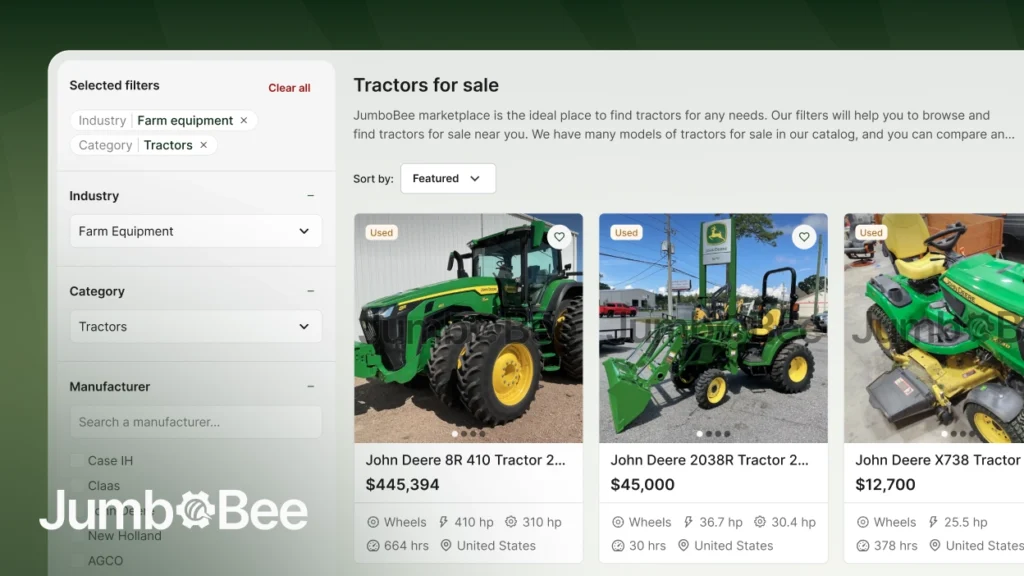
JumboBee is a global marketplace with logistics built in. Rather than list features, here is what that actually changes in the three situations this article has described.
You have found the same tractor in three countries and cannot compare the prices. The listings are ex-location, so the numbers are not comparable until freight, duty, and tax are added to each. JumboBee attaches a shipping quote to the listing, which turns three sticker prices into three landed costs you can put side by side.
The machine is too large for RoRo and you do not know what that costs. A Class 9 combine or an articulated tractor usually needs flat rack or breakbulk, and may need partial disassembly. That work is quoted up front — disassembly, loading, ocean leg, and reassembly — rather than discovered after purchase.
You are buying from a seller you have never met, in a country you have never visited. Sellers are verified, payment is held securely, and optional third-party pre-purchase inspection covers the verification gap that stops most buyers from importing at all.
The platform handles import and export compliance and door-to-door movement, including to destinations with additional requirements such as cleaning and quarantine treatment.
Conclusion
Farm equipment prices vary drastically across the globe in 2026. While inflation has raised baseline costs, massive regional surpluses in places like North America offer incredible buying opportunities for those willing to look internationally.
By understanding the true mechanics of export logistics and calculating Total Landed Cost, agribusinesses can bypass expensive local distribution networks. Leveraging a global platform to handle verification, secure payments, and door-to-door shipping transforms international sourcing from a risky venture into a smart, standard business practice. Expand your search globally, and secure the machinery you need at a fraction of the local cost.






Be the first to leave a comment
There are no replies to this post yet. Share your thoughts and help start the conversation.