


 Selling
Knowing the true value of heavy machinery is the difference between a profitable deal and a financial disaster. Whether you are selling a fleet of excavators, acquiring a manufacturing plant, buying a used combine harvester, or securing a loan against industrial assets, accurate numbers are not just a formality – they are the bedrock of asset management.
In the high-stakes world of industrial capital, a variance of 10% in valuation can mean hundreds of thousands of dollars in lost equity or overpaid taxes. Plant and machinery valuation is the systematic and defensible process of determining the economic value of tangible assets.
It goes far beyond simple guesswork or glancing at a single listing on a marketplace. It involves a rigorous analysis of market trends, macro-economic factors, asset condition, technical obsolescence, and depreciation schedules.
For businesses involved in construction, agriculture, mining, and manufacturing, professional valuation is a critical requirement for:
- Transactions: Ensuring you don’t overpay for acquisitions or undersell your fleet.
- Financing: Lenders require precise collateral values (loan-to-value ratios) before approving capital.
- Insurance: Guaranteeing coverage matches the actual Replacement Cost New to avoid under-insurance penalties.
- Financial reporting: Maintaining accurate balance sheets for stakeholders, complying with IFRS/GAAP, and managing tax liabilities.
- Litigation & dispute resolution: Providing evidence in shareholder disputes, divorce, or bankruptcy proceedings.
This comprehensive guide breaks down how to determine fair market value of equipment, the technical nuances of professional appraisals, the regulatory standards governing the industry, and how to leverage market data from platforms like JumboBee to ensure your numbers are accurate.
What Is Machinery and Equipment Valuation?

Definition and Core Concepts
Machinery and equipment valuation is the practice of estimating the monetary worth of tangible assets used in business operations. In the professional appraisal industry, this falls under the discipline of Personal Property Valuation (as opposed to Real Property, which is real estate).
This category includes a vast spectrum of assets:
- Yellow iron/construction: Bulldozers, excavators, wheel loaders, graders.
- Agricultural machinery: Tractors, combine harvesters, sprayers, balers.
- Industrial plant: CNC machines, injection molding lines, conveyor systems.
- Transportation: Heavy trucks, trailers, specialized vocational vehicles.
- Process equipment: Boilers, silos, crushers, and mixing plants.
While machinery valuation refers to individual movable assets, plant and machinery valuation usually encompasses the operational infrastructure of a facility. This includes the assumed assets – the wiring, piping, foundations, and installation labor required to make a machine operational.
Gold Standard: Fair Market Value (FMV)
The concept of value is subjective unless defined by a standard. The most common standard is Fair Market Value. According to major valuation standards like the Uniform Standards of Professional Appraisal Practice (USPAP) or the International Valuation Standards (IVS), FMV is defined as:
“The price at which property would change hands between a willing buyer and a willing seller, neither being under any compulsion to buy or sell and both having reasonable knowledge of relevant facts.”
However, in the M&E world, FMV has nuances. An appraiser must determine if the value is:
- FMV – in continued use: The value of the asset including installation and contribution to the going concern (the business is operational). This is typically higher as it includes soft costs.
- FMV – in exchange (installed): The value of the asset installed, but assuming it will be sold to a new user who will operate it on-site (common in building acquisitions).
- FMV – in exchange (removal): The value of the asset assuming it must be removed from the facility. This deducts the cost of de-installation and transportation.
When Do Businesses Need Equipment Valuation?
You rarely need a formal valuation for curiosity. It is usually triggered by a specific trigger event that carries legal or financial weight:
- Mergers & acquisitions: When one company buys another, they must allocate the purchase price across the assets (Purchase Price Allocation or PPA). This requires valuing the machinery separately from the goodwill and real estate.
- Collateral lending (asset-based lending): Banks do not lend on hope. They lend on liquidation value. They need to know what the equipment will fetch at auction if the borrower defaults.
- Insurance claims: After a fire or flood, you must prove the value of the lost assets. If your policy covers Replacement Cost, you need a valuation of what a new equivalent machine costs today, not what you paid ten years ago.
- Property tax appeals: Industrial equipment is subject to personal property tax. Assessors use generic depreciation tables that overvalue old machines. A specific appraisal can prove your 20-year-old press is worth less than the tax bill suggests.
- Financial reporting (impairment testing): Under GAAP/IFRS, if an asset’s market value drops significantly below its book value, companies must write down the asset (impairment loss).
Types of Value Definitions Explained
Different situations require different value definitions. Using the wrong one can be catastrophic.
- Fair Market Value (FMV): The price in an open and unrestricted market. This assumes a retail scenario where the seller has time to find the right buyer.
- Orderly Liquidation Value (OLV): The estimated gross amount realized from a liquidation sale, given a reasonable period of time to find a purchaser (usually 6–12 months). This is often 10-20% lower than FMV.
- Forced Liquidation Value (FLV): The amount realized in a properly advertised and conducted public auction (fire sale) where the seller is compelled to sell immediately (e.g., bankruptcy). This can be 30–50% lower than FMV.
- Replacement Cost New (RCN): The current cost of a new machine having the same utility. This is used for insurance and the Cost Approach.
- Scrap/Salvage Value: The value of the metallic content if the machine is rendered inoperable.
Key Factors Affecting Machinery and Equipment Value
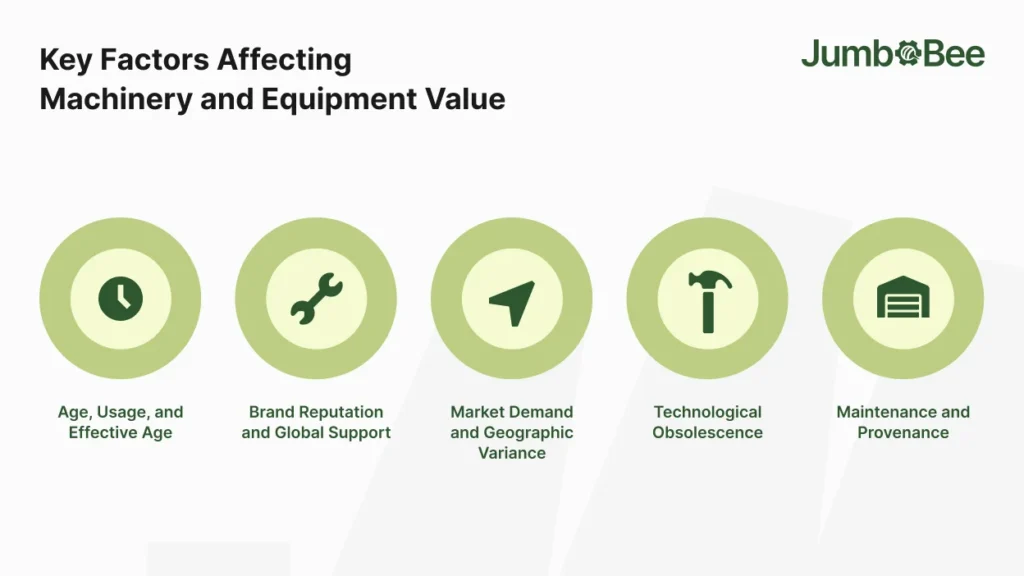
Two identical tractors can have vastly different values based on specific technical variables. Valuation goes beyond the model number; it is about the asset’s biography.
1. Age, Usage, and Effective Age
Chronological Age is simple (Year Built). However, Effective Age is what appraisers care about.
- Usage intensity: A generator used for standby power might be 10 years old but have only 200 hours (Low Effective Age). A generator used for prime power at a mine might be 2 years old with 15,000 hours (High Effective Age).
- Component lifecycle: Heavy machinery is a collection of components (Engine, Transmission, Hydraulics, Undercarriage). Each has a different lifecycle. A dozer with a brand-new undercarriage (which can cost $50,000) is worth significantly more than one with 10% life remaining, even if they are the same age.
2. Brand Reputation and Global Support
Top-tier brands (Caterpillar, Komatsu, John Deere, Liebherr) command a brand premium. This is based on:
- Parts availability: Can you get a sensor for this machine in rural Iowa or central Africa within 24 hours?
- Service network: Are there technicians trained to fix it?
- Secondary market liquidity: A Caterpillar excavator can be sold anywhere in the world. A niche or defunct brand (like Daewoo or older Terex models) may only have a local market, depressing its value.
3. Market Demand and Geographic Variance
Value is intensely local.
- Seasonality: A combine harvester has peak value in the Midwest US before harvest (August). Its value drops in November.
- Regional regulations: A non-emission compliant truck (pre-DEF) might have high value in export markets (Africa, South America) but low value in California due to CARB regulations.
- Global logistics: Platforms like JumboBee mitigate local price depressions by connecting sellers with global buyers. However, the Landed Cost (Machine Price + Ocean Freight + Tariffs) dictates the ceiling of what an international buyer will pay.
4. Technological Obsolescence
This is the silent killer of value.
- Tier 4 / Stage V Emissions: In highly regulated markets (EU/North America), older dirty engines are becoming liabilities. Conversely, in developing markets with poor fuel quality, Tier 4 engines are less desirable because they clog up.
- Automation/GPS: In agriculture and grading, machines wired for GPS/Laser guidance are standard. Retrofitting is expensive. A machine without this capability suffers from functional obsolescence.
5. Maintenance and Provenance
Service records available is the most profitable phrase in a listing.
- Oil sampling (SOS): For high-value mining and construction gear, fluid analysis history (showing lack of metal filings or coolant leaks) proves the internal health of the engine and transmission.
- Refurbishment: A Rebuild is only valuable if documented. Rebuilt engine claims without paperwork are treated as hearsay by appraisers.
| Factor | Impact on Value | Technical Nuance |
|---|---|---|
| Undercarriage | Critical (Dozers/Excavators) | Consumables (tracks, rollers, idlers) represent 20-40% of the machine’s total value. |
| Tier Level | High (Regional) | Tier 4 Final/Stage V is mandatory for public works in US/EU; Tier 2/3 is preferred for export to regions with high-sulfur fuel. |
| Hours vs. Miles | High | Hours measure engine load. 10,000 hours on a loader is roughly equivalent to 300,000+ miles on a truck. |
| Attachments | Moderate/High | Specialized attachments (shears, processors, mulchers) can exceed the value of the carrier machine. |
Machinery and Equipment Valuation Methods
Professional appraisers do not pull numbers out of thin air. They generally use three distinct approaches to value, cross-referencing them to ensure accuracy.
1. Cost Approach (Replacement Cost Method)
This method is based on the principle of substitution: A prudent buyer will not pay more for a property than the cost of acquiring a substitute property of equivalent utility.
Logic
Calculate what it costs to buy a brand new equivalent today (Replacement Cost New – RCN), then deduct for all forms of depreciation.
Types of Depreciation Deducted
- Physical deterioration: Wear and tear from use (e.g., rusted metal, worn tires).
- Functional obsolescence: The machine is old technology (e.g., a manual lathe vs. a CNC lathe). The new machine is faster, so the old machine is worth less even if it’s in mint condition.
- Economic obsolescence: External factors reducing value (e.g., a ban on coal mining reduces the value of specialized coal crushers).
Formula
FMV = Replacement Cost New (RCN) – (Physical + Functional + Economic Depreciation)
Best for
Unique, custom-built machinery, specialized processing plants, or new facilities where no active used market exists.
2. Market Approach (Sales Comparison Method)
This is the most common and reliable method for standard, mass-produced equipment. It relies on the principle of contribution.
Logic
Compare the subject asset to similar items recently sold or currently listed.
Hierarchy of Data
- Confirmed sold data: The gold standard. Actual transaction prices from auction results or dealer sales ledgers.
- Offer/listing prices: What sellers want. These must be adjusted down (typically 5-15%) to estimate a strike price.
- Opinion: Anecdotal evidence from dealers (I usually sell these for $X).
Adjustment Grid
Appraisers take a Comparable sale and adjust it to match the Subject.
- Subject: 2018 Excavator, 4,000 hours.
- Comparable: 2018 Excavator, 2,000 hours, sold for $100,000.
- Adjustment: The comparable has lower usage. We deduct value (e.g., -$10 per hour difference = -$20,000).
- Indicated Value: $80,000.
Best for
Trucks, tractors, excavators, forklifts, and machine tools with an active secondary market.
3. Income Approach (Income Capitalization Method)
This method values machinery based on the revenue stream it generates. It is complex and rarely used for single machines unless they are leased.
Logic
The value of an asset is the Present Value of the future economic benefits it will provide.
Methods
- Discounted cash flow (DCF): Projecting net income for 5 years and discounting it back to today’s dollars.
- Direct capitalization: Using a Cap Rate based on the machine’s rental income potential.
Best for
Leased equipment portfolios (e.g., a rental company fleet), power plants, or entire production lines where revenue can be directly isolated to the asset.
4. Hybrid Valuation (Weighted Conclusion)
For complex industrial plants, valuers reconcile these methods.
- Example: A Plastic Injection Molding Plant.
- Injectors: Valued via Market Approach (liquid market).
- Molds: Valued via Cost Approach (custom-made, no resale market).
Result: The final report sums these distinct values.
Deep Dive: Valuing Specific Asset Classes
To add real meat to your understanding, we must look at how valuation differs by industry.
Heavy Construction (Yellow Iron)
- Key drivers: Hours, Undercarriage Remaining (%), EPA Tier Level.
- Trap: Undercarriage. A D8 Dozer might look shiny, but if the rails, pads, and sprockets are 100% worn, you are looking at a $50,000 repair bill immediately. An appraiser physically measures the grouser height and rail wear to calculate remaining life.
- Market: Highly liquid. Auctions (Ritchie Bros, IronPlanet) set the global baseline for FLV, while dealers set the FMV.
Agriculture Equipment
- Key drivers: Engine Hours vs. Separator Hours (for combines), Drive type (2WD, MFWD, 4WD/Track), Technology Packages.
- Trap: Technology. A tractor is a computer on wheels. Activation codes for GPS autosteer and precision planting can cost $10,000+. A valuation must confirm if these subscriptions/activations transfer with the machine.
- Market: Highly seasonal and regional.
Industrial Manufacturing (CNC & Process)
- Key drivers: Controller Type (Fanuc, Siemens, Haas), Spindle Hours, Tolerance capabilities.
- Trap: Moving Costs. A massive stamping press might be worth $200,000, but if it costs $150,000 to rig, transport, and install it, its In-Exchange – Removal value is only $50,000. This is the Net Realizable Value.
- Market: Slower-moving. Often sold via private treaty rather than auction.
How to Determine Fair Market Value of Equipment: A DIY Guide
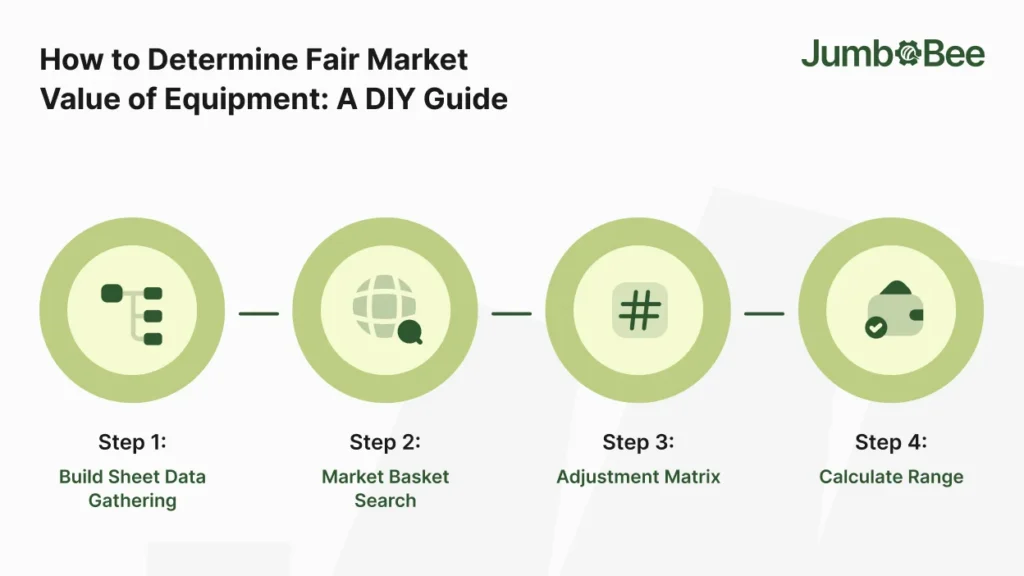
If you don’t need a certified report for the bank or court, you can estimate FMV yourself. However, you must follow a systematic path to avoid Optimism Bias. Learning how to determine fair market equipment value requires a strict adherence to data over emotion.
Step 1: Build Sheet Data Gathering
You cannot value what you cannot define. Gather:
- Make, model, year: Accurate to the sub-model (e.g., Cat 320D L vs. 320D LRR).
- Serial number: Crucial for verifying the year of manufacture.
- Specs: Boom length, bucket capacity, tire size, auxiliary hydraulics.
- Condition report: Take 20+ photos. Focus on wear points: bucket pins, tires/tracks, cab interior, engine compartment.
Step 2: Market Basket Search
Use JumboBee and other aggregators to find data.
- Search criteria: Filter by Year (+/- 1 year), Model, and Region.
- Data scrubbing: Toss out the outliers. If you see five machines listed for $100k, $105k, $98k, $102k, and one for $150k, ignore the $150k. It’s an anomaly.
- Sold vs. asking: Assume that Asking Prices are 10-15% higher than the final transaction price.
Step 3: Adjustment Matrix
Be honest.
- Hours: High hours = lower value. General rule of thumb: Deduct 1-2% of value for every 1,000 hours over the average.
- Location: Is the machine in a remote mine in Alaska? Deduct the $10,000 it will cost to float it to a port.
- Appearance: Paint and Decals matter. A repainted machine suggests care (or a cover-up), but a rusted machine screams neglect.
Step 4: Calculate Range
Never settle on a single number.
- FMV Floor: The lowest reasonable comparable sale.
- FMV Ceiling: The highest reasonable listing minus negotiation room.
Your Value: Where your machine sits in that range based on its specific condition.
Valuation Costs: Understanding Investments
Professional appraisal is a service, and like all professional services (legal, accounting), it carries a cost. However, the cost of an appraisal is a fraction of the potential loss from a bad deal.
Cost Structure
Appraisers do not charge a percentage of the equipment’s value. This is unethical and prohibited by USPAP, as it incentivizes the appraiser to inflate the value to get a higher fee.
1. Desktop Appraisal ($500 – $1,500)
- Method: You send photos and specs; the appraiser does the research.
- Use case: Standard equipment, low litigation risk, internal decisions.
- Limitations: The appraiser assumes your description is honest. The report will state, based on client-provided information.
2. Full Summary Appraisal with Inspection ($3,000 – $10,000+)
- Method: The appraiser travels to the site, inspects the assets, verifies serial numbers, photographs conditions, and interviews maintenance staff.
- Use case: Bank financing, litigation, partnership disputes, M&A.
- Includes: Travel expenses, time on site, research time, and report writing.
3. Mass Appraisal / Fleet Valuation (Quote Basis)
- Method: For a rental company with 500 assets, appraisers use statistical modeling combined with sample testing (inspecting 10% of the fleet).
- Cost: Often quoted as a day rate ($1,500 – $2,500/day) or a per-asset fee ($50 – $200 per asset).
Regulatory Standards: USPAP, IVS, and Tax
The machinery valuation industry is self-regulated but adheres to strict ethical codes.
USPAP (Uniform Standards of Professional Appraisal Practice)
In the United States, USPAP is the bible of appraisal. A USPAP-compliant report must:
- Identify the client and intended users.
- State the purpose (e.g., loan collateral).
- Define the value type (e.g., FMV).
- Describe the Scope of Work.
- Sign a certification of non-bias.
IVS (International Valuation Standards)
Used globally and increasingly in cross-border transactions. IVS focuses heavily on transparency and consistency in financial reporting.
Tax Implications (IRS & PPA)
In an acquisition, the IRS requires a Purchase Price Allocation (PPA) under ASC 805. You cannot lump everything into Goodwill. You must assign FMV to the machinery to establish the new depreciation basis.
Bonus depreciation: The Tax Cuts and Jobs Act allowed 100% bonus depreciation on used equipment. A high valuation on machinery can create massive immediate tax write-offs for the buyer.
Choosing a Qualified Machinery Valuer
Your brother-in-law who knows tractors is not a qualified appraiser. If your report needs to hold up in court, with the IRS, or with a bank’s risk department, you need credentials.
Look for these designations:
- ASA (Accredited Senior Appraiser): Issued by the American Society of Appraisers. The most rigorous designation requires years of experience and complex exams.
- CMEA (Certified Machinery and Equipment Appraiser): A specialized designation for business brokers and appraisers.
- RICS (Royal Institution of Chartered Surveyors): The global standard, common in the UK, Europe, and Asia.
- CSA (Certified Senior Appraiser): Issued by the Equipment Appraisers Association of North America (EAANA).
Questions to Ask a Potential Valuer
- Have you valued this specific type of plant/equipment before? (Valuing a MRI machine is different from valuing a rock crusher).
- Is your report USPAP compliant?
- Do you have a database of comparable sales, or do you rely only on current listings?
Machinery Valuation in the Digital Age
The valuation industry is undergoing a digital transformation.
Big Data & AI
Algorithms now scrape thousands of auction results and listings daily. Tools can predict depreciation curves based on millions of data points.
- Pros: Instant data, removal of human bias in data gathering.
- Cons: AI cannot smell a burnt transmission or see a cracked frame. It misses the physical nuances.
Telematics
Modern machines (Cat Product Link, John Deere JDLink) report their own health.
- Utilization data: Appraisers can now see not just hours, but idle time vs. working time. A machine with 5,000 hours but 60% idle time is in better shape than one with 5,000 hours at 90% load factor.
- Fault codes: Access to the ECU history reveals if the engine has frequently overheated or suffered low oil pressure events.
Why JumboBee Helps
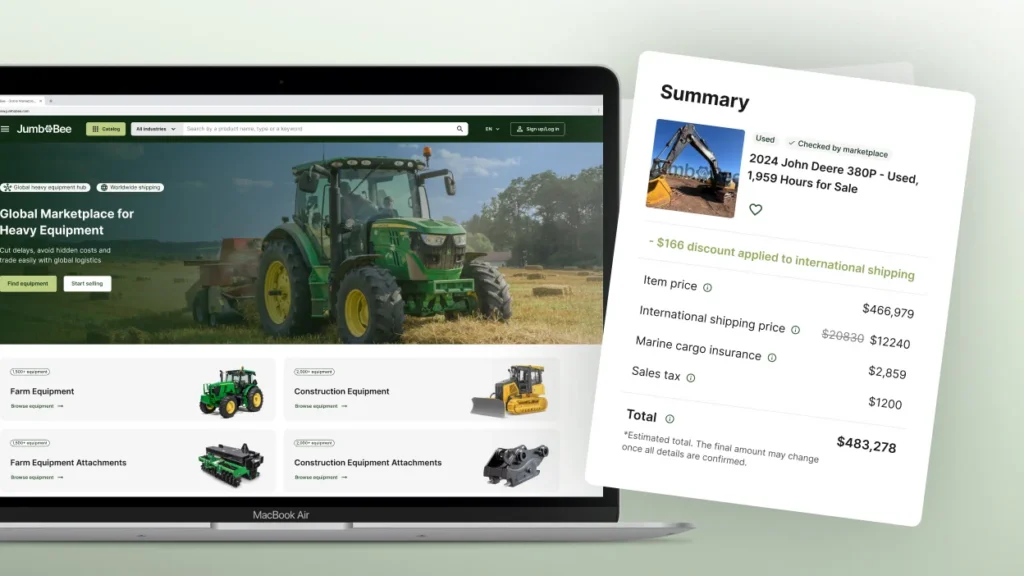
JumboBee is bridging the gap between local sellers and global buyers. By integrating logistics data, they help users understand the Global Market Value.
Scenario: An excavator in the UK might be cheap, but shipping it to the USA is expensive. JumboBee helps calculate the total cost, allowing buyers to make an apples-to-apples comparison of value across borders.
Methodology Note
Valuation examples in this guide are based on a combination of market listings, auction results, depreciation models, and appraisal standards (USPAP / IVS). Figures are illustrative and intended for educational purposes.
Conclusion
Accurate machinery and equipment valuation is a blend of art and science. It requires a mastery of the hard numbers-depreciation curves, usage hours, and auction results – and an intuitive understanding of the soft factors – market sentiment, brand reputation, and macroeconomic trends.
Whether you rely on the Cost Approach for a custom plant, the Market Approach for your vehicle fleet, or the Income Approach for a production line, the goal is defensibility. You must be able to prove why that number is correct.
In a market where asset values fluctuate with steel prices, construction booms, and global shipping rates, ignorance is expensive.
Ready to determine the real value of your equipment?
JumboBee empowers you to move beyond guesswork. With access to verified listings, global market analytics, and professional inspection resources, we provide the clarity you need to transact with confidence. Whether you are buying, selling, or managing your balance sheet, start with accurate data.








Be the first to leave a comment
There are no replies to this post yet. Share your thoughts and help start the conversation.