


 Shipping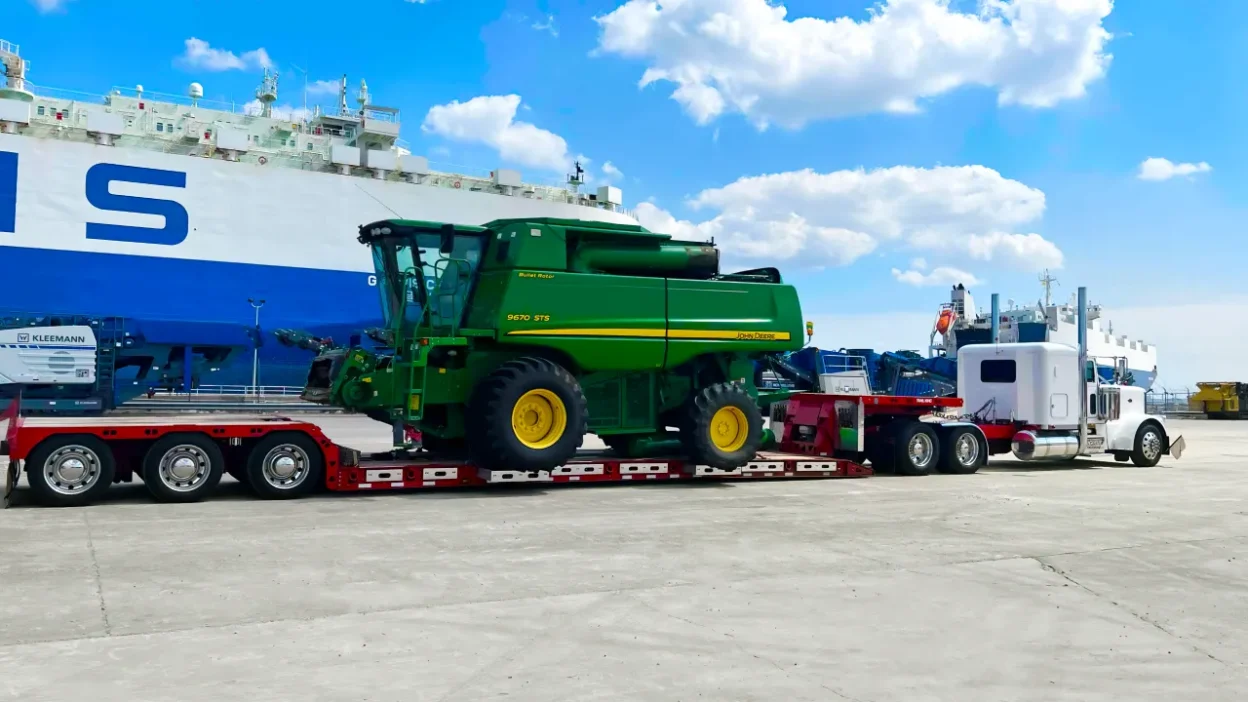
United States remains the premier marketplace for high-quality heavy iron. From John Deere tractors in the Midwest to Caterpillar excavators in the South, international buyers flock here for inventory. However, moving a 20-ton machine across borders involves more than just booking a ship. It requires navigating a complex web of compliance, logistics, and documentation.
Export compliance has grown increasingly rigorous in recent years. A significant regulatory update – the Foreign Trade Regulations final rule effective September 15, 2025 – clarified USPPI responsibilities and mandatory EEI filing requirements. Understanding current rules before you ship prevents costly delays and federal penalties.
This guide explains how to export machinery from USA legally, efficiently, and safely. It covers everything from the initial paperwork to the final delivery at a foreign port, ensuring that once you find the right heavy equipment on JumboBee, you can get it to your global job site without a hitch.
Step 1: Confirm Export Eligibility
Before spending a dollar on logistics, you must verify that the equipment can legally leave the country. U.S. laws are strict regarding machinery export, specifically concerning who you are selling to and where the machine is going.
Check Export Regulations
Most commercial heavy equipment (tractors, combines, excavators) is designated as EAR99. This means it generally does not require a specific license to be shipped to most friendly nations. However, you must check the Export Administration Regulations.
- Determine ECCN: Identify if your machine has an Export Control Classification Number. While a standard bulldozer is likely EAR99, equipment with advanced GPS, military-grade sensors, or dual-use technology might have a specific ECCN requiring a license.
- Screen parties: You cannot sell to individuals or entities on the Consolidated Screening List. This list includes denied persons and sanctioned entities.
- Check Destination: Embargoed countries are off-limits. Sending equipment to sanctioned regions can result in severe federal penalties.
Reference the Bureau of Industry and Security for the most current lists and licensing requirements.
Step 2: Determine Correct HS Code
Classification drives the entire customs process. The Harmonized System code determines the import duties the buyer will pay and alerts customs to any specific inspections required.
Why Classification Matters
An HS code is a standardized numerical method of classifying traded products. In the U.S., you will technically use a Schedule B number for export filing, which is based on the international HS system.
If you classify a backhoe loader as a general lifting machine, two things happen:
- Customs delays: Inspections increase because the physical goods do not match the paperwork description.
- Financial loss: You or the buyer might pay 15% duty instead of 0%, or face fines for misdeclaration.
Example:
- 8429.51: Wheeled front-end shovel loaders (e.g., wheel loaders).
- 8429.52: Machinery with a 360-degree revolving superstructure (e.g., hydraulic excavators, backhoe loaders with rotating cab).
Always cross-reference with the World Customs Organization standards or the U.S. Census Bureau Schedule B search tool.
Step 3: Prepare Required Export Documents
Paperwork is the fuel that moves exporting heavy equipment. Missing a single signature or ID number can ground a shipment indefinitely.
Core Documentation
| Document | Purpose |
|---|---|
| Commercial Invoice | Proof of sale and value. Must list seller, buyer, and detailed machine description (VIN/PIN). |
| Bill of Lading (BOL) | Contract between shipper and carrier. Acts as a receipt of freight services. |
| Packing List | Details dimensions, weight, and cubic meters of the cargo. Essential for space planning. |
| Certificate of Origin | Proves where the machine was manufactured. critical for free trade agreements (e.g., USMCA). |
| Power of Attorney (POA) | Authorizes a freight forwarder or JumboBee to file customs docs on your behalf. |
AES Filing and EEI
This is the most critical step in U.S. exports. For any shipment valued over $2,500 per Schedule B number (which applies to almost all heavy machinery), you must file Electronic Export Information via the Automated Export System.
Once filed, you receive an Internal Transaction Number. You must put this ITN on your Bill of Lading. Without an ITN, the steamship line will not load your cargo.
Rule of thumb: For general cargo, file EEI at least 24 hours before loading onto the vessel at the U.S. port – not before the cargo arrives at the terminal, which can be 48–72 hours earlier. For used self-propelled vehicles and equipment (which covers most machinery in this article), a stricter rule applies: AES must be filed 72 hours prior to export. Build your timeline accordingly and never calculate from the vessel’s sailing time.
Step 4: Arrange Logistics and Transportation
Shipping heavy machinery overseas requires selecting the right mode of transport based on the machine’s size, budget, and fragility.
Choose Shipping Method
Roll-on/Roll-off (RoRo)
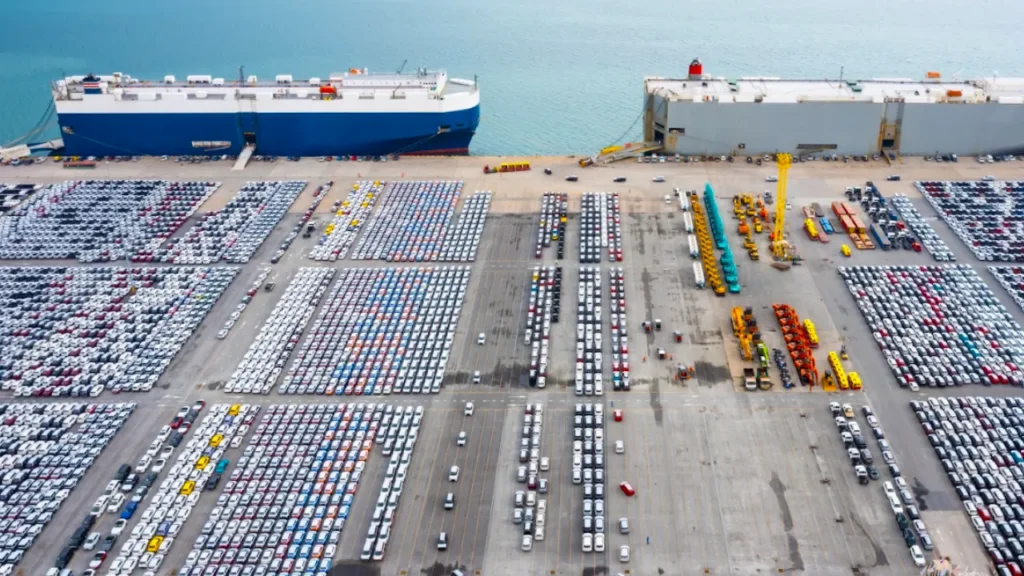
The most common method for self-propelled machinery like tractors and wheel loaders. You drive the machine onto the vessel, and it is secured below deck.
- Pros: Cost-effective, simple loading, minimal handling damage.
- Cons: Machine must run and brake perfectly. Most RoRo carriers prohibit storing any items inside the cab for safety and customs compliance reasons. Some carriers permit a limited quantity of spare parts or personal effects with prior written approval. Always confirm the specific carrier’s policy before loading — undeclared cab contents can result in cargo rejection or customs holds at the destination.
Container Shipping
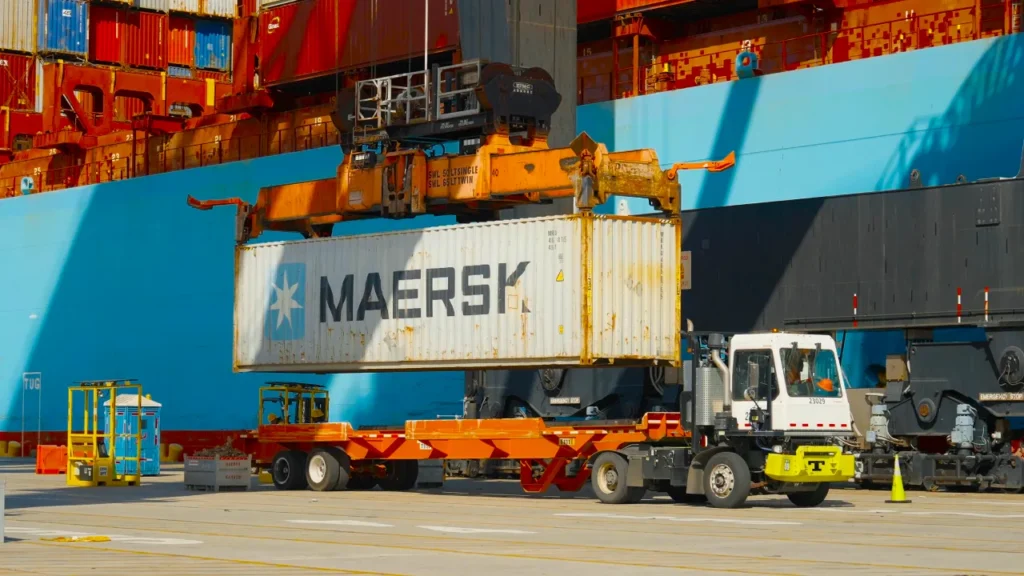
Ideal for smaller equipment (skid steers) or machinery that can be disassembled.
- Pros: Lower ocean freight cost, greater protection from weather, allows for parts consolidation.
- Cons: High labor cost for disassembly and reassembly. Crane required for loading/unloading.
Breakbulk / Flat Rack
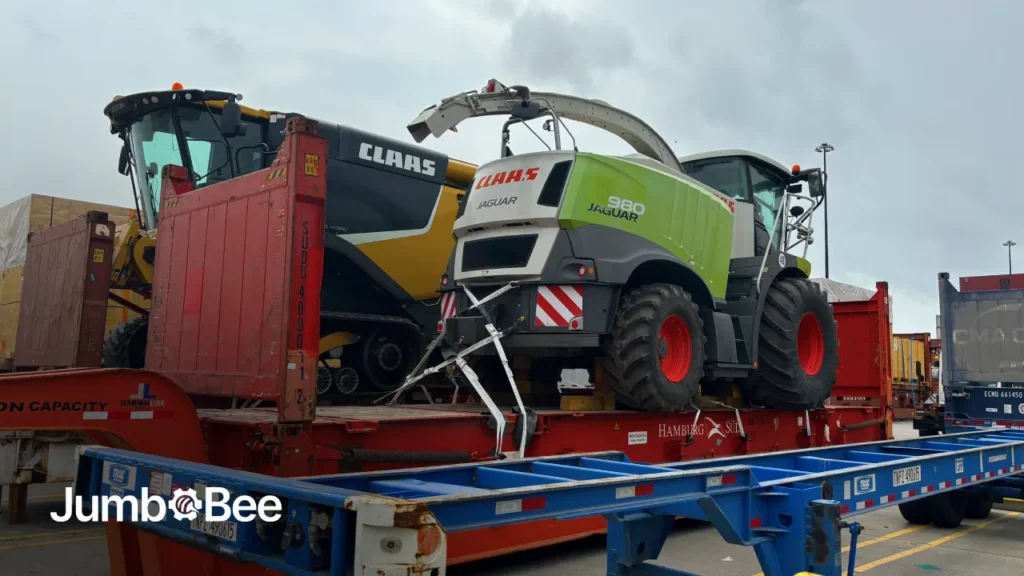
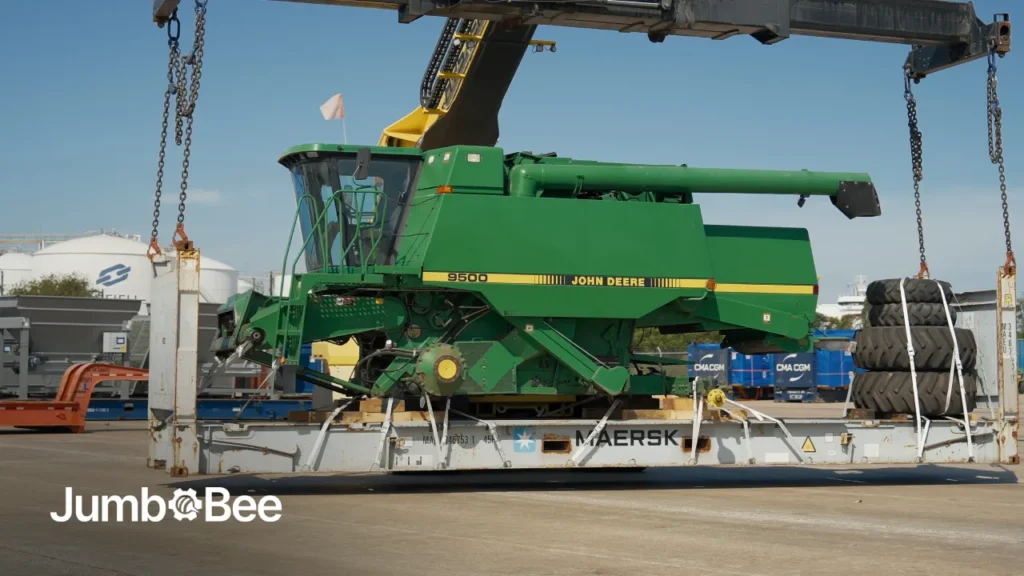
Used for static or oversized cargo that does not fit in a container and cannot be driven (e.g., large generator sets, crushers, or disabled machines).
- Pros: Can handle massive dimensions.
- Cons: Most expensive option. Higher risk of exposure to saltwater and elements.
Calculation example:
A 40-foot container might cost $3,500 to ship to Europe. A RoRo spot for a large combine might cost $110 per cubic meter. If the combine is 150 cubic meters:
$110 * 150 = $16,500 via RoRo.
If the combine can be partially disassembled to fit into two Flat Racks or containers, you might save thousands.
Step 5: Comply with U.S. Customs and Border Protection
U.S. Customs and Border Protection acts as the gatekeeper. Their primary concern with machinery export is preventing stolen vehicles from leaving the country.
Filing Requirements and 72-Hour Rule
For self-propelled vehicles (anything with a VIN or PIN and an engine), you must present the original Title of ownership to CBP at the port of export.
- 72-hour rule: The vehicle and the original Title must be presented to CBP at least 72 hours prior to export (i.e., loading onto the vessel). Note: the regulation does not contain a universal weekend or holiday exclusion for vessel exports — the 72-hour clock runs continuously. Some ports may apply local procedures, so confirm directly with the port of exit.
- Validation: Customs officers physically check the VIN plate on the machine against the Title. If they match, they stamp the Title, authorizing export.
If you fail this step, the cargo rolls to the next vessel, incurring storage fees.
Step 6: Insurance and Risk Management
Damage happens. Storms hit the Atlantic, and cranes drop loads. Relying on the carrier’s default liability is a mistake. Under COGSA (Carriage of Goods by Sea Act), the default liability limit is $500 per package or customary freight unit – meaning a single machine shipped RoRo could be covered for just $500 regardless of its actual value. Carrier contracts may vary, so always review the specific terms, but never assume adequate coverage without a separate marine policy.
Marine Cargo Insurance
Always purchase All-Risk marine insurance. This covers the equipment from the moment it leaves the seller’s yard until it reaches the buyer.
Incoterms
International Commercial Terms (Incoterms) define who pays for what and who holds the risk.
- EXW (Ex Works): Buyer picks up at the seller’s yard. Buyer holds all risk for inland transport and ocean freight.
- FOB (Free on Board): The seller delivers the goods loaded onto the vessel at the named port of shipment and clears them for export. Risk transfers to the buyer once the machine is on board. Note: FOB is appropriate for RoRo and bulk shipments. For containerized machinery, FCA (Free Carrier) is generally the better choice, as it transfers risk at the point the container is handed to the carrier – before the vessel loading gray area begins.
- CIF (Cost, Insurance, Freight): Seller pays for everything up to the destination port, including insurance.
Recommendation: For international buyers, CIF is often preferred as it centralizes logistics responsibility with the seller or their logistics partner.
Common Challenges When Exporting Machinery from the USA
Even seasoned pros face hurdles when exporting heavy equipment.
Title and Lien Issues
This is the number one deal-killer. In the U.S., lenders file liens against equipment to secure loans. If a seller owes money on a John Deere 8R, and you try to export it, CBP will flag it. The machine will be seized or rejected until the lien is satisfied.
- Solution: Perform a UCC lien search before purchasing any used equipment. On platforms like JumboBee, ownership records and lien status are often verified before a listing is approved.
Cleanliness Standards
Many destination countries (like Australia and New Zealand) have strict quarantine laws. If your excavator has U.S. soil in the tracks, it will be rejected at the destination, leading to massive cleaning fees.
- Solution: Pressure wash equipment thoroughly before it arrives at the U.S. port.
Port Congestion
Major ports like Savannah, Houston, or Baltimore sometimes face backlogs. Drivers may wait 6 hours to gate-in a machine.
- Solution: Build a buffer into your timeline. Never book the last possible ship.
On JumboBee, ownership and lien status are verified before any listing goes live — so you skip the paperwork headaches.
Costs Involved in Exporting Machinery
Budgeting for heavy equipment shipping overseas requires looking beyond the ocean freight rate. Here is a breakdown of potential costs for a standard 15-ton excavator going from Illinois (USA) to Bremerhaven (Germany).
| Cost Item | Estimated Range (USD) | Notes |
|---|---|---|
| Inland Transport | $2,500 – $4,000 | Trucking from Midwest to East Coast port. |
| Port Handling / Terminal Fees | $200 – $500 | Fees charged by the port to receive cargo. |
| AES Filing & Doc Fees | $75 – $150 | Processing the export declaration. |
| Ocean Freight (RoRo) | $2,500 – $4,500 | Based on volume (cubic meters). |
| Marine Insurance | 0.5% – 0.8% of Value | E.g., $500 on a $100k machine. |
| Courier Fees | $50 – $100 | Sending original Title/docs to buyer. |
| Total Estimated Cost | $5,825 – $9,750 | Does not include destination duties. |
How Long Does It Take to Export Machinery from the USA?
Timelines vary, but you should manage expectations realistically.
-
- Purchase & funds clearing: 3-5 Days.
- Inland transport booking: 2-7 Days (finding a specialized lowboy trailer takes time).
- Inland transit: 2-5 Days.
- Customs & title validation: 3-5 Days (must sit at port for 72 hours).
- Ocean transit:
-
- East Coast to Europe: 12-18 Days.
- West Coast to Asia: 18-25 Days.
- USA to West Africa (e.g., Lagos): 18–25 Days.
- USA to Middle East (e.g., Jeddah): 20–28 Days.
- USA to East/Southern Africa: 30–40 Days.
Total Time: Plan for 45 to 60 days from payment to arrival at the destination port.
When to Work with a Freight Forwarder
While it is possible to handle machinery export yourself, the complexity often warrants professional help. You should engage a freight forwarder or a full-service platform if:
- Documentation is complex: You are unsure about ECCN classification or Letter of Credit terms.
- Equipment is oversized: You need state permits for inland transport of any load exceeding 8’6″ (102 inches) in width – the standard legal maximum on U.S. highways. Requirements escalate at greater widths: loads over 12–14 ft typically require pilot/escort vehicles, and loads over 16 ft are classified as superloads with additional routing and engineering reviews.
- Consolidation needed: You are buying three different headers from three different states and want them in one container.
- Compliance risks: You are shipping to a sensitive region and need to ensure strict adherence to BIS regulations.
Freight forwarders act as travel agents for cargo, leveraging volume discounts and expertise to prevent costly errors.
Final Checklist Before Exporting Machinery
Use this checklist to ensure your shipment is ready to move.
- Verify ownership: Ensure the seller has the original Title and it is free of liens.
- Check dimensions: Measure the machine yourself. Discrepancies between booked and actual dimensions cause the shipment to be rolled to the next available vessel, adding weeks of delay and storage costs.
- Screen the buyer: Run a restricted party screening.
- File AES: Submit EEI and get your ITN number.
- Clean the machine: Remove soil and organic debris.
- Secure insurance: Confirm the policy is active before the truck leaves the yard.
- Confirm incoterms: Ensure both parties agree on where liability transfers.
Simplify Your Global Trade with JumboBee
Exporting machinery involves moving parts, strict deadlines, and regulatory hurdles. At JumboBee, we integrate these logistics directly into the buying process.
When you purchase equipment through our marketplace, you aren’t just getting a machine; you get access to verified sellers, transparent pricing, and comprehensive export support. We handle the heavy lifting—from lien checks and inspections to AES filing and ocean freight booking — so you can focus on putting the equipment to work.





Be the first to leave a comment
There are no replies to this post yet. Share your thoughts and help start the conversation.