


 Shipping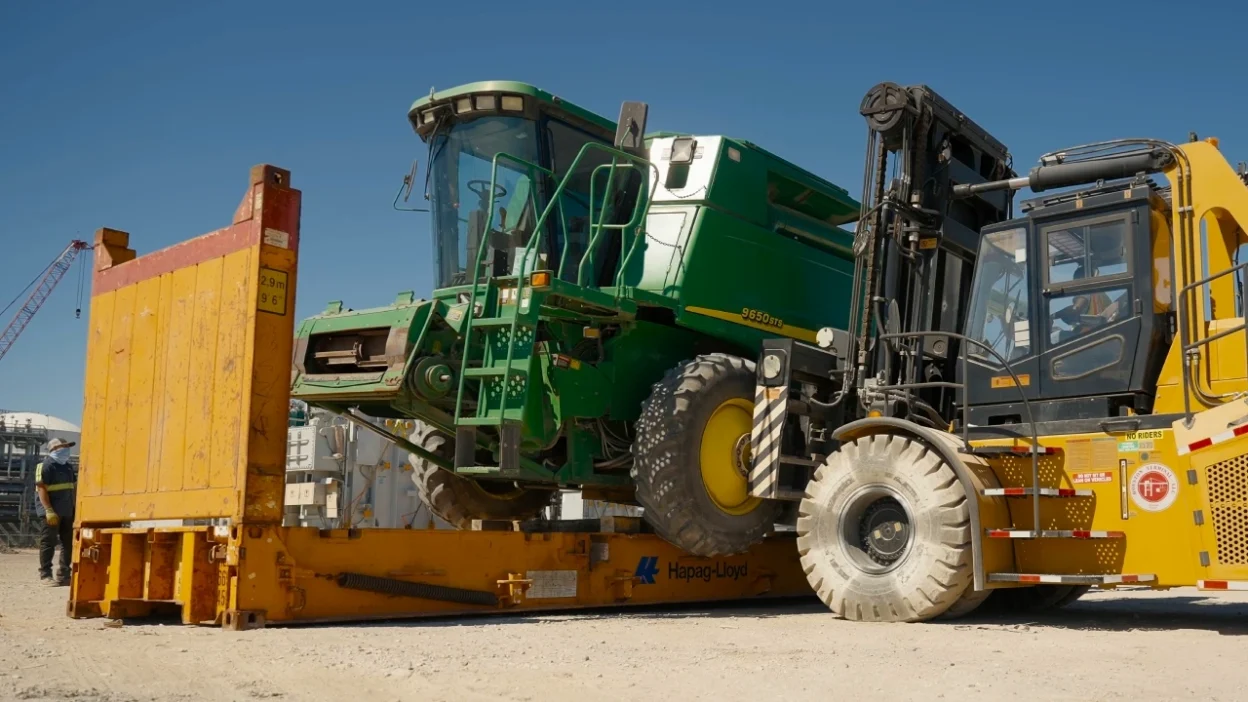
Moving a 20-ton excavator across the ocean differs from mailing a package. It requires precision, heavy-duty logistics, and a deep understanding of international regulations. For construction companies, dealerships, and agricultural operations, international heavy equipment shipping acts as the bridge between a good deal and a profitable investment.
Global trade in machinery is booming. Buyers in South America, Africa, and Asia constantly source high-quality used John Deere, CAT, and Case IH equipment from the United States. However, the logistics process remains a barrier for many. Missteps result in thousands of dollars in fines, stuck cargo, or damaged assets.
This guide breaks down how to ship heavy equipment efficiently. We cover methods, costs, documentation, and preparation strategies to ensure your machinery arrives ready to work.
Why International Heavy Equipment Shipping Matters
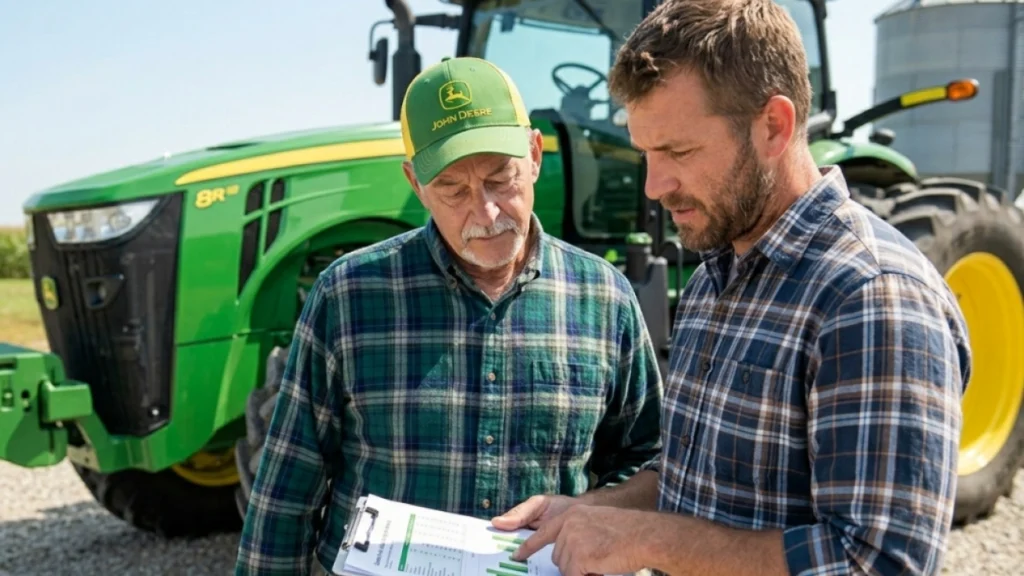
Buying equipment globally opens up a massive inventory. You might find a John Deere 8R tractor in the US for 30% less than the local market value. However, that margin exists only if you manage the shipping correctly.
Heavy equipment shipping is a high-stakes game. A single mistake in customs paperwork can hold a machine at a port for weeks, incurring demurrage (storage) fees that can reach several hundred dollars per day, depending on the port and carrier. Furthermore, improper loading can lead to structural damage that insurance might not cover if negligence is proven.
Successful shipping creates a competitive advantage. It allows access to the global marketplace, specifically platforms like JumboBee, where sourcing and logistics are integrated to lower these risks.
Step-by-Step Heavy Equipment Shipping Guide
Follow this framework to navigate the complexities of moving yellow iron across borders.
Step 1: Assess Type and Size of Equipment
Before requesting a quote, you need precise data. Telling a freight forwarder you have “a big bulldozer” provides insufficient information. The dimensions dictate the shipping method, which dictates the price.
Data points you need:
- Make and model: (e.g., CAT D8T Dozer).
- Precise dimensions: Length, Width, Height (in both imperial and metric).
- Operational weight: Total weight including attachments.
- Attachments: Are buckets, blades, or rippers attached or detached?
Why size matters:
Shipping costs are calculated based on Cubic Meters (CBM) or Revenue Tons.
- Calculation: $Length (m) \times Width (m) \times Height (m) = Volume in CBM$
If your machine exceeds the width of a standard container door, which is typically just over 2.3 meters, depending on container type, disassembly or alternative shipping methods may be required. Learn about all specifications here.
Step 2: Choose Right Shipping Method
Selecting the correct method is the most critical decision in shipping equipment overseas. There are four primary ways to move heavy machinery.
Roll-On/Roll-Off (RoRo)
Best for: Self-propelled, wheeled machinery (tractors, combines, wheel loaders).
RoRo functions as a floating parking garage. Your machine is driven onto the vessel, secured to the deck, and driven off at the destination.
- Pros: Generally, the cheapest option for large, drivable units. Minimal handling risk since cranes are rarely used.
- Cons: Machine must be in running condition (run-and-drive). You cannot pack spare parts or personal items inside the cab (strict customs rule).
- Availability: Not all ports handle RoRo vessels.
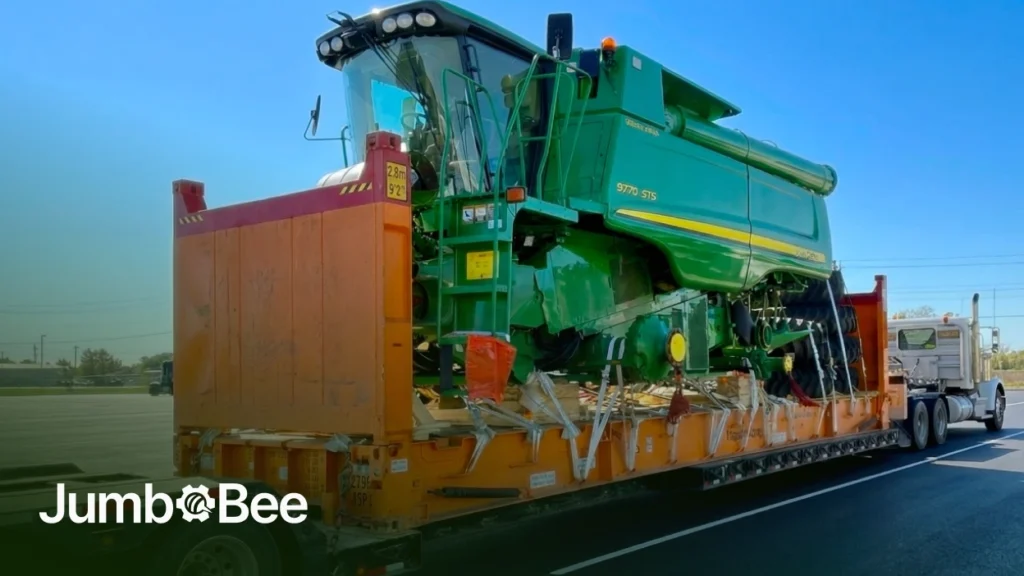
Flat Rack Container
Best for: Oversized or irregular equipment that cannot be driven (static) or is too wide for a standard container.
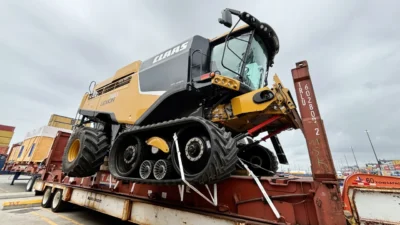
A Flat Rack is a container with no walls or roof — only a floor and ends. Equipment is loaded by crane and strapped down.
- Pros: Protects equipment better than Breakbulk. Good for boats or machinery that does not run.
- Cons: Expensive. If your machine is wider than the rack, you pay for “lost slots” on the ship (space next to your cargo that cannot be used).
Breakbulk Shipping
Best for: Very large, non-containerized machines (huge mining trucks, cranes, large excavators).
This is the traditional method where cargo is loaded individually directly onto the ship’s hold.
- Pros: The only option for massive equipment exceeding all container/RoRo limits.
- Cons: Most expensive and slowest. High risk of damage during loading/unloading due to crane operations.
Standard Container Shipping (FCL – Full Container Load)
Best for: Smaller machinery (skid steers, mini excavators) or large machinery that can be disassembled.
Shipping construction equipment overseas via container is frequently the most cost-effective method if you are willing to do some mechanical work. An excavator can fit into a 40ft High Cube container if the boom, arm, and cab are removed.
- Pros: Lowest freight cost. High security (sealed box). Protects against salt water and weather.
- Cons: Requires professional disassembly and reassembly (D&R) costs.
|
Method |
Cost |
Protection |
Complexity |
|
RoRo |
Low/Med |
Medium |
Low |
|
Container |
Low |
High |
High (Disassembly) |
|
Flat Rack |
High |
Medium |
Medium |
|
Breakbulk |
Very High |
Low |
High |
Step 3: Prepare Documentation and Customs Paperwork
Bureaucracy stops more shipments than bad weather. Shipping heavy equipment overseas requires a specific paper trail.
Essential documents:
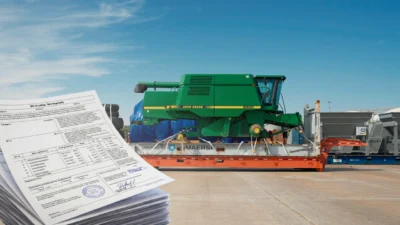
- Bill of Lading (BOL): The contract between you and the carrier. It acts as the receipt and the title of the cargo.
- Commercial invoice: Proof of purchase showing the value (used for tax/duty assessment).
- Packing list: Detailed inventory of everything being shipped (including spare parts).
- Export/import license: Depending on the country, you may need a license to move heavy machinery.
- Certificate of Origin: Proves where the machine was manufactured (vital for trade agreements and tariff reductions).
Common Mistake
Inaccurate descriptions. If you declare a Tractor but ship a Tractor with Loader and Mower, customs may flag the shipment for undeclared goods, leading to fines.
Step 4: Prepare Heavy Machinery for Transport
Preparation focuses on safety and compliance. When figuring out how to ship heavy equipment, you must factor in biosecurity.
Cleaning
Countries like Australia, New Zealand, and the USA have strict agricultural quarantine laws. Equipment must be free of soil, seeds, and organic matter.
- Requirement: High-pressure steam wash.
- Risk: If a single clod of dirt is found at the destination port, the machine may be denied entry, re-exported at your expense, or chemically treated for thousands of dollars.
Mechanical Prep
- Batteries: Disconnect to prevent drainage or fire risk.
- Fluids: Drain fuel to less than 1/4 tank (standard regulation). Check hydraulic lines for leaks.
- Loose parts: Remove or secure anything that could fly off (mirrors, exhaust stacks).
- Space saving: Retract all cylinders. Fold mirrors. The smaller the footprint, the lower the cost.
Step 5: Arrange Insurance and Compliance Checks
Never rely solely on the carrier’s liability coverage. It is usually limited (e.g., $500 per shipping unit) and will not cover the replacement cost of a $150,000 tractor.
Marine Cargo Insurance
You need All-Risk insurance. This covers damage from loading, ocean transit (storms), and unloading.
- Cost: Typically 0.5% to 2% of the cargo value + freight cost.
- Calculation: $(Value of Goods + Freight Cost + 10\%) \times Rate$
You must also ensure adherence to SOLAS Convention safety requirements. International maritime transport is governed by these safety regulations, which define cargo securing, vessel safety standards, and shipper responsibilities during ocean transport.
Compliance
Check the EPA (emissions) standards if importing into the USA or Europe. Importing an older engine that fails to meet Tier 4 Final standards might be illegal in certain jurisdictions.
Step 6: Select Reliable Carrier or Freight Forwarder
Do not book directly with a steamship line unless you are a high-volume shipper. Use a specialized Freight Forwarder.
What to look for:
- Experience: Do they specialize in heavy machinery shipping?
- Network: Do they have agents at the destination port to handle customs clearance?
- Transparency: Do they offer a flat rate, or are there hidden terminal handling charges (THC)?
Step 7: Track and Receive Your Shipment
Modern logistics allows for real-time tracking. Use the container number or booking number on the shipping line’s website.
Upon arrival:
- Inspect immediately: Do not sign release papers until you have inspected the machine for new damage.
- Take photos: If there is damage, photograph it while the machine remains at the port.
- Customs clearance: Your broker will present the docs and pay duties. Once cleared, you can arrange final truck transport to your job site.
Why You Need an Expert in International Shipping for Heavy Equipment
You might excel at construction or farming, but you likely are not a logistics expert. The complexity of international heavy equipment shipping involves coordinating trucks, cranes, wash bays, customs brokers, and ocean vessels.
Value of an Expert Partner
- Regulatory knowledge: Experts know that shipping a combine to Australia requires a specific level of cleanliness that shipping to Mexico does not.
- Cost savings: Logistics partners like JumboBee have volume contracts with shipping lines, passing those savings to you.
- Risk reduction: They handle insurance and vetting of carriers, ensuring your asset is in safe hands.
Working with a platform that integrates sales and logistics means you are not buying only a machine; you are buying the delivery of that machine.
Common Challenges in Shipping Heavy Equipment Overseas
Even with a plan, issues arise. Here is how experts mitigate them.
Port Congestion
Global trade routes (like the Panama Canal or the Red Sea) face delays.
- Solution: Experts re-route cargo to alternative ports or use land-bridge services (shipping to one coast and rail to the other) to save time.
Hidden Fees
Port storage, chassis fees, and detention charges can shock first-time shippers.
- Solution: Get an All-In quote. Ensure your forwarder includes Terminal Handling Charges (THC) and documentation fees in the upfront price.
Capacity Issues
RoRo vessels frequently get booked months in advance.
Solution: Booking 4-6 weeks out is standard. For urgent shipments, experts might recommend disassembly and container shipping, which offers higher availability.
Tips for Reducing Costs When Transporting Heavy Equipment
Profit margins are made in the buying and the shipping. Here is how to lower your heavy machinery shipping bill.
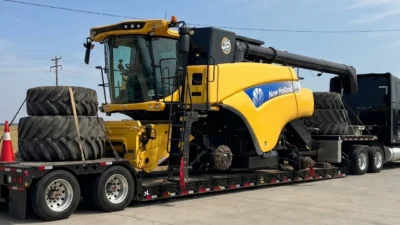
- Dismantle to containerize. This is the biggest money saver. A large harvester might cost $15,000 to ship RoRo because of its volume. If you remove the tires and header, it might fit into a 40ft container for $6,000. Even with $2,000 in labor for disassembly/reassembly, you save $7,000.
- Consolidate shipments. If buying attachments (buckets, forks), do not ship them separately. Put them inside the container with the machine. You pay for the space regardless; fill it up.
- Plan for stackability. If shipping multiple units, ask if they can be stacked. Some flat racks allow for double stacking of smaller frames, effectively halving the ocean freight cost per unit.
- Buy near the port. If exporting from the USA, buying a machine in Georgia (near Savannah port) is cheaper than buying one in North Dakota and trucking it 1,500 miles to the ocean. Internal trucking costs are expensive—frequently $3 to $5 per mile for heavy loads.
Final Thoughts: Smooth and Reliable Heavy Equipment Shipping
Transporting heavy equipment across the world is a manageable process if you respect the logistics. It requires assessing dimensions, choosing the right method (RoRo vs. Container), and preparing meticulous documentation.
The difference between a nightmare shipment and a smooth delivery lies in the quality of your logistics partner. You need a team that understands not just the shipping lanes, but the machinery itself — how to load it, how to clean it, and how to clear it through customs.
Partner with JumboBee’s logistics team for expert support.
JumboBee operates as an integrated marketplace where equipment sourcing and international shipping are handled as part of the same process. Our integrated global shipping solutions ensure that the price you see includes a clear path to your door. Whether you need disassembly services, inspections, or cargo insurance, we handle the heavy lifting so you can focus on the job site.





Be the first to leave a comment
There are no replies to this post yet. Share your thoughts and help start the conversation.