


 Shipping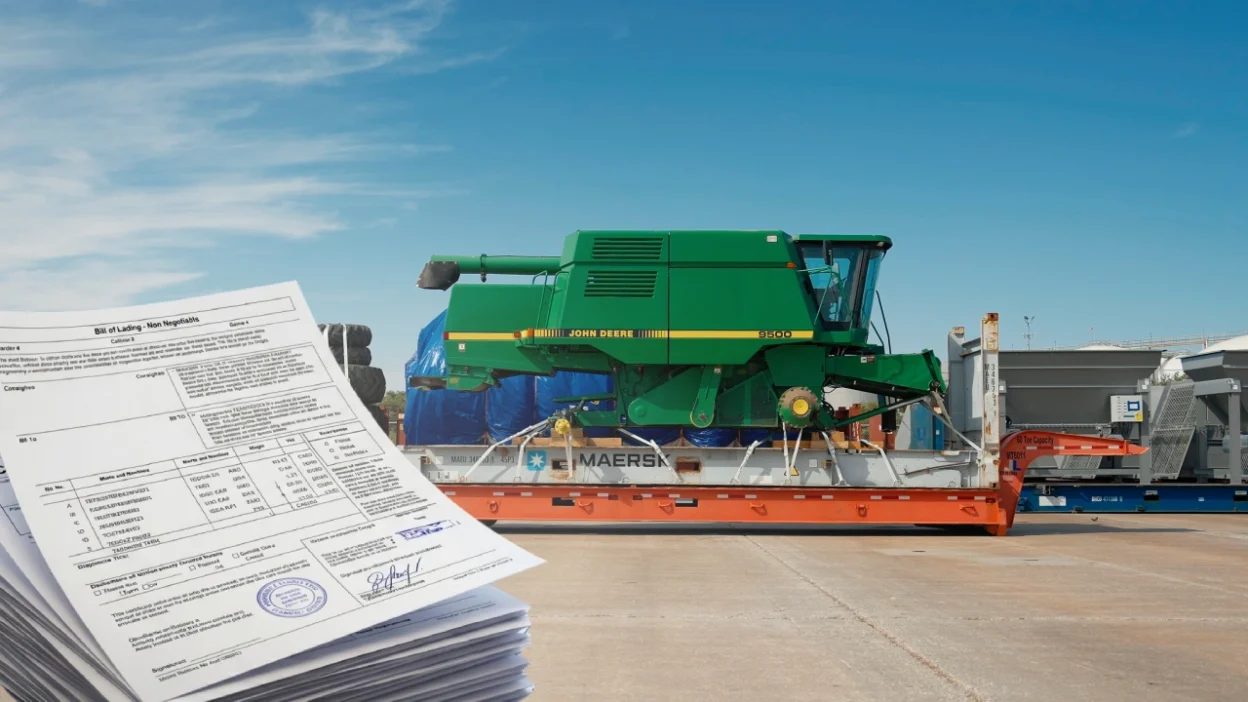
Selling heavy machinery locally is straightforward. You agree on a price, sign a bill of sale, and hand over the keys. Selling that same excavator or tractor across borders is a different game. The moment equipment leaves your country, it enters a complex web of regulations, taxes, and security checks.
Success in the global market doesn’t just depend on the quality of your machine. It depends on the quality of your paperwork.
This guide is a practical compliance manual for sellers exporting equipment. We will explain which international shipping documents are required, how they function during customs clearance, and how to ship documents internationally without incurring delays or legal risks. We focus on real-world scenarios for heavy machinery — where a simple typo in a serial number can leave a $400,000 combine harvester stranded at a port for weeks.
Why Customs Documentation Matters When Selling Equipment Internationally
Most first-time exporters assume that logistics is just about moving metal from Point A to Point B. In reality, the physical movement is the easy part. The flow of information — represented by your documentation — is what actually moves the cargo.
If your paperwork is perfect, your equipment flows through borders like water. If your paperwork is flawed, your equipment hits a brick wall.
Financial, Legal, and Compliance Risks
Bad documentation costs money. It is not just about a customs officer asking you to fix a typo.
Demurrage and Detention Fees
Ports are not parking lots. If your equipment arrives at the destination port but cannot clear customs because of missing documents required for international shipping, the terminal charges you storage fees.
Example calculation: Port storage (demurrage) runs $200 to $500 per container or flat rack per day. If a document creates a 10-day delay, that is $2,000–$5,000 in unexpected costs.
Fines and Seizures
Customs authorities take misdeclaration seriously. If you classify a construction crane incorrectly to lower the duty rate, you aren’t just risking a correction; you are risking fraud charges. In severe cases, customs can seize the equipment entirely.
Buyer-Seller Disputes
If the equipment is stuck in customs, the buyer cannot use it. This leads to the buyer refusing to pay the final balance or demanding compensation. Accurate documentation protects your revenue.
How Documentation Impacts Customs Clearance and Delivery Time
Customs officers do not inspect every single container physically. They use a risk-based assessment system. Your documentation is the data they feed into this system.
- Clean documentation: The system flags the shipment as Low Risk. The equipment is cleared electronically before the ship even docks.
- Messy documentation: Inconsistent values, vague descriptions (e.g., labeling a high-tech harvester simply as a farm truck), or missing HS codes trigger a Red Flag. This leads to physical inspections, which can take weeks and cost thousands of dollars in labor to unpack and repack the equipment.
Core International Shipping Documents Explained
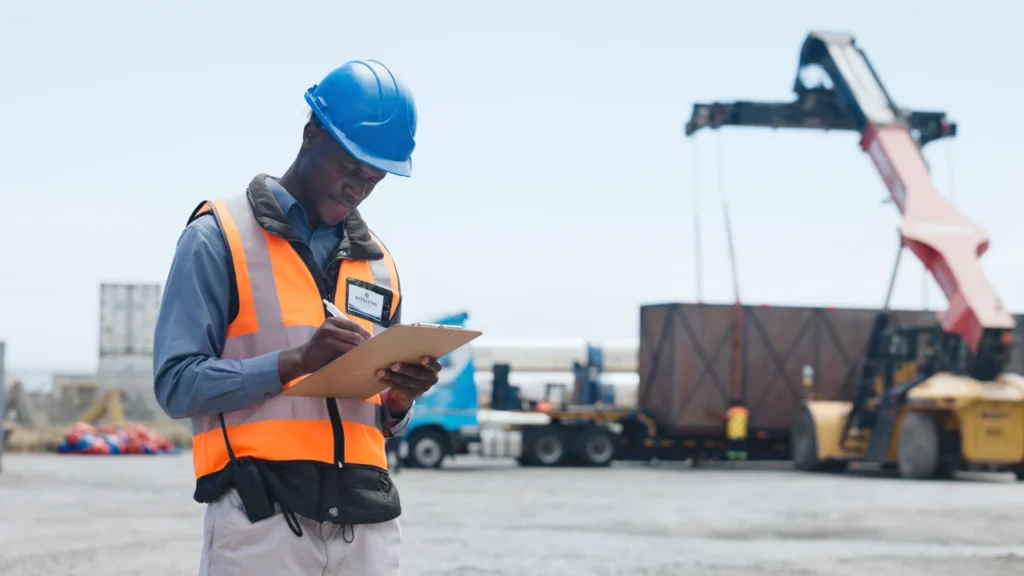
To successfully move heavy equipment, you must master a specific set of documents. These form the backbone of international trade.
Commercial Invoice
This is more than just a bill. It is the primary document customs uses to assess duties and taxes.
What Customs Requires
Unlike a domestic receipt, an international commercial invoice must include:
- Full seller and Buyer details: Names, addresses, and tax ID numbers.
- Incoterms: The agreed terms of sale (e.g., CIF, FOB).
- Detailed description: “Used 2019 Caterpillar 320 Excavator” is better than “Excavator”.
- HS code: The Harmonized System code that classifies the product for taxes.
- Country of origin: Where the machine was manufactured, not just where it is shipping from.
- Value: Unit price and total value in the currency of the transaction.
Common Mistakes in Equipment Sales Invoices
A frequent error is under-declaring the value to help the buyer save on taxes. This is illegal. Another mistake is failing to list attachments separately. If you are shipping a tractor with a separate plow attachment, list them as line items. If the customs officer sees two distinct items but only one on the invoice, they will hold the shipment.
Packing List
While the invoice focuses on the financial aspect (value), the packing list focuses on the physical aspect (logistics).
Why It Matters for Heavy Equipment
For standard boxes, a packing list is simple. For heavy machinery, shipped on flat racks or RORO (Roll-on/Roll-off), it is critical. It tells customs and port workers:
- Net and gross weight: Crucial for crane safety.
- Dimensions: Length, width, and height.
- Cubic meters (CBM): Used to calculate freight costs.
- Content breakdown: If a harvester is partially disassembled to fit in a container, the packing list must detail which box contains the tires, the cab, and the header.
Bill of Lading
The Bill of Lading (BOL or B/L) is the most important legal document in shipping. It serves three functions:
- Receipt of Goods: Proof that the carrier received the cargo.
- Contract of Carriage: The agreement between the shipper and the carrier.
- Document of Title: Whoever holds the original BOL owns the goods.
Ocean Bill of Lading vs Air Waybill
- Ocean Bill of Lading: Used for sea freight. It can be negotiable, meaning ownership can be transferred while the goods are at sea.
- Air Waybill (AWB): Used for air freight (rare for heavy equipment unless it is urgent spare parts). An AWB is non-negotiable; the goods are consigned directly to a specific party.
Shipper, Consignee, and Notify Party
- Shipper: Usually the seller.
- Consignee: The party receiving the goods (usually the buyer).
- Notify Party: The party – often the buyer, their freight forwarder, or customs broker — who must be alerted when the vessel arrives at the destination port so they can prepare for customs clearance and cargo pickup.
Certificate of Origin
Some countries require proof of where the equipment was made to determine duty rates.
Preferential Trade Agreements
If you are shipping a US-made tractor to a country with a Free Trade Agreement with the US, the buyer might pay 0% duty. To claim this, you need a Certificate of Origin. Without it, the buyer pays the standard tariff, which could be 20% or higher.
Export Declaration
Governments want to know what is leaving their country for security and economic reasons.
Filing Requirements
In the United States, this is known as the Electronic Export Information (EEI) filed through the Automated Export System (AES). The AES system is administered by the US Census Bureau for trade statistics purposes, and by the Bureau of Industry and Security (BIS) for export control. You can learn more at the Census Bureau’s AES resources or Trade.gov. If you fail to file, CBP enforces compliance at the port of export and can stop the cargo from leaving the country.
- Threshold: Required when the value of goods under a single Schedule B/HTS classification number exceeds $2,500, shipped from one exporter to one recipient on the same day. Filing is also mandatory at any value if an export license is required. For heavy machinery, which almost always exceeds this threshold and carries a single HS code, EEI filing should be treated as a standard requirement on every export.
- Responsibility: The US Principal Party in Interest (USPPI) – usually the seller – is responsible for accurate and timely filing. Failure to file is enforced by CBP at the port of export, and can result in the cargo being held, civil penalties of up to $10,000 per violation, or loss of export privileges.”
Additional Documents Required for International Shipping of Equipment
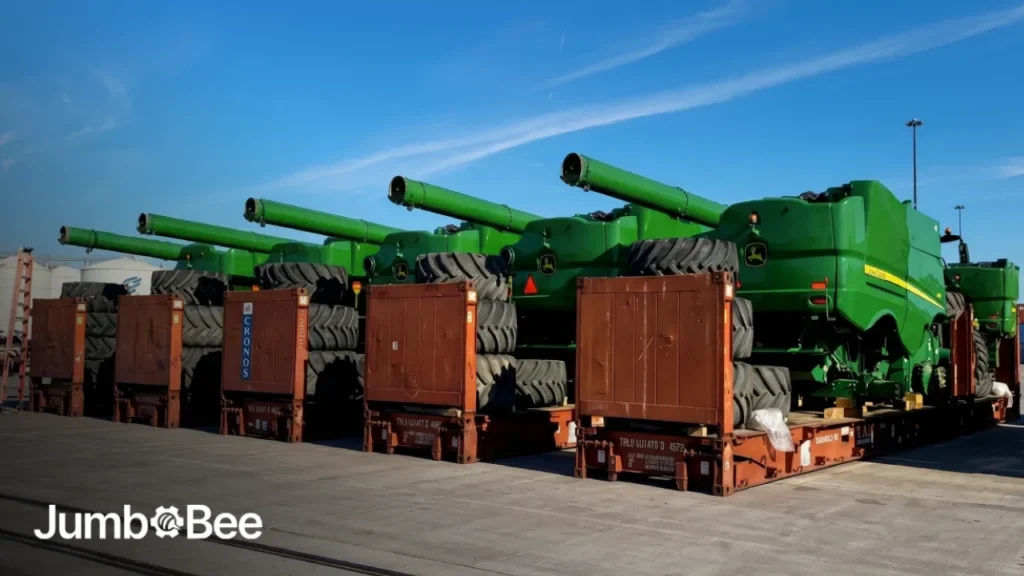
Beyond the core four documents, heavy machinery triggers specific regulatory requirements.
Export License and Restricted Goods Documentation
Not all equipment can be shipped everywhere.
Dual-Use Goods
Some heavy machinery is considered dual-use, meaning it has both civilian and military applications. For example, certain high-specification excavators or off-road trucks could be used to build military fortifications.
Check: You must check your equipment against the Commerce Control List. If your machine has an Export Control Classification Number, you may need a license from the Bureau of Industry and Security before you ship.
Sanctions
Shipping to sanctioned countries (e.g., Iran, North Korea, parts of Russia) is strictly prohibited or heavily restricted. Documentation proving the ultimate end-user is required to ensure you aren’t violating international sanctions.
Customs Value Declaration
Customs duties are calculated on the Landed Cost, not just the invoice price.
Declared Value vs Transaction Value
Many countries, including the EU, Australia, and most of Asia, use the CIF value (Cost, Insurance, and Freight) as the basis for import duty calculations. However, the United States uses the FOB value – freight and insurance costs are excluded from the dutiable value. Always confirm the valuation method with a broker in the destination country before quoting the buyer a landed cost estimate.
Calculation: For countries that use CIF valuation (EU, Australia, most of Asia): Invoice Price + Shipping + Insurance = Taxable Value. For the United States, which uses FOB valuation, only the Invoice Price and inland freight to the US port of export are included – international freight and insurance are excluded from the dutiable value.
You may need a separate Customs Value Declaration form to break these costs down for the import authorities.
Insurance Certificate
This document proves that the cargo is insured against loss or damage.
Matching Terms
If you sell under the Incoterm CIF (Cost, Insurance, and Freight), you (the seller) are legally obligated to provide the buyer with an insurance certificate. It must cover at least 110% of the CIF contract value. Note that under CIF, the minimum coverage required is Institute Cargo Clauses (C), which only covers named perils. For high-value machinery, buyers should negotiate Clauses (A) – all-risk coverage – in the contract.
Documents Required When Selling Used Equipment Internationally
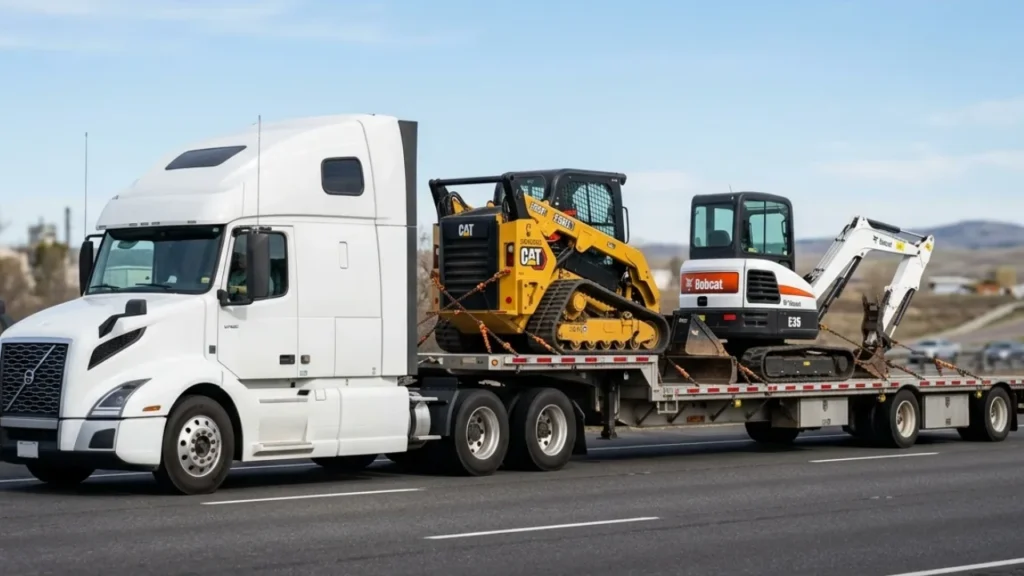
Selling used equipment adds a layer of complexity regarding ownership and biosecurity.
Proof of Ownership and Title
You cannot export what you do not own.
Preventing Fraud
For used self-propelled vehicles and equipment – including tractors, excavators, trucks, and self-propelled agricultural machinery – US Customs requires the original Certificate of Title and, where a lien exists, written authorisation from the lienholder permitting export (19 CFR 192).
Non-self-propelled equipment such as towed implements or static machinery does not fall under this rule, but a clean bill of sale and lien release remains best practice for all used equipment.
You must provide the original Title (for vehicles) or a notarized Bill of Sale and proof of lien release. This proves the machine is free of financial encumbrances.
Equipment Condition and Inspection Reports
Biosecurity is a major issue for agricultural and construction machinery.
Soil and Contamination
Countries like Australia, New Zealand, and the USA have strict rules about importing soil. Soil can carry pests, seeds, and diseases.
Cleaning declaration: You need a certificate stating the machine has been steam-cleaned and is free of soil, plant matter, and animal debris. If a machine arrives dirty, it will be quarantined and cleaned at the buyer’s expense (which is incredibly expensive), or re-exported.
Serial Numbers and Equipment Identification
Traceability is key.
Verification
Customs will physically check the VIN (Vehicle Identification Number) or PIN (Product Identification Number) plate on the machine.
The number on the metal plate must match the number on the Commercial Invoice, Bill of Lading, and Title exactly. A single-digit error causes massive delays.
Incoterms and Their Impact on Shipping Documents
Incoterms (International Commercial Terms) determine who is responsible for which documents. For official definitions and rules, refer to the ICC Incoterms 2020.
How Incoterms Define Documentation Responsibility
Incoterms clarify the handover point. They dictate who arranges transport, who pays duties, and who handles the paperwork.
Most Common Incoterms Used in Equipment Sales
| Incoterm | Name | Seller’s Doc Responsibility | Buyer’s Doc Responsibility |
|---|---|---|---|
| EXW | Ex Works | Minimal. Provide goods and a commercial invoice. | High. Buyer handles export clearance, transport, and import. Note: risky for the seller too — export control and sanctions compliance obligations remain with the seller regardless of Incoterm. EXW is generally not recommended for international equipment sales. |
| FOB | Free On Board | Export clearance (license, EEI) and getting goods to the port. | Ocean freight, insurance, and import clearance. |
| CIF | Cost, Insurance, Freight | Export clearance, ocean freight, and an insurance certificate. | Import clearance and duties. |
| DAP | Delivered at Place | All export docs, freight, and delivery to named destination (unloaded by buyer). | Import customs clearance, duties, and unloading. |
| DDP | Delivered Duty Paid | Maximum. The seller does everything, including import clearance and paying taxes. | Minimal. Just receiving the goods. |
How to Ship Documents Internationally Safely
Once you have created the documents, you have to get them to the buyer. Do not just tape them to the tractor.
Physical vs Electronic Shipping Documents
The world is going digital, but shipping is old-school.
- Originals: Many countries still require the Original Bill of Lading (3 paper copies) to release the cargo. You cannot email these. They must be physically couriered.
- Telex release: In some cases, you can surrender the originals at the origin port and have the carrier email the destination agent to release the goods. This is faster but requires trust between buyer and seller.
Document Timing and Coordination
Here, speed matters.
- Ship sails: You get the Bill of Lading.
- Courier docs: You must send the full set of original documents (Invoice, Packing List, BOL, Cert of Origin) to the buyer via DHL/FedEx immediately.
- Arrival: The documents must arrive before the ship. If the ship arrives on Monday and the docs arrive on Wednesday, the cargo sits in storage for two days (demurrage charges apply).
Working With Freight Forwarders and Customs Brokers
Unless you have a dedicated logistics department, do not try to generate these documents from scratch.
- Freight forwarders: They can issue the Bill of Lading and help with the Export Declaration.
- Customs brokers: They act as the bridge between you and the government, ensuring classification codes are correct.
JumboBee integrates these services. Instead of hiring a separate broker, forwarder, and courier, the platform manages the document flow alongside the physical shipment.
Common Documentation Mistakes in International Equipment Sales
Avoid these three pitfalls to ensure a smooth sale.
Incorrect HS Codes
The Harmonized System code determines the duty rate.
- Mistake: Using a generic code for Machinery Parts (high duty) instead of the specific code for Agricultural Harvesters, which attracts lower or zero duty in many markets. The correct code can mean the difference between a 5–15% duty rate and near-zero, depending on the destination country and any applicable trade agreements.
- Fix: Use an HS code lookup tool or consult the World Customs Organization (WCO) or a broker to classify your specific model.
Mismatched Values Across Documents
- Mistake: The Commercial Invoice says the value is $50,000. The Export Declaration says $48,000 (perhaps excluding an attachment).
- Consequence: Customs flags this as potential fraud or money laundering. All documents must match to the penny.
Missing or Late Documents
- Mistake: Forgetting the Certificate of Origin until after the goods ship.
- Consequence: In most countries, a Certificate of Origin must be issued before or at the time of export to qualify for preferential duty rates. A late or post-shipment certificate is not guaranteed to be accepted. Many countries allow retrospective issuance only under strict conditions — such as clerical error or force majeure — and not all FTAs permit it at all. Even where a refund claim is technically possible, it requires additional filings, delays payment resolution, and may be rejected. The safest position is to treat the Certificate of Origin as a pre-shipment document without exception.
Documentation Checklist for Selling Equipment Internationally
Use this checklist for every transaction.
Pre-Shipment Document Checklist
- [ ] Commercial Invoice: Signed, stamped, with HS codes and Incoterms.
- [ ] Packing List: Detailed weights and dimensions.
- [ ] Proof of Ownership: Title or Bill of Sale (free of liens).
- [ ] Export License: If required for dual-use goods.
- [ ] Cleaning Certificate: If shipping used equipment to strict regions.
Customs Clearance Document Checklist
- [ ] Bill of Lading: Originals or Telex Release instructions.
- [ ] Certificate of Origin: If applicable for tax reduction.
- [ ] Insurance Certificate: If selling CIF.
- [ ] Customs Value Declaration: If required by the destination country.
Post-Shipment Record Keeping
- [ ] Proof of Export: Keep all export documentation for 5 years from the date of export, as required by FTR §30.10. This includes the AES filing, Bill of Lading, Commercial Invoice, Packing List, any export licenses, and relevant correspondence. This is your proof to your local tax authority that the sale was tax-exempt (VAT/GST) as an export.
Conclusion
Documentation is not just paperwork; it is the key to the border. In the world of international heavy equipment sales, a missing document is just as bad as a missing engine. Accurate, timely, and compliant international shipping documents ensure that your buyer receives their machine on time and you receive your payment without dispute.
The complexity of HS codes, export filings, and biosecurity forms is why many sellers hesitate to go global. However, the global market offers higher prices and more demand.
You do not have to navigate this bureaucracy alone. JumboBee offers more than just a marketplace for buying and selling heavy equipment. Our integrated logistics services handle the heavy lifting of compliance for you. From export declarations to door-to-door delivery documentation, we ensure your sale is safe, legal, and efficient.
Stop worrying about paperwork and start selling to the world. Visit JumboBee today to list your equipment or find your next machine with full logistics support.
The mandatory documents usually include the Commercial Invoice, Packing List, Bill of Lading (or Air Waybill), and Export Declaration. Depending on the destination and equipment type, you may also need a Certificate of Origin, Insurance Certificate, and specific cleaning/inspection reports.
This depends on the Incoterms agreed upon. Generally, the seller is responsible for export documentation (licenses, export filing), and the buyer is responsible for import documentation (import declaration). However, the seller must provide the buyer with the necessary paperwork (Invoice, BOL) to facilitate that import.
For the movement of the cargo, electronic data is used. However, for the legal release of the goods at the destination, many countries still require original paper documents (especially the Bill of Lading and Certificate of Origin). Always check with the destination agent before relying solely on digital copies.
Incorrect documents lead to customs holds. This results in demurrage fees (storage costs at the port), potential fines for misdeclaration, and significant delivery delays. In worst-case scenarios, the cargo can be seized or returned to the origin at the seller’s expense.


Be the first to leave a comment
There are no replies to this post yet. Share your thoughts and help start the conversation.