


 Shipping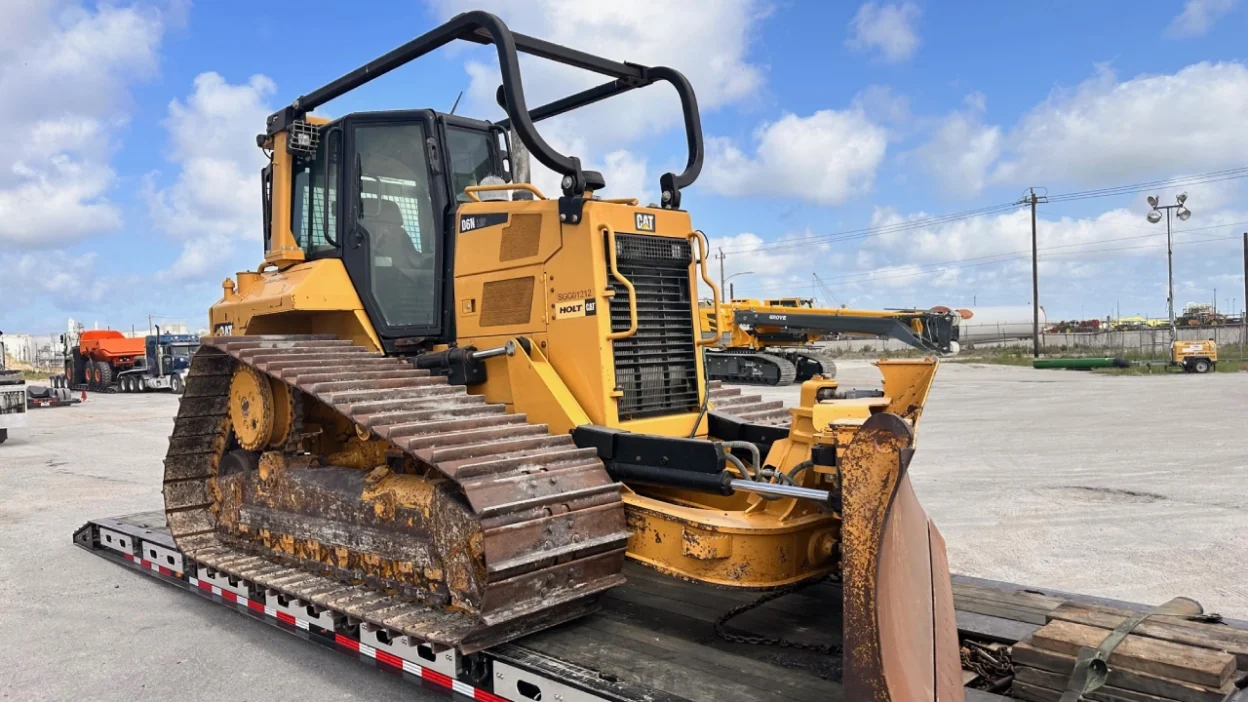
Saudi Arabia is building at a scale that few countries have attempted in modern history. NEOM, the Red Sea Project, Diriyah Gate, King Salman Energy Park – these are not small developments. They are multi-decade, multi-billion-dollar programs that require enormous quantities of heavy equipment: excavators, cranes, loaders, graders, compactors, drilling rigs, and agricultural machinery. And a large share of that equipment is coming from the United States.
If you are a U.S. seller, an international dealer, or a Saudi buyer planning to move heavy machinery across the Atlantic and through the Arabian Peninsula, this guide is built for you. It walks through everything you need to know about shipping to Saudi Arabia from the USA in 2026: export compliance, documentation, shipping methods, customs rules, realistic costs, and common mistakes that slow shipments down.
Why Export Equipment to Saudi Arabia in 2026?
Construction and Infrastructure Boom
Saudi Arabia’s Vision 2030 program has moved from planning phase into full execution. The Public Investment Fund is deploying capital into infrastructure at a pace not seen in the Gulf in decades. Active construction projects include:
- NEOM smart city (ongoing through 2030+)
- Qiddiya entertainment and sports city
- Red Sea luxury resort development
- King Salman International Airport expansion in Riyadh
- Downstream petrochemical facilities in Jubail and Yanbu
All of these projects require earthmoving, lifting, grading, and material handling equipment – and demand consistently outpaces local supply. Saudi Arabia’s construction equipment market has been valued in the multi-billion dollar range by industry analysts, with the United States consistently among the top supplying countries.
Demand for Used U.S. Equipment
American-made heavy equipment carries a strong reputation in Saudi Arabia. Brands like Caterpillar, John Deere, Komatsu (U.S.-assembled), Case, and Volvo are well-recognized and supported by dealer networks within the Kingdom. Used equipment from the U.S. offers a significant price advantage over new units, while typically arriving in better mechanical condition than comparable used equipment from closer regions.
A used 2019 Caterpillar 320 excavator with 3,000 hours might be priced at $85,000–$95,000 in the U.S., where equivalent capacity in Saudi Arabia could command $120,000 or more – making the logistics cost of shipping equipment to Saudi Arabia from the USA a profitable trade even after freight, duties, and clearance.
Step 1: Verify Export Eligibility in the U.S.
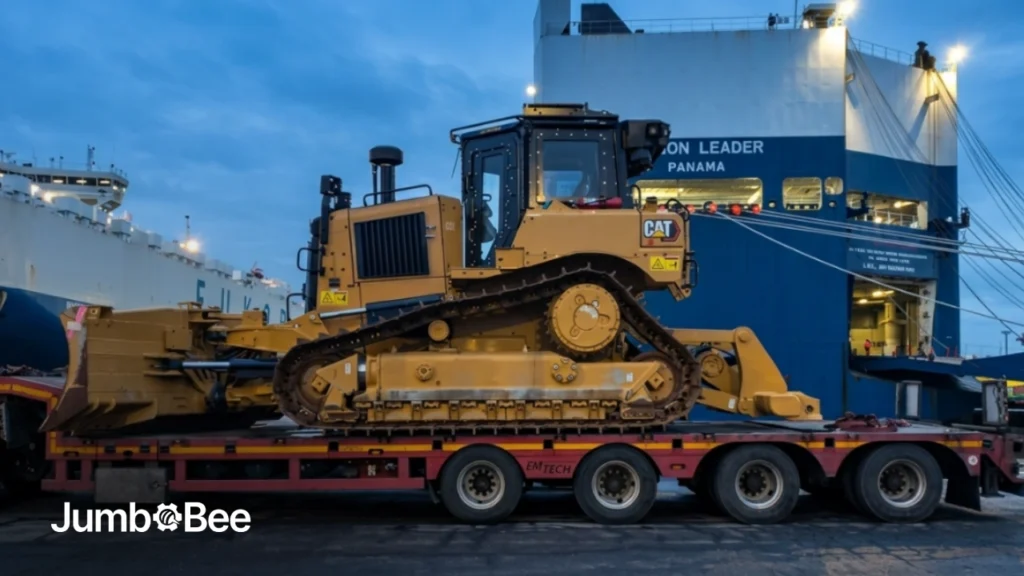
Before you arrange any shipping to Saudi Arabia from the USA, you need to confirm the equipment can legally leave the country.
Export Control Regulations
Most commercial heavy equipment – excavators, loaders, tractors, cranes – does not require an export license. But not everything qualifies as straightforward commercial cargo.
Start by identifying the Export Control Classification Number (ECCN) for the machinery. This classification determines whether the item falls under Export Administration Regulations managed by the Bureau of Industry and Security. Most standard construction and agricultural equipment is classified as EAR99, meaning it is subject to minimal export control and generally does not require a license for shipment to Saudi Arabia.
However, if the equipment includes advanced positioning systems, dual-use components, or specialized electronics – think precision agriculture tech or GPS-guided grading systems – you may need to verify the classification more carefully before proceeding with shipping equipment to Saudi Arabia.
AES Filing Requirements
Any U.S. export with a total value over $2,500 per Schedule B commodity code, or that requires an export license, must be reported through the Automated Export System. This is called filing Electronic Export Information.
For heavy equipment, this is almost always required. The filing is done through the Automated Commercial Environment portal managed by the U.S. Census Bureau. You will need the Schedule B number for the equipment, the consignee’s details, and shipping information. Your freight forwarder can handle this filing on your behalf, but you, as the exporter, remain legally responsible for its accuracy.
Step 2: Prepare Required Export Documentation
Missing a single document can hold your shipment at port for days or weeks. Here is the core export document set:
- Commercial Invoice – describes the equipment, declares its value, identifies buyer and seller
- Bill of Sale – confirms legal transfer of ownership
- Packing List – details dimensions, weight, contents of each shipping unit
- Bill of Lading – the contract between shipper and ocean carrier; also serves as the title document during transit
- Certificate of Title / Lien Release – critical for used equipment; Saudi customs requires proof the equipment is free of liens
- Export License – only if required by BIS classification
- AES Filing Confirmation (ITN number) – Internal Transaction Number generated after AES filing
For used equipment specifically, a clean title is non-negotiable. If there is an outstanding loan or lien on the machine, the lender must issue a lien release before the equipment can be legally exported. This step is frequently overlooked and causes serious delays.
Planning to move construction or agricultural equipment internationally? Getting your documentation right before the machine leaves the yard is far cheaper than sorting it out at port.
Step 3: Understand Saudi Arabia Import Requirements
Saudi Customs Regulations
Saudi Arabia’s customs authority is the Zakat, Tax and Customs Authority. All imported equipment must be classified under the Harmonized System (HS) code, which determines the applicable duty rate.
For most heavy construction equipment, import duties in Saudi Arabia are 0%–5%. Agricultural machinery typically falls at 0%–5% as well. However, Value Added Tax (VAT) of 15% is applied to most imports – including equipment – based on the customs value (equipment price + freight + insurance). This VAT is usually recoverable for registered Saudi businesses.
Example
If you are shipping an excavator with a purchase price of $90,000, ocean freight of $4,500, and marine insurance of $1,000, the CIF customs value is $95,500. Duty at 5% = $4,775. VAT at 15% applies to customs value plus duty: ($95,500 + $4,775) × 15% = $15,041.
Total import taxes: approximately $19,816.
Always verify the exact HS code with your customs broker before filing. Misclassification is one of the most common reasons shipments are held at Saudi ports.
SASO and Product Compliance
The Saudi Standards, Metrology and Quality Organization regulates product conformity for all goods entering Saudi Arabia. Conformity assessment is now managed through SABER, SASO’s mandatory electronic platform that connects importers, accredited certification bodies, and Saudi customs in a single online system.
Every shipment, regulated or not, must be registered in SABER before it arrives. For each consignment, the Saudi importer must obtain a Shipment Certificate of Conformity (SCoC) through the platform; without it, the cargo will not clear customs. For regulated product categories, which can include machinery with electrical systems, safety devices, or emissions-relevant components, an additional Product Certificate of Conformity (PCoC) issued by a SASO-accredited certification body is required before the SCoC can be issued. The PCoC is valid for one year and covers all shipments of that product model during the period.
One critical change from prior practice: Letters of Undertaking that previously allowed shipments to enter Saudi Arabia pending documentation are no longer accepted. If a shipment arrives without the required SABER certificates already registered, the consequence is re-export at the importer’s expense — not a delay or a fine. This makes pre-shipment SABER compliance a hard prerequisite, not a step that can be corrected on arrival.
Your Saudi importer is responsible for initiating the SABER registration process. Confirm with them, and with your customs broker, which certificate tier applies to your specific equipment category well before the shipment departs.
Shipping Methods from U.S. to Saudi Arabia
Container Shipping
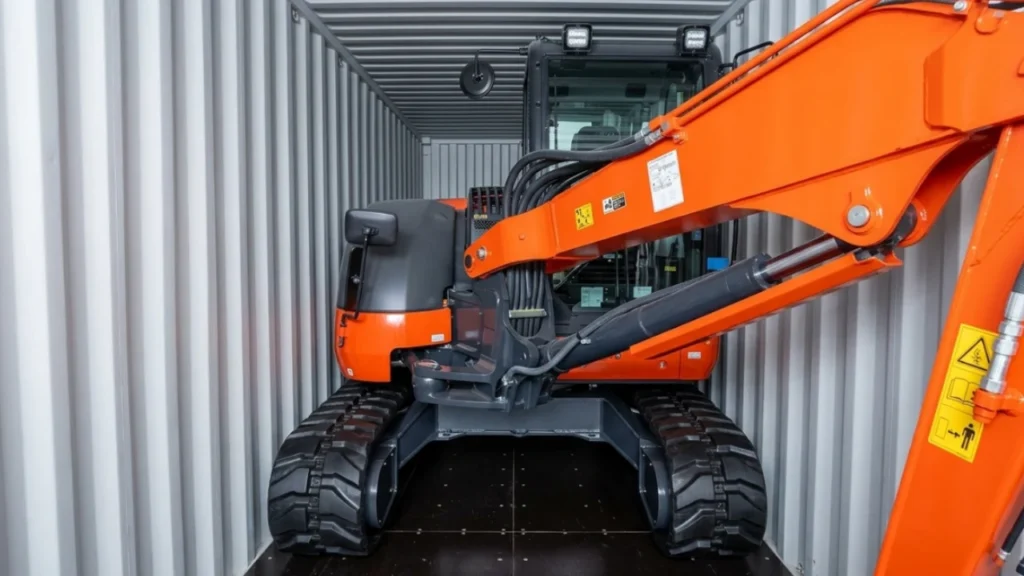
Best suited for smaller equipment – compact track loaders, skid steers, small tractors, attachments, and components. Equipment is loaded into a 20-foot or 40-foot container (or a 40-foot high-cube for taller machines). Containers offer the best protection from weather and handling damage, and container shipping to Saudi Arabia from the USA is often the most cost-efficient option for machines that fit within standard dimensions.
A typical 40-foot container can fit a compact excavator (up to about 8 tons) or a mid-size wheel loader with the bucket detached.
Roll-On/Roll-Off (RoRo)
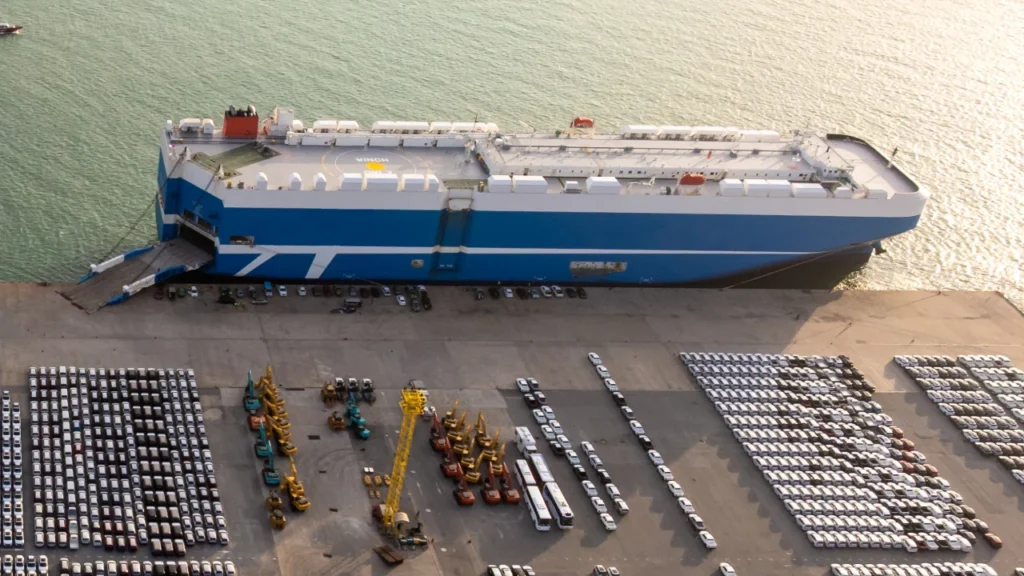
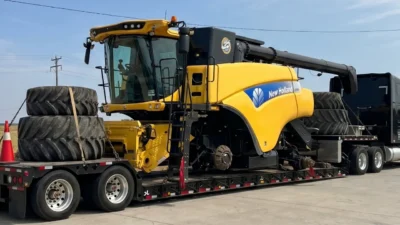
RoRo vessels carry wheeled or tracked equipment that is driven or towed on and off the ship using ramps. This is the most commonly used method for shipping equipment to Saudi Arabia at a larger scale – excavators, bulldozers, motor graders, and large tractors all ship well via RoRo.
Cost advantage is significant: RoRo rates are generally 20–35% lower than flat-rack or breakbulk for standard self-propelled machinery. The tradeoff is less protection from weather and salt air during transit.
Breakbulk Cargo
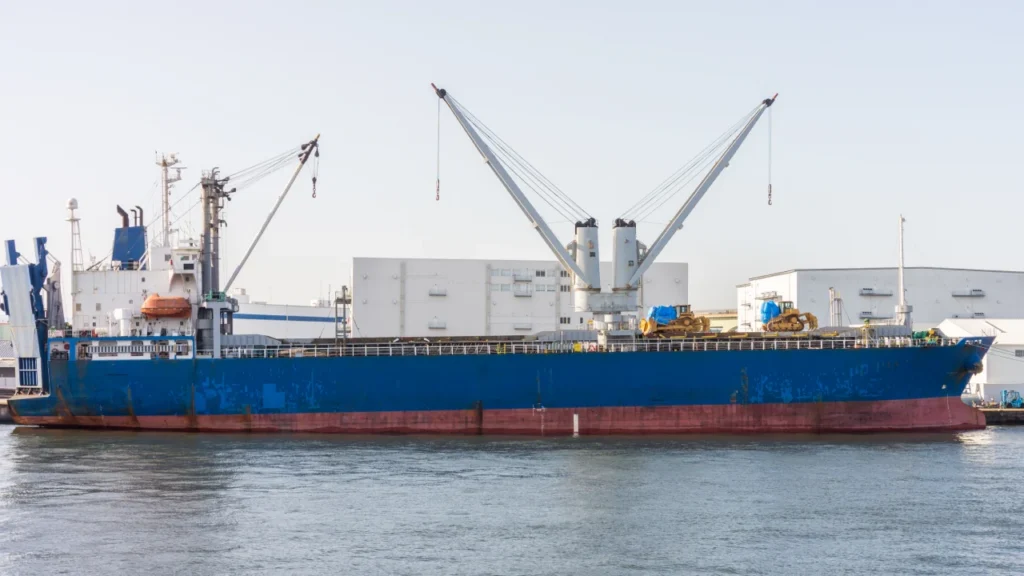
For oversized or non-standard equipment – large cranes, wide-track machines, long boom sections, or equipment that cannot be driven – breakbulk is the method. The equipment is lifted onto the vessel using crane equipment and secured in the hold or on deck. Rates are higher, handling is more complex, and scheduling requires more lead time.
Major U.S. Export Ports for Saudi Shipments
| Port | Best For | Advantage |
|---|---|---|
| Houston, TX | Construction and oilfield equipment | Closest major port to Texas dealers; strong RoRo infrastructure |
| Savannah, GA | Agriculture and mixed cargo | High-volume container port; competitive rates |
| Baltimore, MD | RoRo and project cargo | One of the most active RoRo ports on the East Coast |
| New York / New Jersey | Mixed cargo, breakbulk | Largest port complex on East Coast; broad carrier options |
Houston is typically the preferred origin for equipment heading to Saudi Arabia, particularly for oilfield-adjacent machinery and large construction equipment. Transit to Jeddah or Dammam from Houston runs approximately 22–28 days depending on the carrier and routing.
Major Saudi Ports for Heavy Equipment
- Jeddah Islamic Port – Primary gateway on the Red Sea coast; handles the largest volume of containerized and RoRo cargo; preferred entry point for western Saudi Arabia and Riyadh-bound freight
- King Abdulaziz Port (Dammam) – Main port on the Arabian Gulf coast; serves the Eastern Province, Jubail Industrial City, and oilfield operations
- King Abdullah Port (Rabigh) – Newer facility with modern infrastructure; growing in capacity for project and industrial cargo
Your choice of Saudi port should align with where the equipment will be used. Shipping to Dammam for a project in Jubail saves significant inland transport costs compared to routing through Jeddah.
How Much Does It Cost to Ship Equipment to Saudi Arabia?
Costs vary significantly based on equipment size, origin location, shipping method, and current freight rates. Here is a realistic breakdown as of early 2026:
Inland Transport in the U.S.
Moving a machine from a dealer yard to the export port typically costs $1.50–$4.00 per loaded mile for flatbed transport. A 300-mile haul from a Dallas dealer to Houston port might run $900–$1,500 for a mid-size excavator.
Port Handling Fees
Port terminal fees on the U.S. side – documentation, loading, and handling – typically run $300–$800 for containerized cargo and $500–$1,200 for RoRo, depending on the port and equipment weight.
Ocean Freight Costs
| Equipment | Method | Approx. Ocean Freight (Houston to Jeddah) |
|---|---|---|
| 20-ton excavator (Cat 320 class) | RoRo | $3,500–$5,500 |
| Wheel loader (large, 170 HP+) | RoRo | $4,000–$6,500 |
| Agricultural tractor (200 HP) | RoRo or container | $2,200–$3,800 |
| Skid steer / compact loader | 40-ft container | $2,800–$4,200 (full container) |
Moving equipment internationally starts with knowing your numbers. Get a realistic shipping estimate for your specific machine before you commit to a deal.
Marine Insurance
Industry standard for heavy equipment is 1%–1.5% of the insured value. On a $90,000 excavator, expect to pay $900–$1,350 for comprehensive marine insurance coverage.
Saudi Customs Duties and VAT
As covered earlier: typically 0%–5% duty plus 15% VAT on the customs value. Budget for this as a significant line item, especially for higher-value machines.
Sample total landed cost estimate – 2019 Cat 320 excavator, Houston to Jeddah:
| Cost Item | Estimated Amount |
|---|---|
| Equipment purchase price | $88,000 |
| U.S. inland transport | $1,200 |
| U.S. port handling | $700 |
| Ocean freight (RoRo) | $4,500 |
| Marine insurance | $1,000 |
| Saudi customs duty (5%) | $4,675 |
| Saudi VAT (15%) | $14,726 |
| Saudi port handling + clearance | $1,200 |
| Total landed cost | ~$117,001 |
This gives a buyer a clear picture of the true cost of ownership – and still represents strong value compared to sourcing equivalent machinery locally in Saudi Arabia. Requesting a shipping quote before you commit to a purchase price is always the smarter move.
How Long Does Shipping Take?
Plan your project timeline around these realistic estimates:
| Stage | Estimated Duration |
|---|---|
| Documentation preparation | 3–7 days |
| U.S. port processing and loading | 5–10 days |
| Ocean transit (U.S. to Saudi Arabia) | 20–35 days |
| Saudi customs clearance | 3–7 days |
| Total estimated timeline | 31–59 days |
From a practical standpoint, most shipments moving from Houston to Jeddah via RoRo complete the full cycle in 35–45 days under normal conditions. Dammam routing may add 3–5 days depending on the carrier schedule.
Checking what equipment is already export-ready and in the U.S. can cut your documentation lead time significantly.
If your project has a hard delivery deadline, equipment that’s already export-ready saves you 1–2 weeks on documentation and port processing.
Common Challenges When Shipping to Saudi Arabia
Lien Issues on Used Machinery
This is the single most common cause of export delays. If a piece of equipment was purchased on financing and the loan is not fully paid off, it cannot legally be exported until the lender releases the lien. Always verify title status before agreeing to any purchase timeline.
Incorrect HS Code Classification
Saudi customs will reclassify cargo at their discretion if the declared HS code does not match the physical equipment. This can result in additional duties, delays, and inspection fees.
Missing Conformity Documentation
Under the current SABER system, all shipments must have conformity certificates registered before arrival. If required documentation is missing when the cargo reaches Saudi customs, the shipment will be returned at the importer’s expense – not held for correction. Pre-shipment SABER compliance is non-negotiable.
Incomplete Commercial Invoice
Saudi customs is strict about invoice detail. The invoice must specify the equipment’s make, model, year of manufacture, serial number, country of origin, and declared value in U.S. dollars.
Seasonal Port Congestion
Jeddah Islamic Port experiences higher congestion during Q4 and around major Saudi holidays, including Ramadan. In 2026, Ramadan ran approximately mid-February through mid-March (expected February 17 to March 18, subject to moon sighting).” If your shipment is arriving during this period, build in additional buffer time.
AES Filing Errors
Mismatches between the AES filing and the bill of lading can trigger holds by U.S. Customs and Border Protection before the vessel departs.
Incoterms and Risk Allocation
Understanding who is responsible for the equipment at each stage of the journey is essential. The International Chamber of Commerce maintains the official Incoterms 2020 rules. Here is how the most common terms apply to equipment exports:
| Incoterm | Who Arranges Freight | Risk Transfers To Buyer | Notes |
|---|---|---|---|
| EXW (Ex Works) | Buyer | At seller’s location | Seller does minimum; buyer handles everything |
| FOB (Free on Board) | Buyer | When loaded on vessel | Common for U.S. equipment exports |
| CIF (Cost, Insurance, Freight) | Seller | When loaded on vessel at origin | Seller pays freight and insurance to destination port, but risk passes to buyer at loading – same transfer point as FOB |
| DDP (Delivered Duty Paid) | Seller | At buyer’s door | Seller handles everything including duties |
For most U.S.-to-Saudi equipment transactions, FOB Houston or FOB Savannah is the standard starting point. The buyer’s Saudi importer then takes responsibility from the moment the equipment is loaded on the vessel.
New vs. Used Equipment Export Considerations
Title verification – Required for all used equipment; not relevant for new machines shipped directly from a dealer or manufacturer.
Mechanical inspection – Saudi buyers purchasing used equipment from the U.S. should arrange for a pre-shipment inspection by an independent third party. This protects both sides if there is a dispute about condition upon arrival.
Age restrictions – Saudi Arabia does not impose a blanket age restriction on imported used equipment, but some categories and some free zones may have restrictions. Confirm with your Saudi customs broker before purchasing older machinery.
Emissions and operating standards – Saudi Arabia does not currently enforce the same Tier 4 Final emissions standards as the U.S. However, if equipment will later be re-exported to a European or U.S. jobsite, the emissions configuration matters. This is worth documenting upfront.
Final Checklist Before Shipping Equipment to Saudi Arabia
Let’s summarize your key steps for shipping to Saudi Arabia from the USA:
- Confirm ECCN classification and verify no export license is required
- Complete AES filing and obtain ITN number
- Verify title is clear and lien release is obtained (for used equipment)
- Confirm correct HS code with Saudi customs broker
- Check SASO conformity requirements for your equipment category
- Prepare complete commercial invoice with all required details
- Secure marine insurance for the full insured value
- Clarify Incoterms with the buyer in writing
- Confirm Saudi importer is registered with ZATCA
- Coordinate port scheduling at both origin and destination
- Build in buffer time if delivery falls near Ramadan or peak port periods
Need Assistance Shipping Equipment to Saudi Arabia?
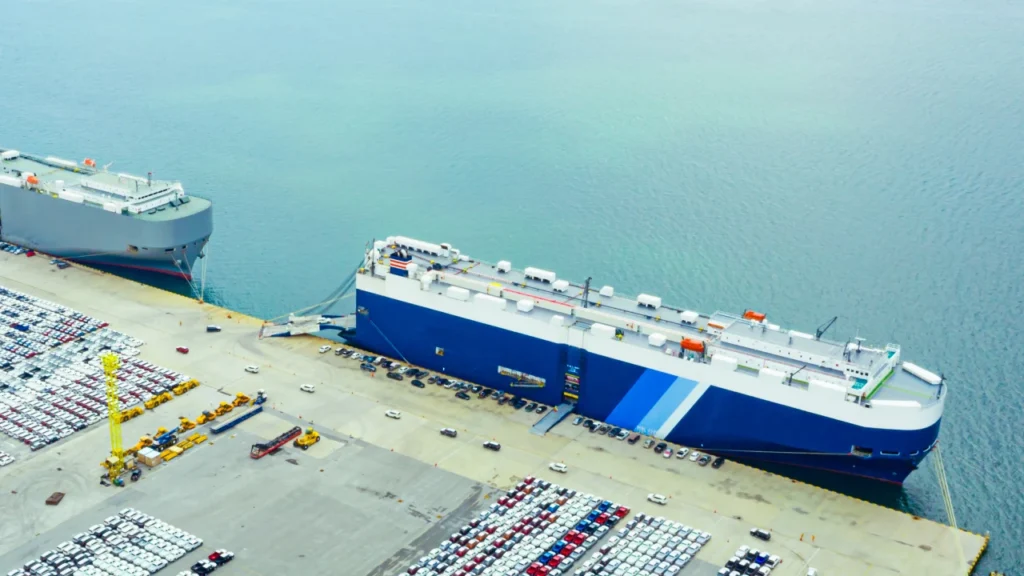
Shipping equipment to Saudi Arabia from the USA is a manageable process – but it has a lot of moving parts. Export classification, AES filing, title clearing, SASO conformity, Saudi customs duties, Incoterms negotiation, port coordination – each step has its own timeline and its own potential for delay if handled incorrectly.
Getting one element wrong can hold a machine at port for weeks, generate unexpected costs, or in serious cases, trigger legal complications on both the U.S. and Saudi sides.
At JumboBee, we work with buyers, sellers, and dealers moving heavy equipment globally, including to Saudi Arabia and across the Middle East. Our listings include construction equipment, farm equipment, and attachments from verified U.S. sellers – and our team supports the full logistics chain, from export compliance to door-to-door delivery.
If you are planning a shipment, the best first step is getting a realistic cost picture before you commit to a deal.
Request a shipping estimate – or browse export-ready equipment listings to find machinery that is already available and ready to move.
Whether you are a Saudi buyer sourcing equipment for a major infrastructure project, a U.S. dealer expanding your international reach, or a contractor looking for one specific machine – having the right logistics partner makes the difference between a smooth transaction and an expensive headache.


Be the first to leave a comment
There are no replies to this post yet. Share your thoughts and help start the conversation.