


 Trends
In 2026, global agriculture and construction sectors are moving faster than ever. Upgrading your fleet or expanding your farm requires serious capital. Understanding how to navigate lenders, interest percentages, and digital marketplaces is crucial for your business survival.
That is why buying machinery is no longer just about physically inspecting the asset in front of you. It is about understanding complex financial structures, cross-border logistics, and digital platforms that handle everything from inspection to delivery. Today, we will explore current equipment financing industry trends, break down real-world math, and show you how to navigate modern lending without losing money to hidden fees.
Shift From 2025 to 2026
To understand where we are today, we must look at equipment financing trends 2025. Last year was a transitional period. Central banks around the world finally stopped their aggressive rate hikes, bringing much-needed stability to global markets. Supply chains, which had been chaotic for years prior, finally normalized. Tractors, excavators, and loaders became readily available again.
Because inventory levels stabilized, equipment financing trends 2025 showed lenders becoming more comfortable with risk. They knew machinery values were no longer artificially inflated by scarcity. This shift laid the groundwork for the highly digital, streamlined equipment financing market we see today in 2026. Lenders are now using advanced algorithms to approve loans faster, and buyers are securing better terms because market volatility has decreased.
Current State of Interest Percentages
Money is the lifeblood of heavy industry. If you want to acquire a 2023 John Deere 9R 440, you need to know exactly what the capital will cost you. Currently, equipment financing rates have settled into a predictable rhythm. According to the Federal Reserve’s historical rate data, the federal funds rate peaked at 5.25–5.50% in 2023 before easing through 2024 and into 2025Today’s rates represent a normalized middle ground — predictable enough to plan around.
Lenders look at different types of machinery and assign different risk levels. Because of this, commercial equipment financing rates often differ significantly from rates applied to heavy farm or construction machinery. Heavy machinery holds its value incredibly well. A well-maintained excavator or combine harvester can work reliably for decades. The Association of Equipment Manufacturers consistently reports that heavy agricultural and construction machinery maintains strong residual values compared to most other capital asset categories. Lenders love this. If a borrower defaults, the lender can easily repossess and resell the asset. This high resale value drives down heavy equipment financing rates.
Conversely, commercial equipment financing rates for assets like computers, office furniture, or specialized software are generally higher. These assets depreciate rapidly and have little resale value. Lenders charge higher percentages to offset the risk of being left with worthless collateral.
Average Rates by Equipment Category
| Equipment Category | Risk Profile | Estimated Annual Interest Rate* |
|---|---|---|
| Heavy Agricultural Machinery | Low | 5.5% – 7.5% |
| Heavy Construction Machinery | Low to Medium | 6.0% – 8.0% |
| Commercial Transport Trucks | Medium | 7.0% – 9.5% |
| General Commercial Office Gear | High | 9.0% – 13.0% |
| Used Heavy Machinery | Medium | 6.5% – 8.5% |
This table shows why understanding your asset class is vital. Your average equipment loan interest rate will depend heavily on what exactly you are buying and how well it retains its value on the global secondary market.
Calculating True Financial Impact
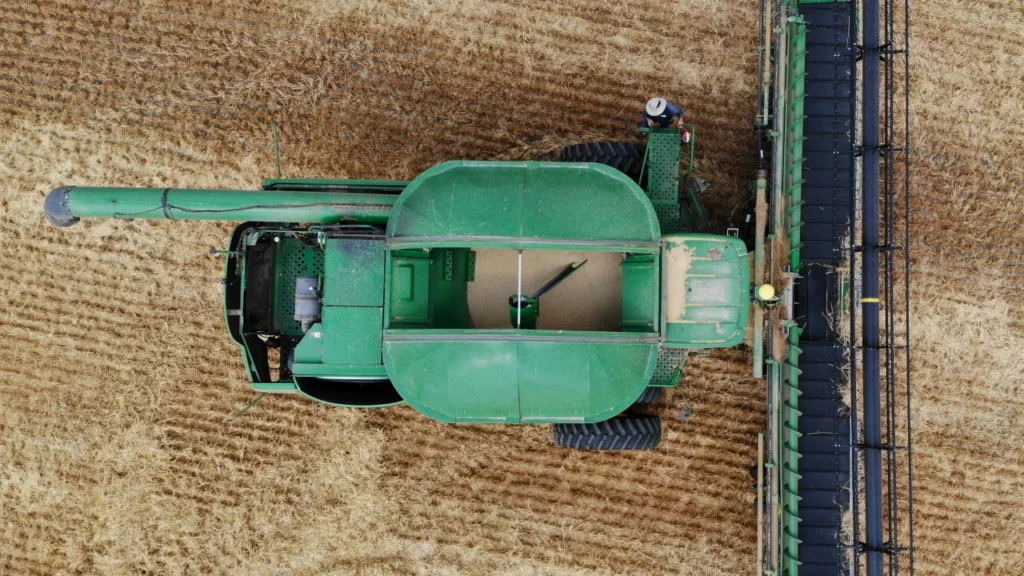
Understanding equipment loan rates requires more than just looking at a percentage. You must calculate the actual dollar amount you will pay over the life of the loan. Let us run a real-world calculation using a machine available on the global market right now.
Imagine you want to buy a used 2024 John Deere S770 combine harvester priced at $435,000. You plan to put down a 20% deposit and finance the rest over 60 months.
Purchase details:
- Machine Price: $435,000
- Down Payment (20%): $87,000
- Financed Amount: $348,000
Let us assume your business has excellent credit, and you secure an average equipment loan interest rate of 6.5% for a 5-year (60-month) term.
Monthly payment calculation:
Using standard amortization math, a $348,000 loan at 6.5% over 60 months results in a monthly payment of approximately $6,805.
Total cost analysis:
- Total Monthly Payments (60 x $6,805): $408,300
- Total Interest Paid: $60,300
- Total Equipment Financing Cost: $495,300 (Down payment + Total Monthly Payments)
By doing this math, you see that your equipment financing cost includes over $60,000 in interest. This is why negotiating your equipment loan rates down by even half a percent can save you thousands of dollars. If you managed to secure a 6.0% rate instead of 6.5%, your monthly payment would drop to approximately $6,724, saving you around $4,860 over the life of the loan.
Major Industry Shifts Shaping 2026
The equipment financing market is evolving rapidly. Traditional banking methods are being replaced by dynamic, technology-driven solutions. Here are the major equipment financing industry trends you need to watch right now.
Artificial Intelligence Underwriting
Lenders no longer take weeks to review your financial statements. AI algorithms now analyze your bank history, tax returns, and current cash flow in seconds. This means you can get approved for heavy equipment financing rates almost instantly, allowing you to move fast when you find a great deal on a used tractor.
Cross-Border Financing Solutions
In the past, buying machinery from another country meant dealing with local banks, massive currency exchange fees, and complex international wire transfers. Today, modern platforms integrate borderless payments. Buyers in Egypt or Ukraine can seamlessly finance machinery located in the United States.
Usage-Based Lending Models
A growing number of specialist lenders are piloting flexible payments tied to machine usage, particularly for large agricultural fleets. Telematics installed in modern tractors track how many hours the machine runs. During busy harvest seasons, your payment is higher. During winter downtime, your payment drops. This aligns your equipment financing cost directly with your revenue generation. The USDA Economic Research Service tracks farm equipment investment cycles and notes that cash flow variability across growing seasons is one of the primary financial challenges facing agricultural operators globally.
How Lenders Evaluate Risk Today
To get the best equipment financing interest rates, you must understand how lenders view you. Lenders in 2026 are highly analytical. They do not just look at your credit score; they look at the complete health of your operation.
Debt Service Coverage Ratio
Lenders calculate your Debt Service Coverage Ratio to see if your business generates enough cash to cover new loan payments. They divide your net operating income by your total debt obligations. If your ratio is 1.25 or higher, lenders feel confident. This means you generate 25% more cash than you need to pay your debts. A strong ratio unlocks the lowest equipment financing rates.
Machine Depreciation Curves
Lenders study the exact make and model you are buying. A 2021 John Deere 8R 370 with 859 hours is a highly desirable asset. Lenders know exactly what this machine will be worth in three years. Because the depreciation curve is slow and predictable, they will offer you excellent heavy equipment financing rates. If you buy a lesser-known brand with poor global parts support, lenders will charge higher percentages to cover their risk.
Global Logistics Reliability
Lenders want to know the machine will safely reach your farm or job site. If you buy machinery internationally without a solid shipping plan, lenders see risk. They worry the asset might get damaged at a port or stuck in customs. Using platforms with built-in logistics makes lenders feel secure, which can positively impact your equipment financing interest rates.
Strategies to Secure Better Terms
You have the power to influence your loan terms. Do not just accept the first offer a bank gives you. Use these hands-on strategies to lower your average equipment loan interest rate.
Increase Your Down Payment
Putting 20% down is standard, but pushing to 30% or more radically changes the lender’s risk profile. When you have more equity in the machine from day one, lenders will drop your equipment financing interest rates significantly.
Buy High-Quality Used Machinery
New machinery loses a large chunk of its value the moment it leaves the dealer lot. Buying mid-cycle used machinery, like a 2021 John Deere 8R 230 with 1,200–1,800 hours, allows you to skip the steepest depreciation curve while still acquiring a well-supported, reliable machine. Lenders love financing high-quality used gear because the value is stable. This stability translates to better equipment loan rates for your business.
Keep Impeccable Maintenance Records
If you are using existing machinery as collateral for a new loan, prove its worth. Detailed maintenance logs show lenders that your assets hold maximum value. Well-maintained collateral reduces lender risk and lowers your overall equipment financing cost.
Utilize Global Marketplaces
Instead of relying on a single local bank, use global platforms like JumboBee that connect you with multiple lending partners. Competition among lenders forces them to offer you their best commercial equipment financing rates to win your business.
Digital Platforms Transforming the Market
The most significant change we see in 2026 is the rise of embedded finance within global marketplaces. Looking back at equipment financing trends 2025, we saw the beginning of this digital integration, but today it is fully realized.
In the past, buying a tractor meant visiting a dealer, finding a separate bank for a loan, hiring a separate mechanic for inspection, and contracting a separate freight company for transport. Each step added friction, hidden fees, and delays.
Today, the equipment financing market operates within centralized hubs. When you browse for a 2018 John Deere 333G track loader on JumboBee, the digital marketplace already knows the machine’s value, location, and shipping dimensions. Through API integrations, the platform connects you directly to lenders who instantly offer customized financing options.
This embedded finance model eliminates the middleman. You see the exact cost of the machine, the exact cost of shipping, and the exact cost of your loan all on one screen. This transparency is revolutionizing equipment financing industry trends, making global trade faster and safer for everyone involved.
JumboBee Advantage For Global Buyers And Sellers
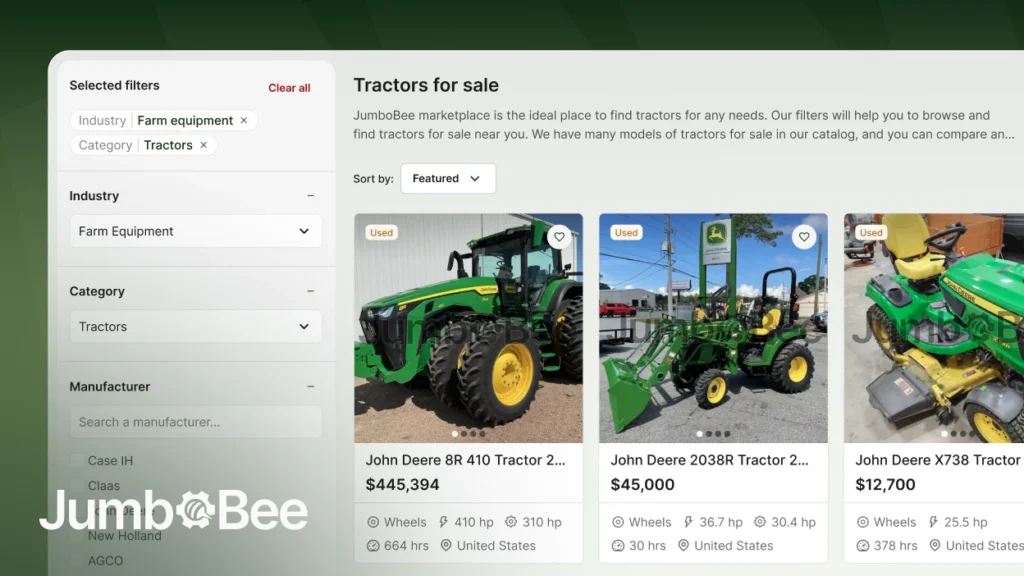
Navigating international machinery purchases requires a partner you can trust. JumboBee is the premier global marketplace for heavy equipment, designed specifically to eliminate hidden fees and simplify global trade.
Whether you are looking for farm equipment or construction machinery, JumboBee connects verified sellers with verified buyers across more than 100 countries. We offer built-in logistics, handling everything from disassembly and loading to customs clearance and door-to-door delivery. You see the full cost instantly, including equipment, shipping, inspections, and fees.
When it comes to capital, JumboBee helps you secure the most competitive equipment financing rates available today. We understand that high equipment financing cost can stall your business growth. That is why our platform offers flexible financing options, including short or long-term loans and currency exchange programs tailored to your specific needs.
Because we specialize in premium heavy machinery from brands like John Deere, Case IH, and CLAAS, our lending partners offer exceptional heavy equipment financing rates. They understand the lasting value of the assets traded on our platform. Whether you need standard commercial equipment financing rates or specialized agricultural terms, JumboBee provides access to an average equipment loan interest rate that keeps your business profitable.
Stop letting complex logistics and high equipment loan rates hold your business back. Embrace current equipment financing industry trends and join a platform built for modern global trade. Sign up with JumboBee today, explore our worldwide inventory, and let our experts help you finance and ship your next heavy machine with absolute confidence.




Be the first to leave a comment
There are no replies to this post yet. Share your thoughts and help start the conversation.