


 Shipping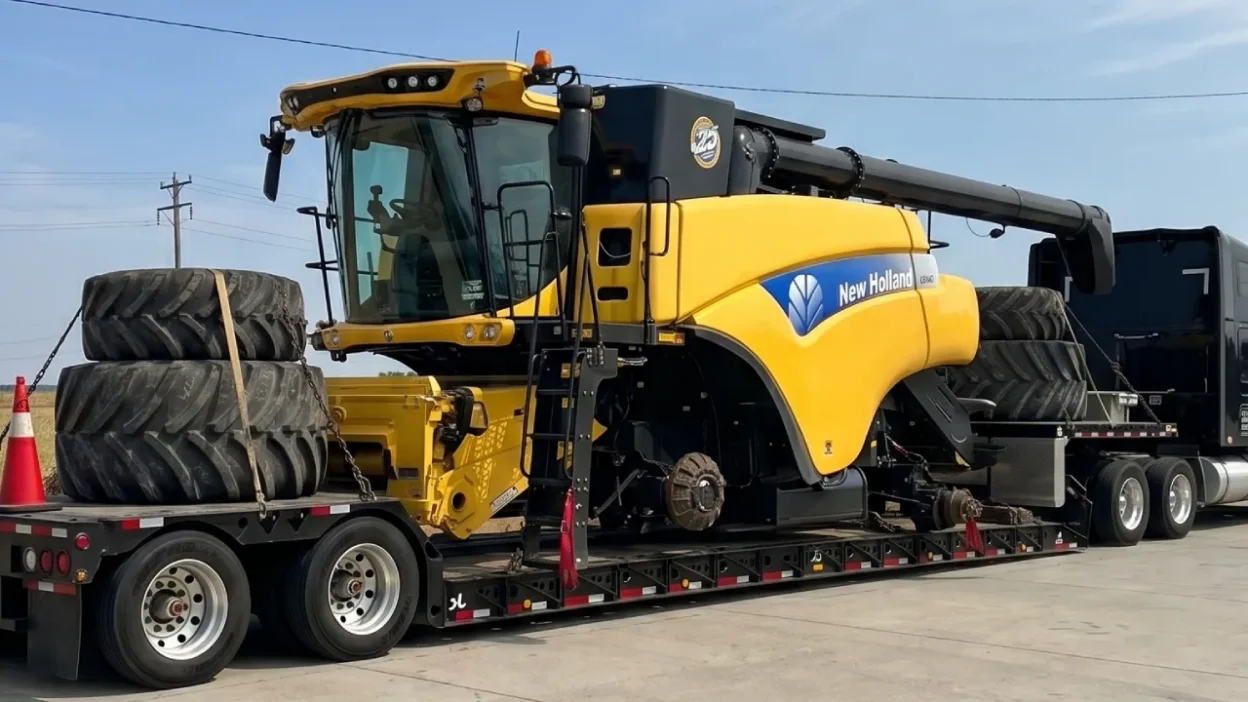
Moving a 40-ton excavator across state lines or shipping a combine harvester across the ocean differs significantly from mailing a package. It requires precision, strategy, and protection. One wrong turn can lead to a bridge strike. One storm at sea can result in a total financial loss.
This guide covers heavy equipment logistics with a focus on route planning and cargo insurance. It details how heavy equipment transport and shipping are planned, risks arising during heavy machinery logistics, and how insurance for heavy equipment protects high-value cargo during domestic and international transport.
Logistics strategy, compliance considerations, and insurance fundamentals combine here to help shippers, buyers, and project managers reduce risk and avoid costly mistakes.
What Is Heavy Equipment Logistics
Heavy machinery logistics is the specialized process of planning, implementing, and controlling the movement of large, heavy, or complex machinery. This sector covers a wide range of assets.
Construction, agricultural, mining, and industrial equipment
This includes excavators, bulldozers, wheel loaders, cranes, tractors, combine harvesters, and industrial generators. These machines possess protruding parts like booms, buckets, and blades that complicate loading.
Oversized, overweight, and high-value cargo
In logistics, oversized (or Out of Gauge) means the equipment exceeds the standard dimensions of a shipping container or a standard flatbed trailer. Overweight means it exceeds legal weight limits for road transport, requiring special axles to distribute the load.
Key Challenges in Heavy Equipment Transport
Size and weight restrictions
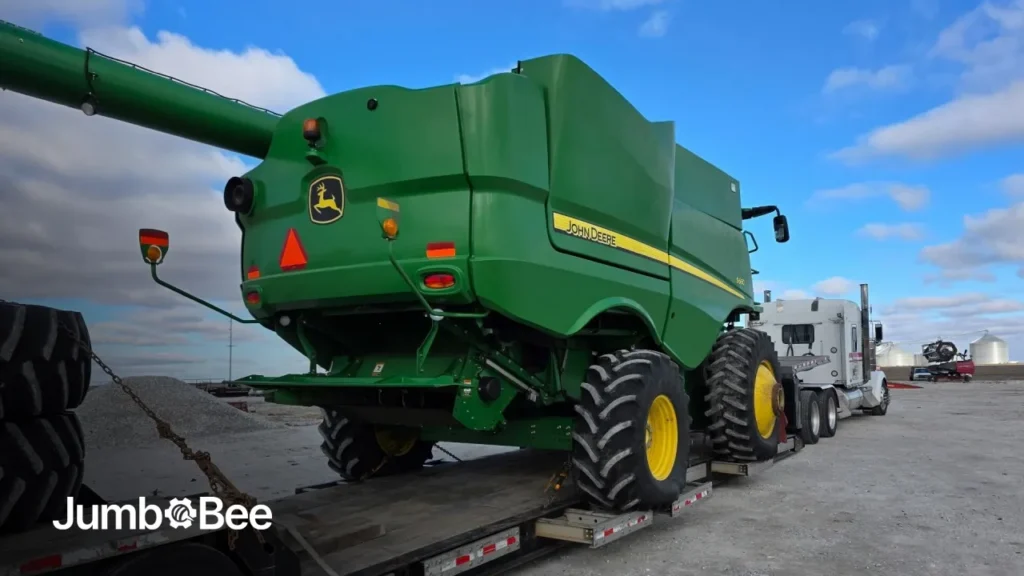
Every road, bridge, and tunnel has a limit. A standard United States highway lane is 12 feet wide. If your combine harvester is 13 feet wide with dual wheels, you represent a safety hazard without proper protocols.
Regulatory and permitting complexity
You cannot move oversized loads without permission. You need permits from every state, province, or country the cargo passes through. Rules change across borders. What is legal in Texas might be illegal in Oklahoma.
High financial and operational risk
These machines are expensive. A single specialized mining truck can cost over $1 million. Damage during heavy equipment transport halts projects. If a crane does not arrive at a construction site on time, the entire project timeline and budget collapse.
Heavy Equipment Shipping Methods
Road Transport for Heavy Equipment
For domestic moves or the first and last mile of international shipments, road transport is the standard.
Flatbed, lowboy, and multi-axle trailers
- Flatbed: Good for smaller equipment (skid steers, small forklifts) that fit within standard dimensions.
- Step-deck (drop-deck): Has a lower deck to accommodate taller machines without hitting bridge height limits.
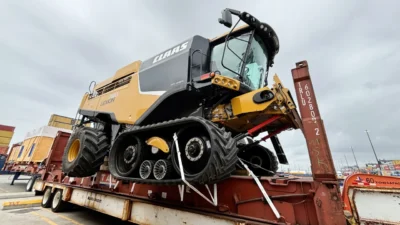
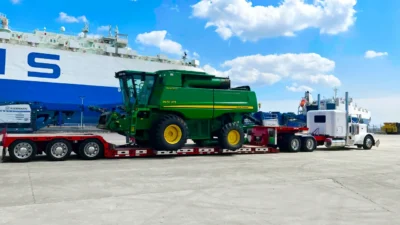
- Lowboy (removable gooseneck): The workhorse of heavy equipment transport. The deck sits very low to the ground, allowing for tall equipment like excavators. The front detaches, creating a ramp for the machine to drive on.
- Multi-axle trailers: For extreme weight. These trailers spread the weight over 9, 13, or even 19 axles to protect the road surface.
When road transport is the best option
Road transport offers door-to-door service. It is flexible and usually faster than rail for distances under 1,000 miles. It serves as the only option for delivering directly to a job site or farm.
Rail Transport for Heavy Machinery
Cost efficiency for long distances
If moving a fleet of tractors from the Midwest to the West Coast, rail is cheaper than hiring twenty separate trucks. Rail can handle immense weight without the same permit headaches as road transport.
Limitations and infrastructure dependency
Rail is not door-to-door. You still need a truck to get the machine to the rail yard and another truck to pick it up. This adds handling steps (loading/unloading), which increases the risk of damage.
Sea Freight and International Heavy Equipment Shipping
When buying or selling globally, you must cross the ocean.
RoRo vs container vs breakbulk
- RoRo (Roll-on/Roll-off): The safest and most common method for drivable machinery. The equipment drives onto the ship and is strapped down below deck, protected from the elements. It resembles a giant floating parking garage.
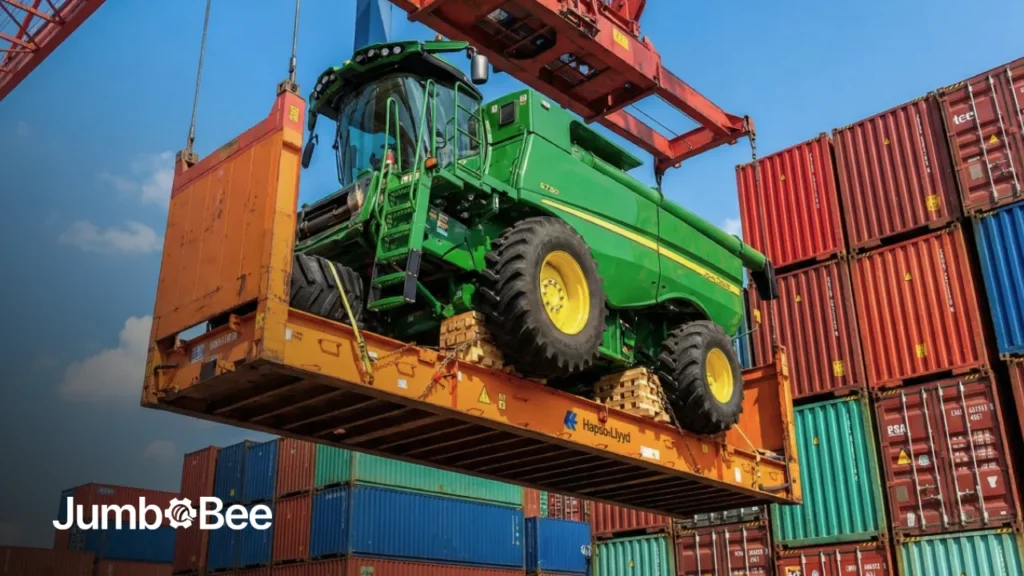
- Container (full container load/less than container load): Great for smaller machinery or equipment that can be dismantled. If you can take the wheels and cab off a tractor to fit it in a 40-foot container, you save money.
- Breakbulk: Used for static, massive cargo that cannot be driven and does not fit in a container. Cranes lift it directly onto the ship deck. This is common for large industrial boilers or mining parts.
Port handling and customs considerations
Ports require correct paperwork. If your machine is dirty (has soil on the tires), customs in countries like the United States, Australia, and New Zealand will reject it due to biosecurity laws. Cleaning must happen before shipping heavy equipment.
Route Planning in Heavy Equipment Transport
Route planning is an engineering calculation, not just looking at a map. A bad route leads to bridge strikes (cargo hitting an overpass). This destroys the cargo, damages the bridge, and results in massive fines and lawsuits.
If a truck arrives at a bridge it cannot cross, it has to turn around. Backing up a 100-foot oversized load on a highway requires police intervention and causes hours of delay. Proper planning prevents this.
Key Factors in Route Planning
Road weight limits and bridge clearances
Logistics planners use specialized databases to check every mile of the route.
- Height: Most United States interstates offer 13’6″ clearance. If your load is 14′ high, you must find an alternate route.
- Weight: Bridges have weight ratings. An older bridge might collapse under a 100-ton load.
Turning radius and slope restrictions
Long trailers cannot take sharp corners. Planners must analyze intersections. Can the truck make a right turn without taking out a traffic light? Also, steep grades can be dangerous for heavy loads; brakes can overheat, or traction can be lost.
Urban vs rural route risks
- Urban: Traffic, tight corners, low utility wires, curbs.
- Rural: Narrow roads, soft shoulders (risk of tipping), weak bridges over creeks.
Permits and Escorts for Heavy Equipment Transport
Oversized and overweight permits
You must apply for permits in every jurisdiction. The permit dictates your route. You cannot deviate from it. If the permit says take Highway 10 and you take Highway 12 to save time, your insurance may be voided, and you face heavy fines.
Because regulations vary significantly by location, you should always consult the official Department of Transportation resources for the specific states you will be traversing. You can find a comprehensive directory of state permitting offices and size regulations on the Federal Highway Administration (FHWA) website:
Pilot cars and escort requirements
- Pilot cars (escorts): Vehicles with flashing lights and Oversize Load signs that drive in front of or behind the truck.
- Height pole car: If the load is tall, a lead car drives ahead with a pole attached to its bumper set at the load height. If the pole hits a bridge or wire, the driver radios the truck to stop immediately.
- Police escorts: Required for extremely large loads that block multiple lanes of traffic.
Risk Factors in Shipping Heavy Equipment
Statistically, loading and unloading are the most dangerous times. Ramps can slip. Chains can snap. Human error is common. If an operator drives a combine onto a trailer too fast, it can tip over.
Vibration and Shifting During Transit
Roads are bumpy. Oceans are rough. Constant vibration can loosen bolts or damage sensitive electronics in modern tractors. If cargo is not lashed (secured) correctly, it can shift. A shifting load can cause a ship to list or a truck to jackknife.
Regulatory and Delay Risks
Permit issues
If your permit expires because of a breakdown, you are stuck. You cannot move until a new permit is issued, which can take days.
Border and customs delays
Missing paperwork or soil contamination leads to quarantine. Storage fees at ports (demurrage) can cost hundreds of dollars per day while you wait for clearance.
Financial Risks in Heavy Equipment Shipping
High asset value
You are moving capital assets. A $500,000 loss can bankrupt a small construction firm.
Liability exposure
If your equipment falls off a truck and hits a car, you could be liable. If it leaks oil into a waterway, you face environmental cleanup costs.
Heavy Equipment Insurance Explained
Equipment insurance (specifically Cargo Insurance) transfers the financial risk of transport from you to an insurance company. It pays for repairs or replacement if the machinery is damaged, lost, or stolen during transit.
Who needs insurance for heavy equipment:
- Sellers: To ensure they get paid if goods are damaged before title transfer.
- Buyers: To protect their investment once they take ownership (usually at the pickup point).
- Logistics companies: To protect themselves from liability.
Insurance for Heavy Machinery vs Standard Cargo Insurance
Standard cargo insurance is typically based on weight or standardized value. Insurance for machinery accounts for the fact that these items are used, have particular market values, and are susceptible to risks (like scratching or marring) that might not matter for scrap metal but matter for a new tractor.
Many standard policies exclude used goods or limit coverage to Total Loss Only (meaning they pay nothing if the machine is damaged but repairable). You need a policy covering partial damage.
Types of Insurance for Heavy Equipment Transport
Insurance Type | Description | Best For |
Carrier Liability | NOT true insurance. Limited by law (e.g., $0.10/lb). Hard to prove negligence. | Low-value scrap. Never rely on this for machinery. |
Total Loss Only | Pays only if the item is completely destroyed or lost. | Older, lower-value equipment where minor scratches don’t matter. |
All-Risk Cargo Insurance | Covers physical loss or damage from any external cause (unless excluded). | High-value, modern heavy equipment transport. |
General Average | Covers your share of ship rescue costs (Maritime law). | All international sea shipments. |
Project-specific insurance
For massive projects involving multiple shipments, you can buy a Project Cargo Policy that covers everything from the factory floor to the final foundation at the construction site.
Insurance for Heavy Machinery During Transport
What insurance for machinery typically covers:
Damage, Loss, and Theft
- Collision: Truck crashes, train derailments.
- Acts of God: Lightning, storms, washing overboard.
- Theft: Stolen trailers or pilferage of parts.
- Fire: Engine fires or warehouse fires during transit.
Loading and Unloading Incidents
Ensure your policy covers loading and unloading. Many policies only cover the item while it is on the conveyance. If you drop it while lifting it onto the truck, a basic policy might deny the claim.
Common Exclusions in Heavy Equipment Insurance
Improper packing
If you put a delicate control panel in a cardboard box without padding and it breaks, insurance will not pay. This is insufficient packing.
Route deviations
As mentioned, if the driver goes off the permitted route, coverage may be suspended.
Mechanical failure
Insurance covers external damage. It does not cover a transmission failing because it was old. If the machine arrives with no dents but will not start, insurance usually denies the claim unless you can prove that the impact caused the internal failure.
How Insurance Premiums Are Calculated
Equipment value
Premiums are a percentage of the Insured Value.
- Calculation: (Cost of Goods + Freight Cost + 10%) x Rate
- Example: Equipment ($100,000) + Shipping ($10,000) = $110,000. Premium might be 0.5% of $110,000 = $550
Route risk
Shipping to a war zone or a region with high theft rates increases the premium.
Transport method
Container shipping usually has lower premiums than Breakbulk because the cargo is better protected.
How to Choose the Right Insurance for Heavy Equipment
First, you need to match insurance coverage to transport risk.
Domestic vs International Shipping
- Domestic: Focus primarily on collision and theft coverage. Domestic transport in the US is typically governed by the Carmack Amendment, which places strict liability on carriers, though coverage limits apply.
- International: You must have coverage for General Average. Under maritime law – specifically the York-Antwerp Rules – if a ship is in danger (e.g., fire, grounding) and the captain voluntarily sacrifices cargo or incurs extraordinary expense to save the vessel, all cargo owners must split the cost of the lost cargo and the rescue.
Even if your tractor is safe, you could owe $50,000+ to the shipping line before they release your cargo. This is a standard risk defined by major insurers and maritime bodies:
- Reference: What is General Average? – Munich Re
New vs Used Machinery
For new machinery, coverage is typically straightforward as the value is established by the commercial invoice.
For used equipment, US insurers frequently require a Condition and Valuation Survey (Marine Survey) prior to shipment. This documents existing dents, scratches, and mechanical conditions to distinguish them from transit damage. Without this, claims for scratching, chipping, or denting are excluded.
- Reference: Marine Survey Definition – International Risk Management Institute (IRMI) (Dallas-based industry authority on risk and insurance).
Documentation Required for Heavy Equipment Insurance
Equipment specs and value
You need a Commercial Invoice or Bill of Sale proving the value. You cannot guess the value.
Transport and route details
Insurers need to know the origin, destination, and carrier details.
Working With Logistics Providers
General insurance agents usually do not understand heavy machinery logistics. They might sell you a policy that excludes on-deck cargo, but your excavator is shipping RoRo (which is technically on-deck/above hold). A specialized broker ensures the policy matches the reality of shipping heavy equipment.
Reducing claim disputes
A good provider helps you file claims. They know what photos to take and what forms to fill out.
Best Practices for Safe Heavy Equipment Logistics
Pre-Shipment Planning and Inspection
Equipment preparation
- Clean it: Remove all soil (biosecurity).
- Secure loose parts: Tape up exhaust stacks, lock doors, and secure the boom.
- Disconnect batteries: Prevents electrical shorts and fires.
- Drain fluids: Some carriers require fuel tanks to be less than 1/4 full.
Documentation checks
Take high-resolution photos of the machine from all angles before it is loaded. Photograph the VIN plate. This is your proof if damage occurs.
Coordination Between Transport and Insurance
Aligning route planning with coverage
Ensure your insurance policy is active for the entire duration of the planned route. If the transport takes longer than expected, request an extension.
Communication across stakeholders
The buyer, seller, trucking company, and insurance broker must be in the loop. Everyone should have a copy of the transport plan.
Simplify Your Heavy Equipment Logistics with JumboBee
Managing heavy equipment logistics involves dozens of moving parts. You have to find the machine, negotiate the price, hire a surveyor, book the truck, arrange the ocean freight, and secure the insurance.
JumboBee eliminates this complexity. We are not just a marketplace; we are a full-service logistics partner.
When you find equipment on JumboBee, you get:
- Verified sellers: Shop with confidence.
- Built-in logistics: We handle route planning, permits, and shipping method selection for you.
- Integrated insurance: Secure comprehensive insurance for heavy equipment directly through our platform.
- Inspection services: Know the condition of the machinery before it ships.
Do not gamble with your high-value assets. Buy, insure, and ship with confidence.
Yes. Relying on the trucking company’s liability coverage is risky. Their coverage typically pays by weight (e.g., 10 cents per pound) or has low limits (e.g., $100,000 total). If your machine is worth $200,000, you are underinsured.
For international shipping, RoRo (Roll-on/Roll-off) is generally the best balance of cost and safety for drivable machinery. For domestic moves, a Lowboy trailer is the standard.
It varies, but typically ranges from 0.4% to 0.8% of the total insured value (CIF value). For a $100,000 shipment, expect to pay between $400 and $800. This is a small price for total protection.
It depends on the Incoterms (International Commercial Terms) agreed upon in the sale. However, without separate cargo insurance, proving the carrier was negligent can be legally difficult and expensive.


Be the first to leave a comment
There are no replies to this post yet. Share your thoughts and help start the conversation.