


 Equipment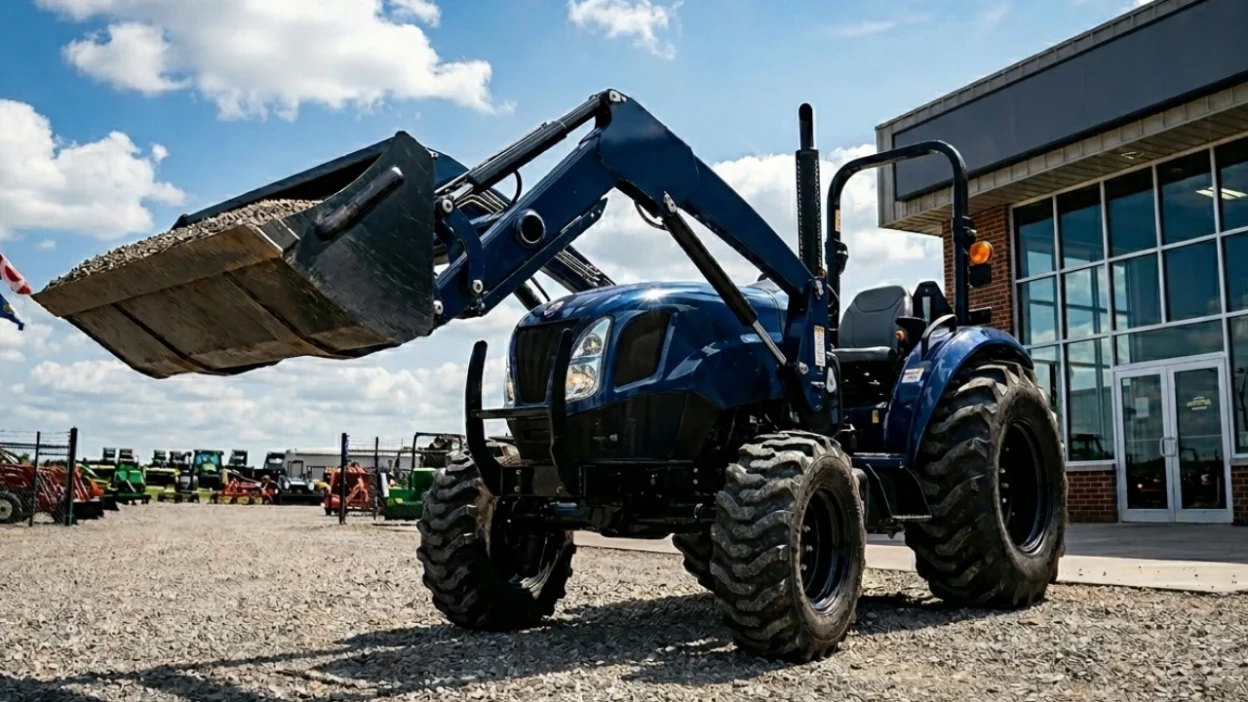
Buying a compact tractor is one of the most significant investments you will make for your property. Whether you manage a small farm, a large landscaping project, or five acres of homestead, the right machine acts as a force multiplier. It turns days of manual labor into hours of seat time.
But the market is flooded with options. You have the Green Paint loyalists (John Deere), the orange reliability of Kubota, the red power of Massey Ferguson, and value-driven disruptors like Mahindra and LS.
This guide cuts through marketing noise. We compare leading manufacturers, analyze technical specifications, and calculate real-world value. By the end, you will understand not just who makes the best compact tractor, but which specific machine offers the highest Return on Investment (ROI) for your specific workload.
What Makes a Compact Tractor Best?
Before naming a winner, we must define the metrics. A tractor perfect for mowing a flat 3-acre lawn is useless for tilling rocky soil on a 20-acre farm. To determine the best compact tractor, you must evaluate three core pillars: capability, durability, and financial logic.
Power, Size, and Versatility
A compact tractor generally falls into the 25 to 60 horsepower (HP) range. Below 25 HP, you are usually looking at sub-compact tractors (glorified lawn mowers with loaders). Above 60 HP, you enter the utility tractor category, which is often too large for residential maintenance or tight barn work.
Engine and PTO Power
Don’t just look at engine HP. Look at PTO (Power Take-Off) HP. This is the power actually available to run attachments like bush hogs, tillers, or balers.
Example: A 35 HP engine might only deliver 29 HP to the PTO due to hydrostatic transmission losses. If your 6-foot mower requires 30 PTO HP, that tractor is underpowered.
Transmission Types
- Hydrostatic (HST): Works like an automatic car. Push a pedal to go. Best for loader work and mowing, where you constantly change speed and direction.
- Gear/shuttle shift: Traditional gears. More efficient power transfer to the ground. Best for plowing or pulling heavy loads in straight lines.
Hydraulic Capacity
Measured in Gallons Per Minute (GPM). A higher GPM means your front-end loader moves faster and can lift more. If a brand boasts high horsepower but low hydraulic flow, the tractor will feel sluggish during loader work.
Build Quality and Reliability
Reliability is the single biggest factor in long-term satisfaction. A tractor is a tool, not a toy. It needs to start in freezing temperatures and endure thousands of hours of vibration and dust.
- Chassis and body: Tap the hood. Is it metal or plastic? While high-quality polymer resists dents, metal generally signals a more rugged build. Look at the rear axle housing. Cast iron or cast steel housings are preferred over aluminum for handling heavy 3-point hitch loads.
- Engine origin: Many brands outsource their engines.
- Kubota: Makes their own engines.
- John Deere: Makes some, uses Yanmar for smaller compacts.
- Mahindra: Uses various suppliers depending on the model.
- Knowing the engine manufacturer helps predict parts availability 15 years down the road.
- Emissions systems: Modern diesel regulations (Tier 4) require emissions control.
- DPF (Diesel Particulate Filter): Traps soot. Requires regeneration (burning off soot at high heat). Can be a maintenance headache if you only do short, light tasks.
- DOC (Diesel Oxidation Catalyst): A flow-through filter that doesn’t require regeneration. Many buyers prefer this for simplicity.
Cost, Maintenance, and Value for Money
The sticker price is only half the story. To find the best compact tractor for the money, you must calculate the Total Cost of Ownership (TCO).
TCO Formula
TCO = (Purchase Price + Maintenance + Fuel) – Resale Value
Resale Value Impact
- Scenario A: You buy a premium John Deere for $30,000. Five years later, you sell it for $22,000. Cost of depreciation: $8,000.
- Scenario B: You buy a budget brand for $24,000. Five years later, it sells for $14,000. Cost of depreciation: $10,000.
In this example, the expensive tractor actually costs you less to own over five years. This is why brands like Kubota and John Deere often win the best value compact tractor debate despite higher initial prices.
Top Compact Tractor Brands Compared
Here is how the major players stack up in the current market.
John Deere — Best Overall Performance
Green and yellow machines are the industry standard for a reason. John Deere offers the most refined user experience among small tractor brands. Their Drive-Over mower decks and Quik-Park loaders allow you to attach and detach implements in under 60 seconds without leaving the seat.
- Key models: 1025R (Sub-compact), 3038E (Economy Compact), 4066R (Premium Compact).
- Pros:
- Ergonomics: Best-in-class pedal placement and seat comfort.
- Resale: Consistently commands the highest used prices.
- Parts network: Massive dealer support globally.
- Cons:
- Price: You pay a Green Paint Tax (usually 10-15% higher than competitors).
- Proprietary attachments: Some loader connections are proprietary, limiting your aftermarket choices unless you buy an adapter.
Kubota — Most Reliable Compact Tractor

If John Deere is the iPhone of tractors, Kubota is the Toyota Land Cruiser. They are legendary for longevity. Kubota practically invented the compact tractor segment in the US in the 1970s. They manufacture nearly every component in-house, ensuring perfect integration between engine, transmission, and axles.
- Key models: B2601, L2501 (The best-selling compact tractor in the world), LX Series.
- Pros:
- Durability: Engines frequently run 5,000+ hours with basic maintenance.
- Engineering: Smooth hydrostatic transmissions.
- Resale: Rivals John Deere for value retention.
- Cons:
- Ergonomics: Treadle pedal (heel-toe drive) is polarizing; some love it, some hate it.
- Lift capacity: Often slightly lower loader lift capacity compared to equivalent Massey or Mahindra models.
Massey Ferguson — Best for Heavy Workloads

Massey Ferguson (an AGCO brand) focuses on weight and power. Their compact tractors often weigh significantly more than competitors in the same horsepower class. Weight is crucial for traction; a heavier tractor pushes snow and dirt better than a light one.
- Key models: 1700M Series, GC1700.
- Pros:
- Heavy build: More steel, less plastic. Better traction without adding wheel weights.
- Loader strength: Typically offers higher lift capacities.
- Transmission: Excellent Iseki engines and transmissions.
- Cons:
- Dealer network: Not as dense as Deere or Kubota in some regions.
- Parts: Can be slightly more expensive or slower to source.
New Holland — Best Value Compact Tractor

New Holland brings distinctive blue styling and a focus on operator comfort (Boomer Guard suite). They are mechanically very similar to Case IH (both owned by CNH Industrial) and often share platforms with LS Tractor.
- Key models: Boomer 24, Workmaster 25S.
- Pros:
- Ergonomics: Very logical control layouts.
- Visibility: Sloped hood designs offer great sightlines for loader work.
- Price: Often priced aggressively to undercut Deere and Kubota.
- Cons:
- Identity: Many models are rebadged LS Tractors, leading savvy buyers to just buy the LS version for less money.
Mahindra — Best Small Tractor for the Money

Mahindra is the world’s largest tractor manufacturer by volume. Their selling proposition is simple: heavy metal, high lift capacity, and no DPF filters on many models. They market themselves as the Official Tractor of Tough.
- Key models: eMax 20, 1600 Series.
- Pros:
- mCRD technology: No DPF means no regeneration cycles and less heat.
- Lift capacity: Consistently out-lifts competitors in specs.
- Warranty: Industry-leading powertrain warranties (often 7 years).
- Cons:
- Fit and finish: Paint quality and plastic switches can feel cheaper than Kubota/Deere.
- Resale: Depreciation is steeper than premium brands.
LS Tractor & Yanmar — Best Emerging Brands
- LS tractor: A South Korean giant that manufactures tractors for New Holland and Case IH. Buying an LS is essentially buying a New Holland without the brand markup. They offer incredible features (like remote hydraulics) as standard, where others charge extra.
- Yanmar: The Japanese engine master. They built John Deere’s compact engines for decades. Now selling under their own name, they offer premium quality, often with better transmission smoothness than anyone else.
Best Compact Tractor for Money (By Use Case)
Best is subjective. Here is the winner based on how you plan to use the machine.
For Small Farms and Hobby Farmers
Winner: Kubota L2501 or L3901
For small agriculture, reliability is king. You cannot afford downtime during harvest or planting. The Kubota L series is simple, lacks complicated electronics, and has a massive support network. It strikes the perfect balance between size (fits in barns) and power (pulls 5-foot rotary cutters easily).
For Landscaping and Property Work
Winner: John Deere 1025R or 2038R
If you are mowing lawns, moving mulch, and clearing snow, the John Deere system is superior. The ability to drop the mower deck without tools and attach the front loader quickly makes it ideal for users who switch tasks five times a day. The resale value also protects your investment if you decide to upgrade later.
For Commercial or Heavy Use
Winner: Massey Ferguson 2800 M Series or Mahindra 1600 Series
When you need to lift heavy round bales or pallets of stone, you need hydraulic grunt and chassis weight. These tractors sacrifice some refinement for raw capability. They will lift loads that would tip a lighter tractor.
Who Makes the Best Compact Tractor Overall?
If we look at the data across reliability, resale value, and capability, here is the scorecard.
| Feature | John Deere | Kubota | Mahindra | Massey Ferguson |
|---|---|---|---|---|
| Reliability | High | Very High | Moderate | High |
| Resale value | Highest | High | Moderate | Moderate |
| Lift capacity | Moderate | Moderate | High | High |
| Comfort | Best | Good | Fair | Good |
| Price | High | High | Low | Moderate |
- For pure reliability: Kubota is the most reliable compact tractor.
- For user experience and resale: John Deere is the best-rated compact tractor.
- For budget and power: Mahindra or LS is the best small tractor for the money.
How to Choose the Right Compact Tractor for Your Needs
Don’t buy based on color. Buy based on specs and support.
Match Tractor Size to Property Size and Tasks
A common mistake is buying too small. It is better to have extra power you don’t use than to lack power when you need it.
- Under 5 Acres (Mowing, light gardening): Sub-compact (22-25 HP).
- Look for: Mid-mount mower compatibility.
- Look for: Mid-mount mower compatibility.
- 5–10 Acres (Horse property, large gardens, snow removal): Small Frame Compact (25-35 HP).
- Look for: Loader lift capacity of at least 1,200 lbs.
- Look for: Loader lift capacity of at least 1,200 lbs.
- 10–40 Acres (Hay, food plots, gravel driveway maintenance): Large Frame Compact (40-60 HP).
- Look for: Heavy-weight, Ag tires, and turbo-charged engines.
Horsepower Rule of Thumb
If you plan to use ground-engaging implements (plows, discs, tillers), you generally need 1 HP for every foot of implement width.
5-foot tiller = Need 25+ HP at the PTO (approx 30-35 engine HP).
New vs Used: Which Offers Better Value?
Tractors are not like cars. A car with 100,000 miles is old. A diesel tractor with 1,000 hours is just broken in.
Depreciation Sweet Spot
New tractors depreciate roughly 15-20% the moment they leave the lot. However, after that initial drop, the curve flattens significantly.
Buying a used compact tractor with 300-800 hours allows you to bypass the initial depreciation hit. You get a machine that operates like new but costs thousands less.
Inspection Checklist for Used Tractors
- Loader pins: Wiggle the bucket. Excessive play indicates heavy abuse.
- Fluids: Check hydraulic fluid. Milky oil means water contamination.
- Blow-by: Open the oil fill cap while the engine is running. Excessive smoke puffing out indicates worn piston rings.
Where to Find Best Deals
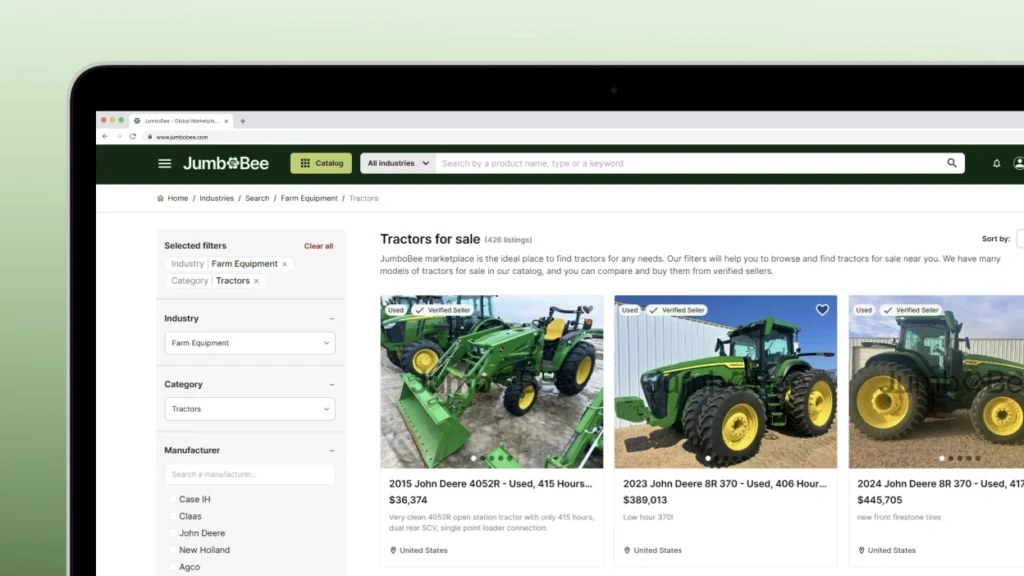
Local dealers are great for new machines, but for the best value, the global used market is superior.
- Auctions: High risk, high reward. No test drives allowed.
- Private sellers: Good prices, but no financing or shipping help.
- Managed marketplaces (like JumboBee): The safest middle ground. You get access to inventory from verified sellers, often with inspection reports available.
When buying used, always check if the tractor was used commercially or residentially. A 5-year-old tractor owned by a landscaping company will have a harder life than one owned by a hobby farmer.
Final Thoughts
There is no single best brand for everyone. If you want a refined machine that holds value like gold, buy a John Deere. If you want a bulletproof workhorse that will run for decades, buy a Kubota. If you need to lift heavy loads on a budget, look at Mahindra or Massey Ferguson.
The smartest buyers look past the shiny paint. They evaluate the dealer support, the hydraulic specs, and the resale history.
Whether you are looking for the best small farm tractor or a powerful 60 HP utility machine, the used market offers incredible opportunities to upgrade your operation without breaking the bank.
Ready to find your workhorse?
Explore a vast inventory of new and used compact tractors on JumboBee. With verified sellers, clear pricing, and global shipping support, you can find the perfect model for your farm or property today.


Be the first to leave a comment
There are no replies to this post yet. Share your thoughts and help start the conversation.