


 Buying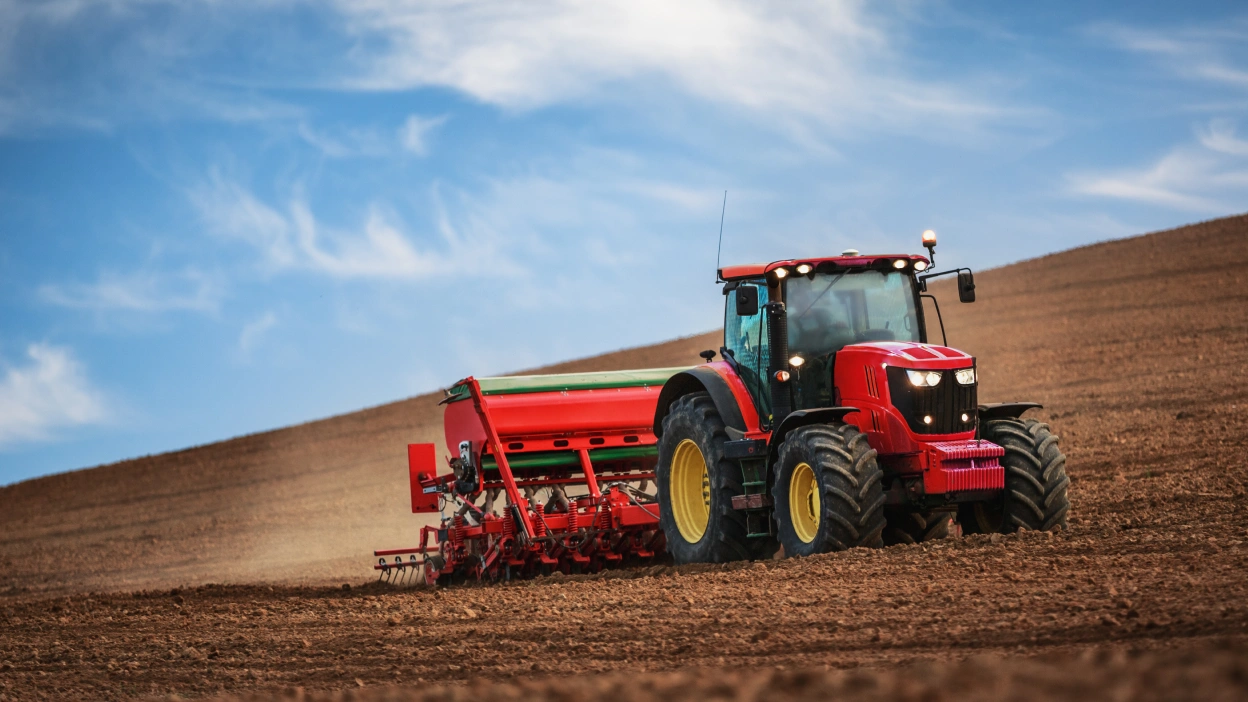
Modern farms rely on a mix of farm machinery and equipment to turn land, seed, and labor into predictable harvests. From compact tractors used on small-family plots to high-horsepower combines that feed global grain markets, each machine fills a clear role in planting, soil work, protection, harvesting, and transport. This guide lists the 20 most important farm vehicles, equipment types, and attachments, explains what they do, shows where they fit in a complete farm equipment list, and gives practical buying tips (including brand examples and cost ranges).
JumboBee helps farmers and dealers buy and sell equipment worldwide, find verified listings, secure payments, and international shipping options on JumboBee when you’re ready to buy or sell.
Core Farm Vehicles
This agriculture equipment list contains the core vehicles that are necessary for every farm.
1. Tractors
What they do
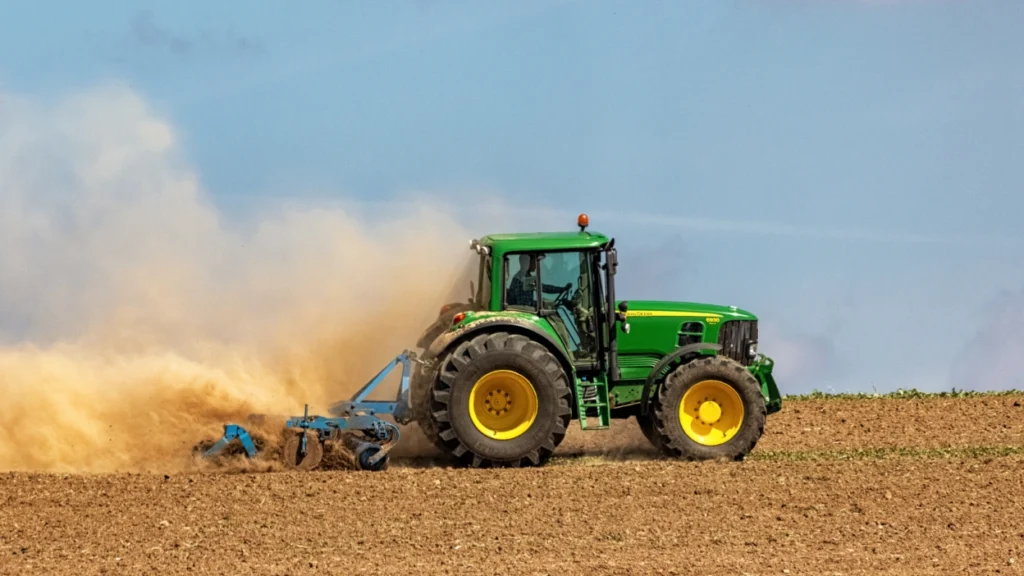
Tractors provide motive power and hydraulic/PTO interfaces to run implements (plows, mowers, seeders) and attachments (loaders, backhoes). They range from sub-compact (garden/amenity work) through compact utility, to large row-crop and high-horsepower articulated units for broadacre farms.
Common variants & brands
Kubota, John Deere, New Holland, Case IH, and Mahindra. Compact tractors (20–60 HP) for small farms; utility tractors (60–120 HP) for mixed farms; high-power tractors (150+ HP) for large commercial operations.
Price snapshot
Compact tractors often start in the low tens of thousands of USD (e.g., $20k–$40k for many 2025 compact utility models), while mid-range tractors frequently sit from $40k–$150k, and large specialty tractors can exceed $150k depending on options and autonomy packages.
2. Combine Harvesters
What they do
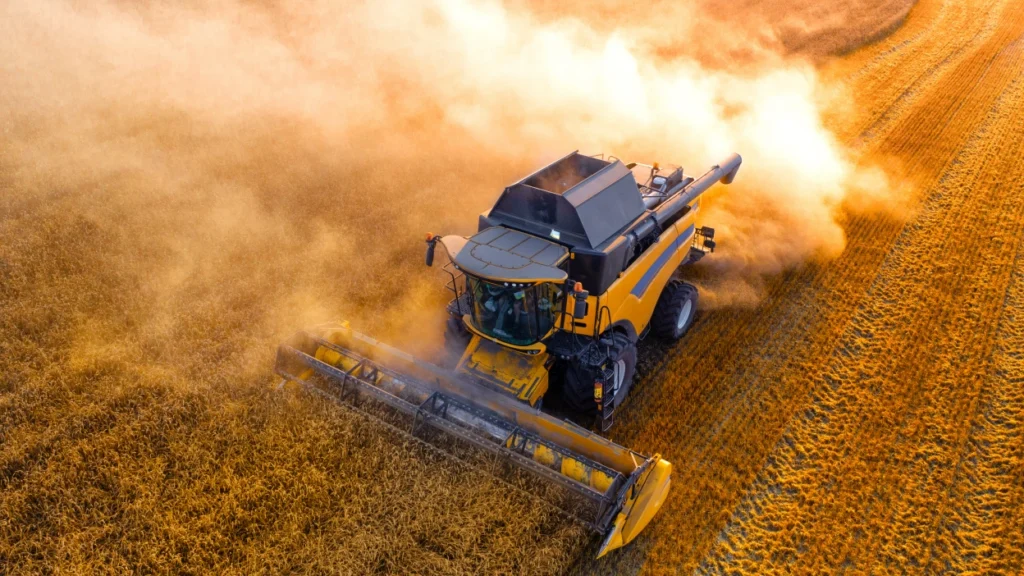
Combine harvesters cut, thresh, and clean cereal and oilseed crops in a single pass, turning standing crop into grain and straw. Models vary by capacity, header width, and onboard grain handling.
Popular brands & example uses
John Deere, Case IH, Claas, New Holland — large operators use wide headers and high-capacity threshing for wheat, corn, and soybeans.
Price snapshot
New self-propelled combines are a major capital purchase — typical 2024–2025 price ranges commonly quoted start around $400,000 and can exceed $1,000,000 for top-end models and large headers. Used combines are widely available at lower prices depending on age and hours.
3. Forage Harvesters
What they do
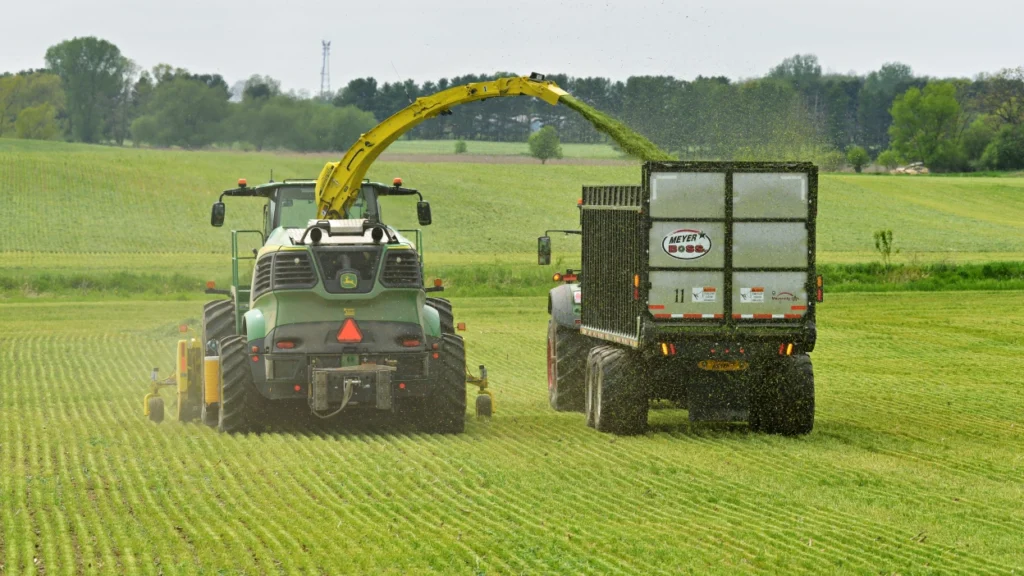
Forage harvesters, available in self-propelled or pull-type versions, chop whole plants such as corn, grass, and sorghum into silage for livestock feed. They use pickups, headers, and kernel processors to improve silage quality, making them essential on dairy and feedlot farms.
Brands & notes
Leading options include Claas (Jaguar series), John Deere (8000/9000 series), and New Holland (FR series). Models range from small-scale farm units to large contractor machines with advanced precision controls.
Price snapshot
Pull-type models may cost $50,000–$100,000, while self-propelled machines typically range from $150,000–$600,000+, depending on size and features.
4. Balers
What they do
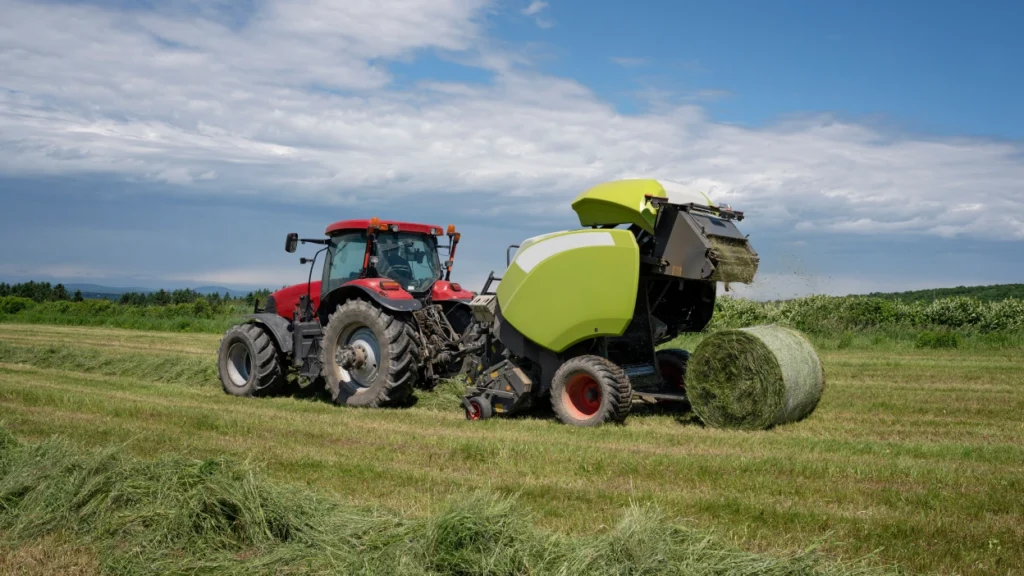
Balers compress forage, hay, or straw into manageable bales for storage, feeding, or transport. They are essential in haymaking and residue management, improving handling and reducing spoilage. Round balers are common for silage and hay, while large square balers suit mechanized stacking and long-distance shipping. Small square balers remain popular on smaller farms or for horse hay markets.
Variants
Round balers, small square balers, large square balers, and wrapper/baler combination units.
Price snapshot
Small square balers may cost $15,000–$35,000, round balers typically $30,000–$75,000, and large square balers $100,000–$250,000+.
5. Farm Trucks and ATVs
What they do
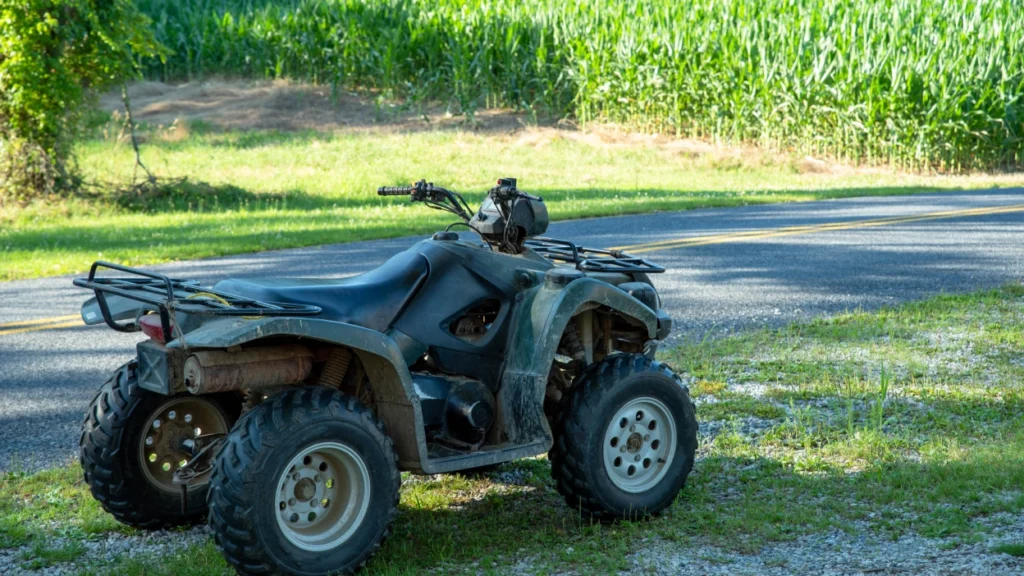
Farm trucks, ATVs, and UTVs provide mobility and efficiency across agricultural operations. They transport workers, tools, and supplies, support planting and harvesting crews, and tow small trailers or feed carts. ATVs are ideal for scouting fields or spraying small plots, while UTVs offer greater hauling capacity and multi-passenger seating. Pickup trucks remain the backbone of farm transport, handling heavier loads and road travel.
Popular types
Light-duty pickup trucks, 4×4 UTVs (e.g., Polaris Ranger, John Deere Gator), and ATVs for smaller tasks.
Price snapshot
ATVs typically cost $7,000–$15,000, UTVs $12,000–$30,000, and new farm pickups $35,000–$70,000+.
Soil Preparation (Tillage Equipment)
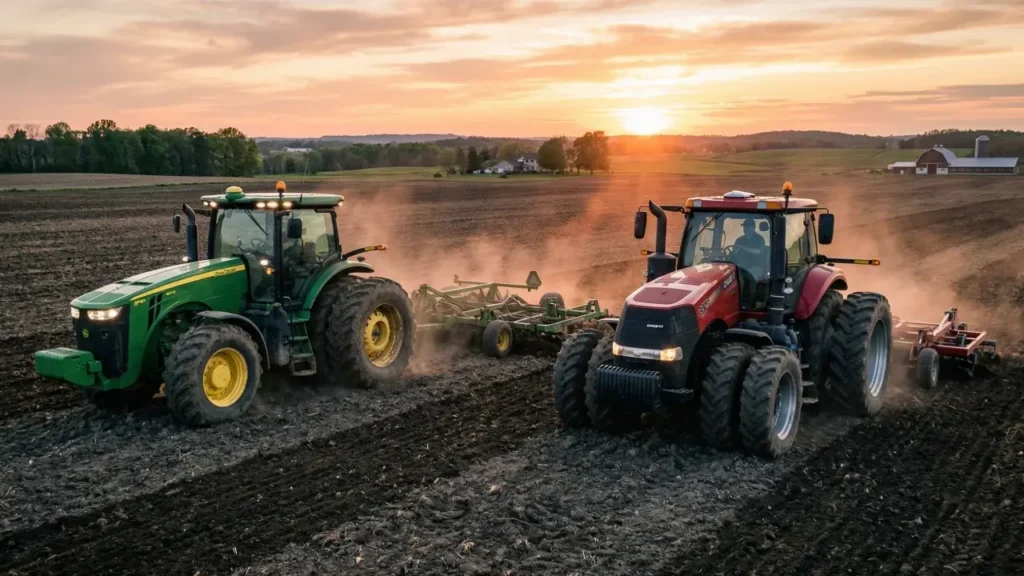
This farm equipment list contains the necessary attachments for soil cultivation.
6. Plows
What they do
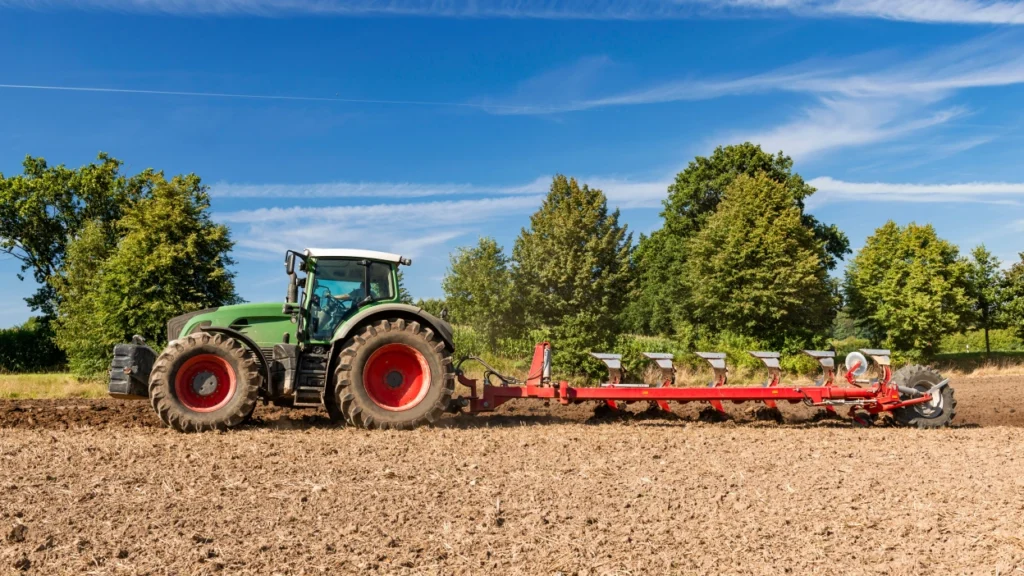
Plows are primary tillage implements that break and invert soil, burying crop residues and preparing fields for planting. They improve soil aeration and control weeds, but must be used carefully to avoid long-term compaction or erosion.
Types
Moldboard plows (full inversion), chisel plows (reduced inversion for conservation tillage), and disc plows (effective in rocky or root-filled soils).
When to use
Breaking heavy sods, incorporating residues, or reclaiming neglected fields.
Price snapshot
New mounted plows typically range from $5,000–$25,000, while larger semi-mounted or high-capacity chisel plows can exceed $40,000+.
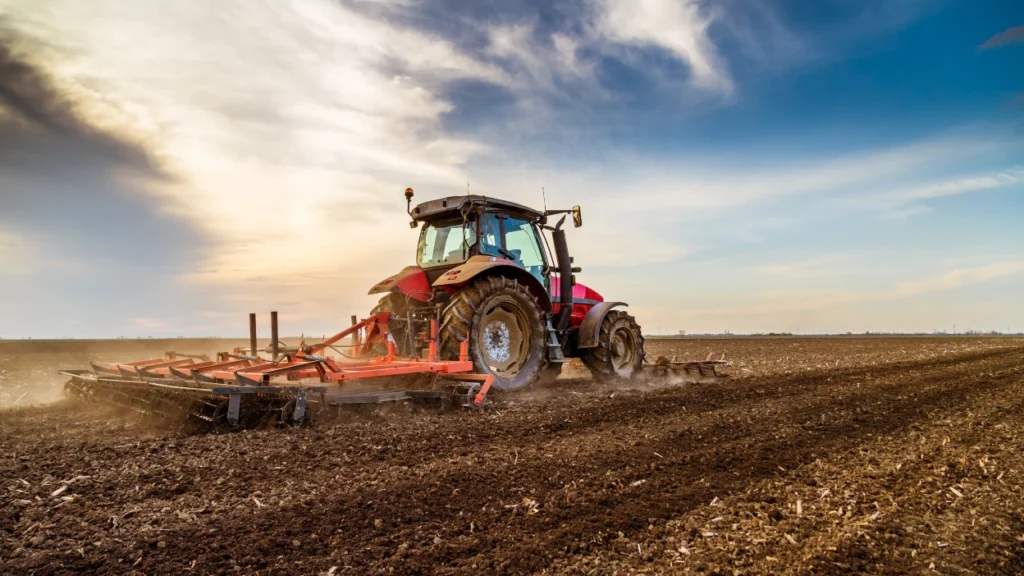
7. Harrows
What they do
Harrows are secondary tillage implements used to break up soil clods, smooth and level the seedbed, and incorporate crop residues or fertilizers. By refining the soil surface, they improve conditions for seed drills and planters, ensuring even germination.
Types
Disc harrows (cutting and mixing residues), tine harrows (light cultivation and weeding), and chain harrows (pasture and surface leveling).
Common combination
Often used after plowing or deep chiseling to create a fine, uniform seedbed before drilling.
Price snapshot
Small chain harrows may cost $1,000–$5,000, while heavy-duty disc harrows range from $10,000–$50,000+.
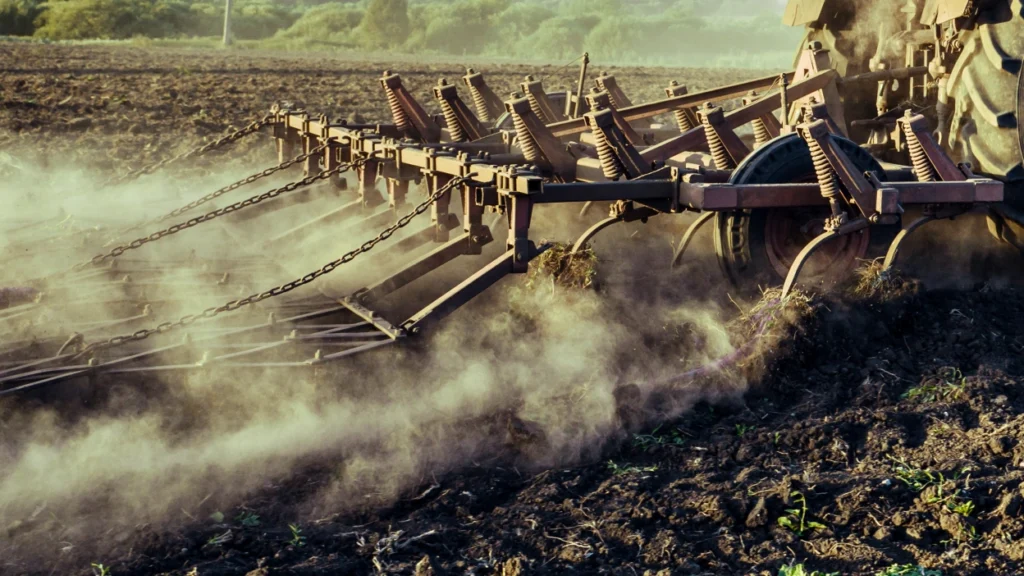
8. Cultivators
What they do
Cultivators are used for shallow tillage, running between crop rows to uproot weeds, loosen compacted topsoil, and prepare seedbeds in no-till or reduced-till systems. They help improve soil aeration and moisture retention while reducing reliance on herbicides. Modern precision models can operate with GPS or camera guidance to protect crops while targeting weeds.
Types
Spring-tine cultivators (light weeding), hoe cultivators (row crops), and inter-row mechanical weeders, including advanced camera-guided systems for organic farming.
Price snapshot
Basic mounted cultivators start around $3,000–$10,000, while advanced camera-guided or large tractor-mounted models range from $20,000–$80,000+.
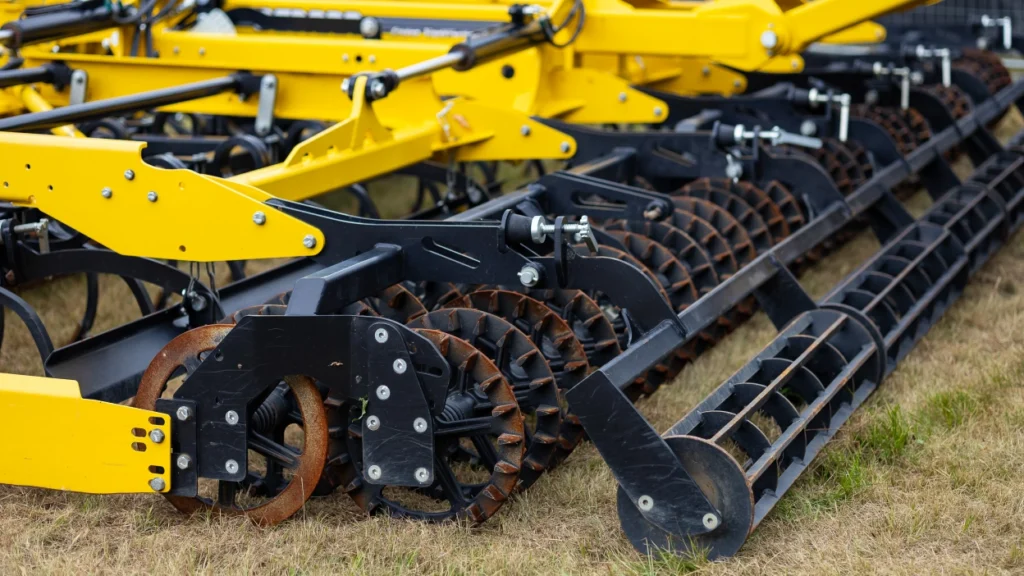
9. Rollers
What they do
Rollers are used after sowing to firm the seedbed, ensuring good seed-to-soil contact for uniform germination. They also help crush clods, level the surface, and improve moisture retention, which is particularly important for small grains and forage crops. Proper rolling can enhance crop emergence and early growth.
Types
Cambridge rollers (heavy-duty soil crushing), sheep-foot rollers (deep soil compaction), and stadium rollers (specialized for turf and fine seedbeds).
Price snapshot
Small to medium rollers typically cost $2,000–$10,000, while large tractor-mounted rollers can range from $15,000–$40,000+.
Planting & Seeding Equipment
In this part, you will have a look at planting and seeding equipment. This list also contains farm equipment with pictures and names.
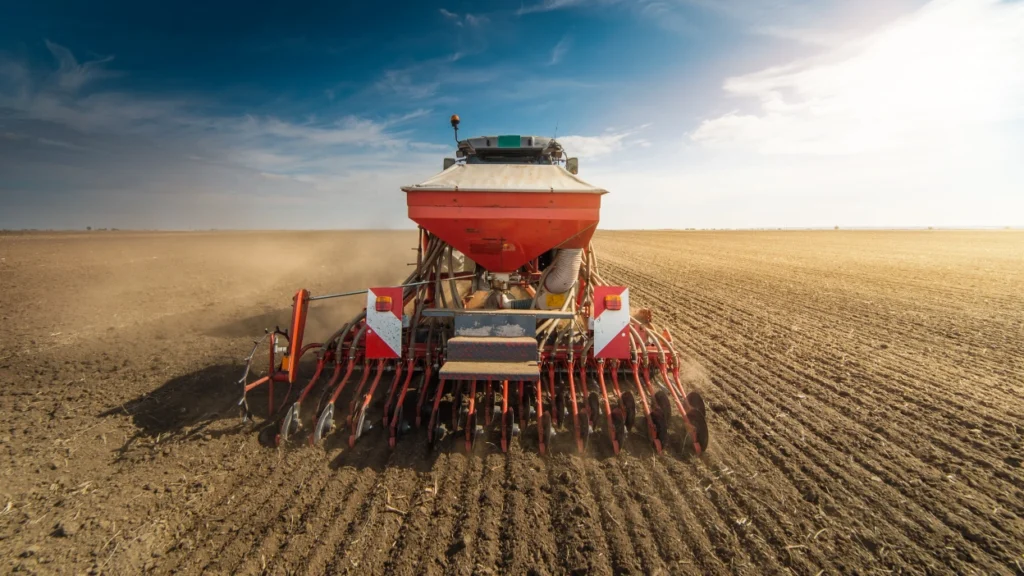
10. Seed Drills
What they do
Seed drills precisely meter and place seeds at consistent depths and spacing, improving germination rates and ensuring uniform crop growth. By minimizing seed waste and optimizing plant density, they contribute to higher yields and more efficient use of inputs. Seed drills can also incorporate small fertilizers simultaneously, enhancing early crop development.
Best for
Wheat, barley, oats, rye, and many cover crops.
Price snapshot
Small tow-behind or mounted seed drills typically range from $5,000–$20,000, while larger, high-capacity tractor-mounted or pneumatic drills can cost $25,000–$80,000+.
11. Planters
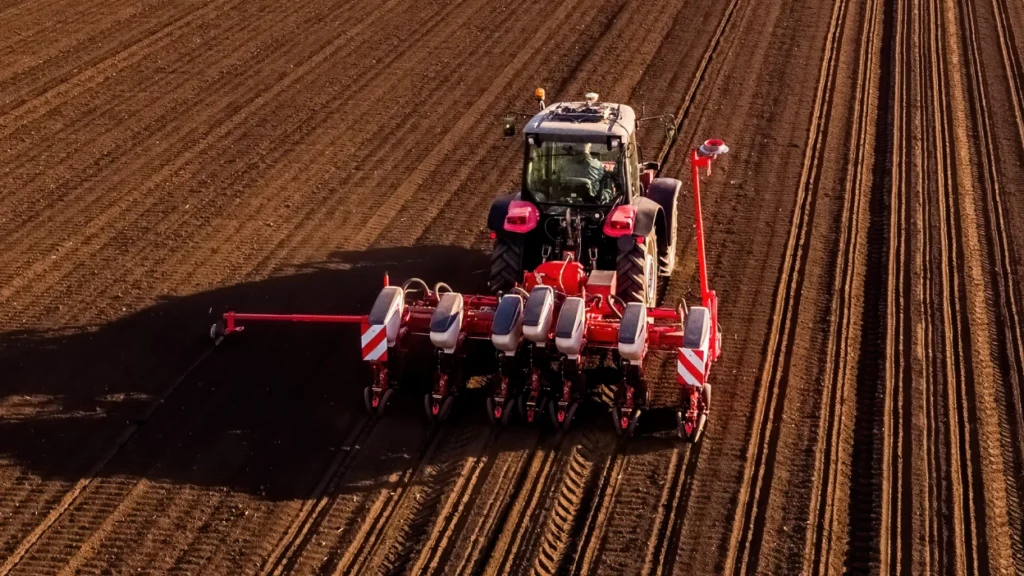
What they do
Row-crop planters place larger seeds such as corn, soybeans, and sunflowers at consistent row spacing and depth. Many models include population control systems and fertilizer placement, optimizing plant density and early growth. Precision planting reduces seed waste and increases yield potential, making planters essential for commercial grain and oilseed farms.
Variants
Vacuum planters, finger planters, and precision planters equipped with seed sensors for accurate metering and spacing.
Price snapshot
Small to medium planters range from $10,000–$40,000, while large, high-precision tractor-mounted units can cost $50,000–$150,000+.
12. Transplanters
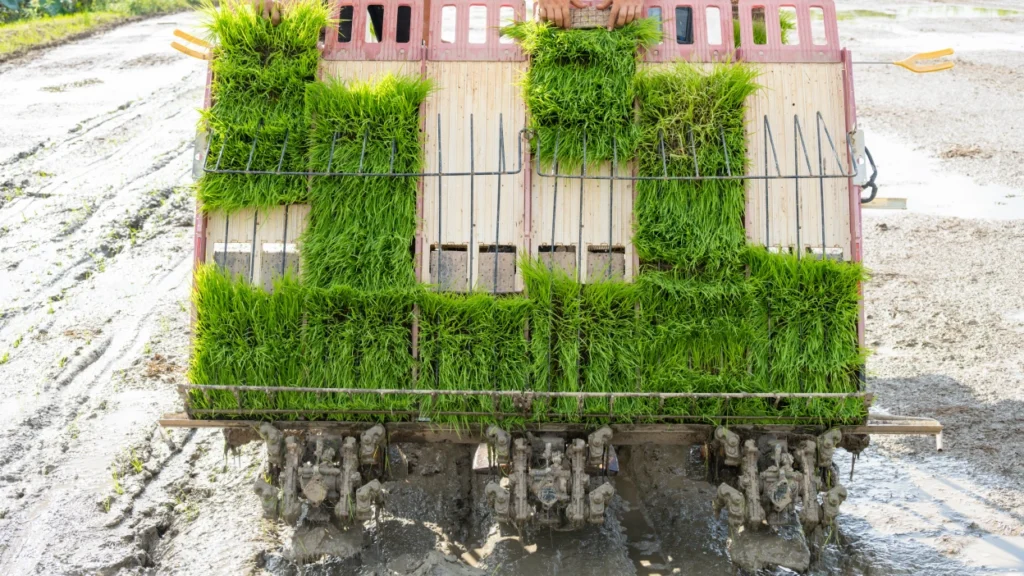
What they do
Transplanters mechanically place seedlings into fields, significantly speeding up planting compared to manual transplanting while preserving plant health. They are widely used in rice paddies, vegetable nurseries, and other crops where precise spacing and minimal root disturbance are critical for uniform growth.
Types
Rice transplanters, multi-row vegetable transplanters, tractor-mounted units, and walk-behind models for smaller operations. Modern versions may include adjustable row spacing and depth controls for different crops.
Price snapshot
Small walk-behind transplanters typically cost $3,000–$10,000, tractor-mounted units $15,000–$50,000, and large multi-row machines $60,000–$120,000+.
Crop Care and Protection
Care and protection machines and attachments contain different farm equipment with a diverse range of uses.
13. Sprayers
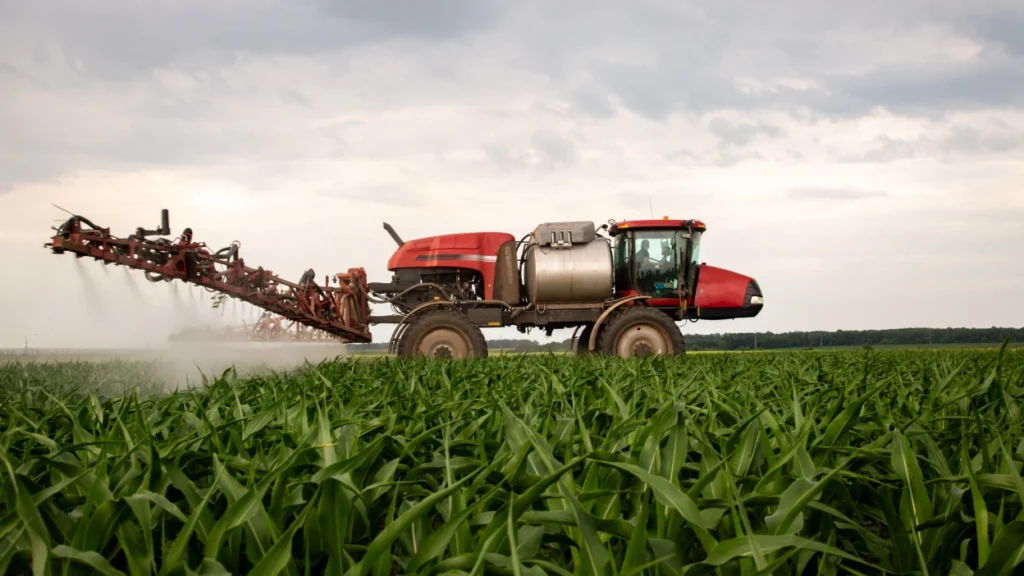
What they do
Sprayers distribute pesticides, herbicides, and foliar fertilizers uniformly across crops, helping protect yields and improve plant health. Options range from handheld backpack sprayers for small plots, boom sprayers for row crops, and air-blast sprayers for orchards, to UAV/drone sprayers for precise, targeted applications in modern precision agriculture.
Key features
Nozzle type and spacing, boom width, pump capacity, and GPS or auto-steer integration enhance coverage accuracy, reduce chemical waste, and improve operator safety.
Price snapshot
Backpack sprayers cost $50–$500, tractor-mounted boom sprayers $5,000–$25,000, and UAV/drone sprayers $3,000–$20,000+.
14. Spreaders
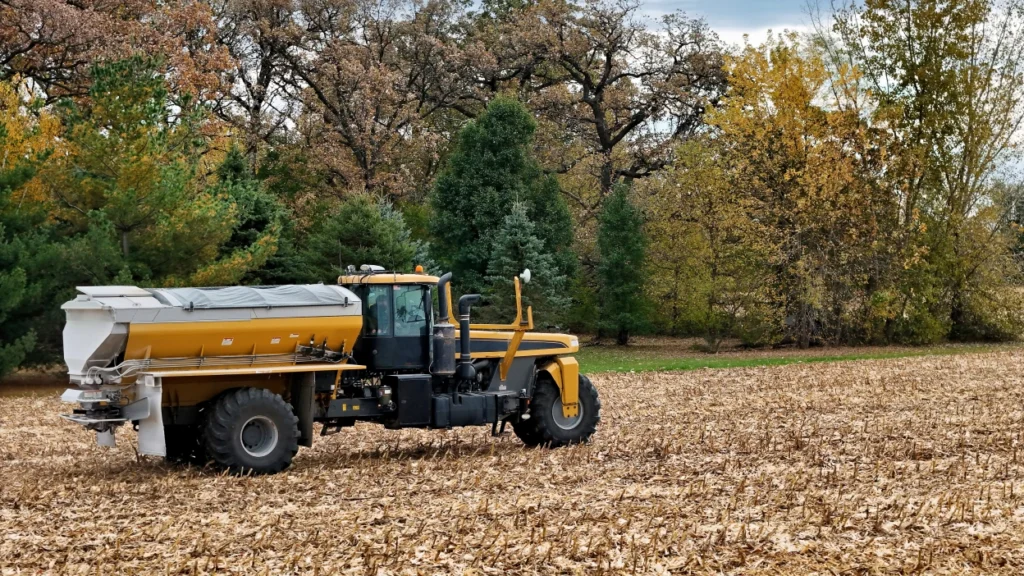
What they do
Spreaders distribute granular materials such as fertilizers, lime, or small-seed cover crops evenly across fields, supporting crop nutrition and soil health. Proper spreading ensures efficient use of inputs and prevents over-application, which can harm crops or the environment.
Types
Spreaders range from simple tow-behind broadcast units to tractor-mounted precision applicators with adjustable settings. Calibration, particle size, and overlap control are critical for uniform coverage and regulatory compliance.
Price snapshot
Small tow-behind spreaders typically cost $500–$2,500, medium tractor-mounted units $3,000–$12,000, and high-precision GPS-controlled applicators $15,000–$50,000+.
15. Irrigation Systems
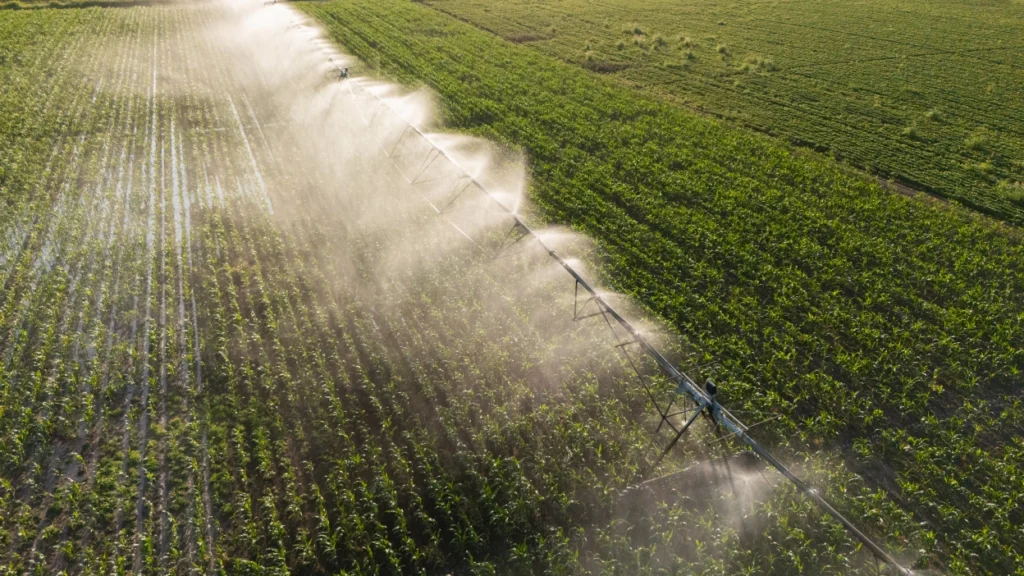
What they do
Irrigation systems deliver water efficiently to crops using methods such as center pivots, linear-move pivots, drip irrigation, and lateral-move systems. Proper selection depends on crop type, field topography, and water availability. These systems improve yields, reduce water waste, and support consistent growth in dry periods.
Trends
Many farms are adopting precision irrigation, including low-pressure pivots and drip systems, to conserve water, lower energy use, and enhance nutrient delivery directly to the root zone.
Price snapshot
Small drip setups cost $500–$5,000, medium pivot systems $25,000–$100,000, and large commercial center pivots $150,000–$500,000+.
Attachments & Implements
16. Front Loaders
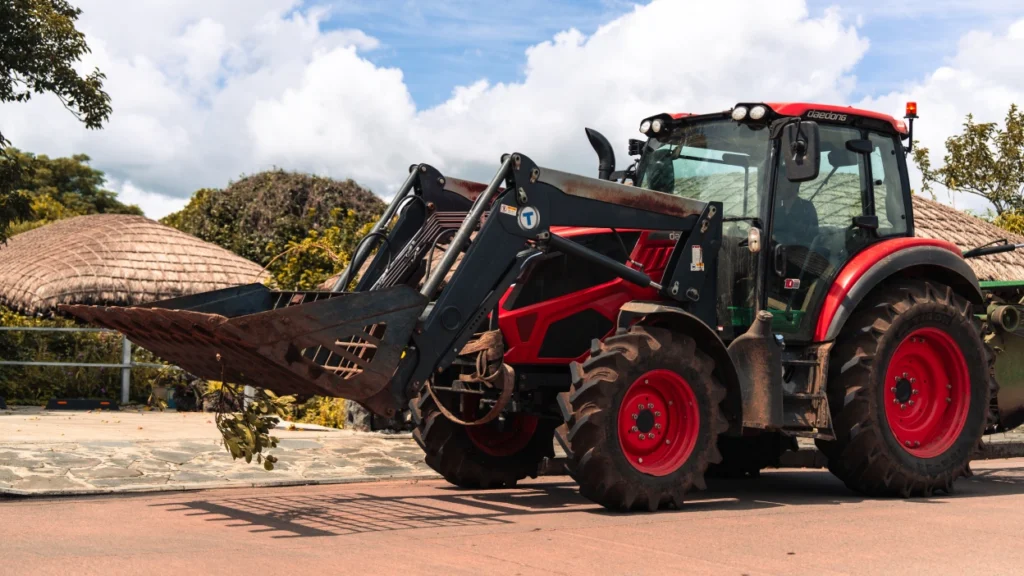
What they do
Front-end loaders attach to tractors to lift and move materials such as pallets, silage, grain, and soil. They also perform light earthmoving tasks, making them versatile tools for daily farm operations. Common attachments include buckets for general use, pallet forks for handling goods, and bale spears for forage management.
Compatibility
Loader frames and hydraulic connections are model-specific, so it is essential to ensure proper fit with the tractor and any attachments.
Price snapshot
Small tractor-mounted loaders typically cost $5,000–$15,000, while larger, heavy-duty models range from $20,000–$50,000+.
17. Backhoes
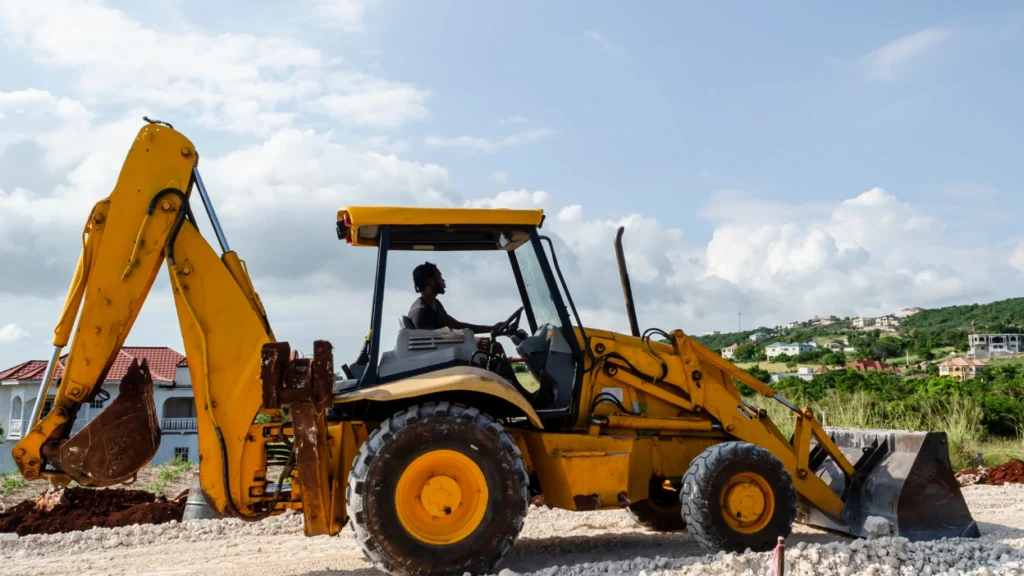
What they do
Backhoes are used for digging, trenching, and light excavation tasks such as installing irrigation lines, fence posts, or drainage systems. They provide precision digging while minimizing labor compared to manual methods.
Types
Available as tractor-mounted attachments for versatility or as dedicated mini-excavators for increased power and reach. Many modern backhoes include extendable arms, quick-attach buckets, and adjustable stabilizers for enhanced efficiency.
Price snapshot
Tractor-mounted backhoes typically cost $8,000–$25,000, while compact mini-excavators range from $25,000–$70,000 depending on size, power, and attachments.
18. Mowers and Rakes
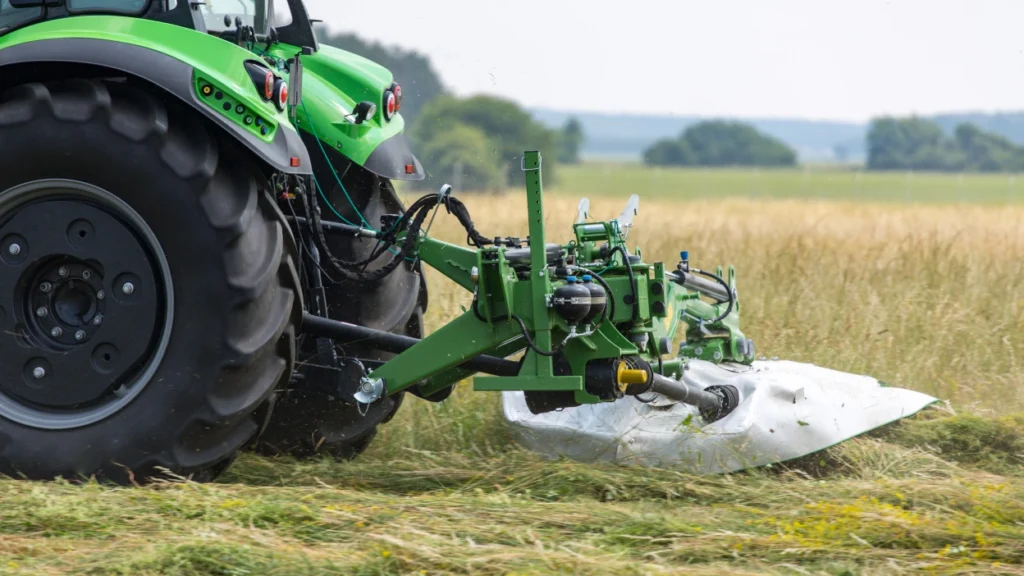
What they do
Mowers and rakes are essential for hay and forage management. Mowers cut crops, while rakes gather windrows for drying. Tedders spread and turn hay to accelerate curing, and mower-conditioners combine cutting and conditioning in a single pass for faster drying and higher-quality forage.
Types
Disc mowers, sickle-bar mowers, rotary rakes, tedder-conditioners, and integrated mower-conditioners.
Price snapshot
Small sickle-bar mowers cost $2,000–$5,000, disc mowers $5,000–$15,000, rotary rakes $4,000–$12,000, and full mower-conditioner units $15,000–$40,000+, depending on width and features.
19. Grain Carts & Wagons
What they do
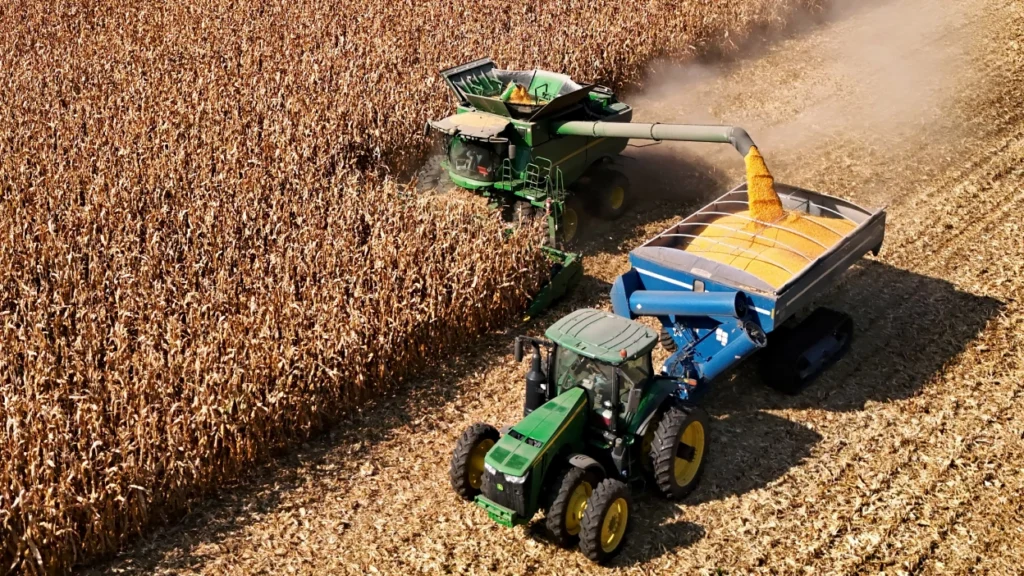
Grain carts transport harvested grain from fields to trucks or storage bins, allowing combines to operate continuously without stopping. They improve harvest efficiency and reduce downtime. Wagons and trailers also move bales, seed, fertilizer, and other farm inputs around the property.
Key choices
Farmers choose between auger and belt grain carts, matching capacity to combine throughput for optimal efficiency.
Price snapshot
Small tow-behind grain carts cost $10,000–$25,000, medium auger carts $30,000–$75,000, and large high-capacity belt or auger carts can exceed $100,000. Standard farm wagons and trailers range from $5,000–$20,000+.
20. Specialty Attachments (Blades, Post Hole Diggers, Snow Implements)
What they do
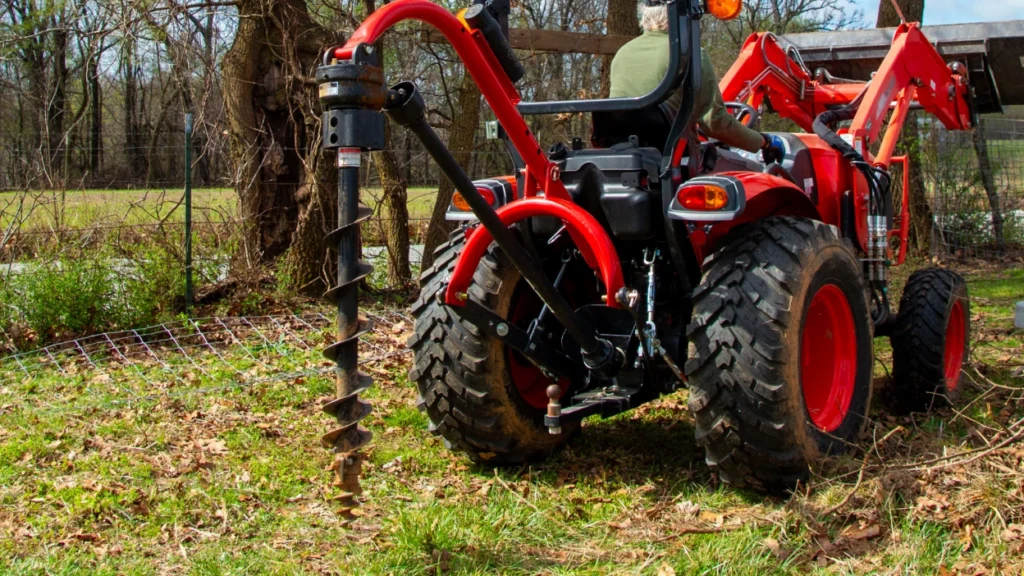
Specialty attachments expand tractor versatility for year-round tasks. These include grader blades for leveling, rear-mounted post-hole augers for fencing or planting, snow blowers for winter maintenance, pallet forks for material handling, and mower decks for turf management. They allow a single tractor to perform multiple jobs efficiently, reducing the need for separate machines.
Buying tip
Look for quick-attach systems and standard 3-point hitch compatibility to ensure flexibility and ease of use across different implements.
Price snapshot
Small attachments start around $500–$2,500, mid-range implements $3,000–$10,000, and large or heavy-duty attachments can exceed $20,000+.
Choosing the Right Mix of Vehicles and Attachments
How to determine essentials:
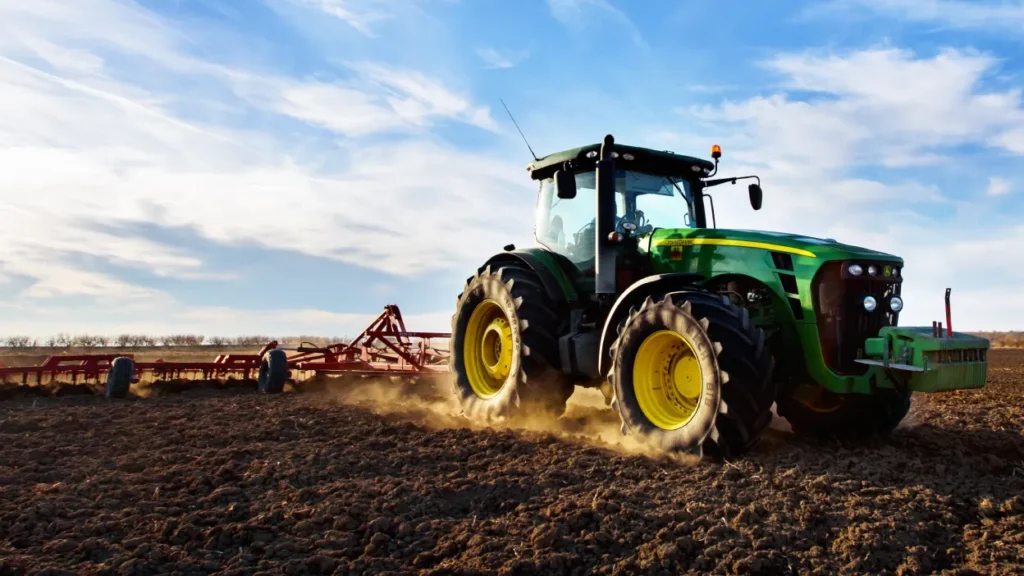
- Scale & crops: Small mixed farms value compact tractors, a mower, cultivator, and sprayer. Large grain farms need high-horsepower tractors, large planters, combines, and grain carts.
- Labor model: If labor is scarce, mechanize with larger implements or consider contractor services for occasional work.
- New vs used: New machines offer warranties and modern tech (precision guidance, telematics); used reduces upfront cost but requires inspecting wear points, hydraulics, engine hours, and service history.
- Attachments strategy: Buy multi-function implements (e.g., front loader + pallet forks + bale spear) that increase utilization. For small farms, prioritize a compact tractor with a loader, mower deck, and post-hole digger.
For step-by-step checks on buying and avoiding scams, see JumboBee’s How to Buy Farm Equipment Online guide.
Farm Equipment Costs
Typical price ranges
Compact tractors (20–60 HP)
Roughly $20,000–$40,000 for many new models (dealer pricing varies by region and options).
Mid-range farm tractors (60–150 HP)
Typically priced between $40,000 and $150,000, depending on the brand and options. (Examples: mainstream series from major OEMs).
Large specialty tractors / high-horsepower
Often $150,000+; top-of-line units and autonomy packages push prices higher.
Combine harvesters
$400,000 → $1,000,000+ for new self-propelled combines, depending on capacity and headers. Used machines can be found at much lower prices.
Implements (seeders, balers, sprayers)
Range widely — small seed drills and sprayers can be under $5,000, while large planters, sprayers, and balers can cost $30,000–$300,000 depending on size and automation.
Global market context & trends
The global agricultural machinery market has grown strongly through the early 2020s. Industry analyses show market sizes in the hundreds of billions USD, with annual growth driven by mechanization, precision agriculture adoption, and irrigation investments. Recent market estimates place the market in the ~$150–190 billion range in the mid-2020s, with continued expansion projected through the decade.
Regional demand trends to watch:
- Africa: increasing focus on mechanization programs, smallholder equipment access, and irrigation investments. Development organizations and regional programs are supporting mechanization to improve productivity and reduce post-harvest loss.
- Latin America (Brazil & Argentina): large agricultural exporters continue to invest in modern equipment — Brazil is expected to remain a high-growth market for tractors and combines even as macro conditions (interest rates, tariffs) create periodic uncertainty. Recent manufacturer statements and news coverage highlight Brazil’s growing importance to OEMs.
- Middle East & North Africa (MENA): governments investing in irrigation, greenhouse production, and precision systems are driving moderate equipment demand; market reports project steady growth in the region.
Other forces shaping the market:
Conclusion
Combining a small set of core machines (tractor, planter/seed drill, sprayer, and harvester appropriate to your crops) with a flexible set of attachments (loader, mower, backhoe, post-hole digger) lets most farms maximize equipment utilization and cost-effectiveness. Whether you operate a family farm or a commercial enterprise, align purchases to crop needs, labor availability, and cash flow: buy new where warranty/tech matters, buy used where cost savings outweigh support needs, and consider contractors for occasional, high-cost tasks.
Buy and sell farm equipment safely with JumboBee. Verified listings, secure payments, and global shipping make international deals easier.



Be the first to leave a comment
There are no replies to this post yet. Share your thoughts and help start the conversation.