Buying
Construction projects live and die by their schedules and budgets. Yet research from McKinsey shows that nearly 9 out of 10 construction projects exceed their planned timelines or budgets, often because of poor efficiency in construction processes. Labor shortages, equipment downtime, and miscommunication all contribute to delays that drain profits and tarnish a company’s reputation.
The good news: these issues are avoidable. By combining modern equipment with lean management and data-driven practices, contractors can significantly boost labor productivity while cutting costs.
This guide reveals 10 real-world strategies on how to improve construction productivity without burning out your team or your budget. Each tactic is backed by industry examples and actionable steps, helping project managers, contractors, and equipment buyers create smarter, faster, and more profitable job sites.
Why Efficiency in Construction Matters
Improving efficiency in construction isn’t just about finishing faster—it’s about protecting margins, maintaining a competitive edge, and winning repeat business. When labor productivity is high, projects meet deadlines, equipment usage is optimized, and unexpected expenses shrink.
Consider two similar commercial builds. One follows a standardized workflow and uses equipment telematics to monitor downtime. The other relies on manual reporting and outdated machines. The first project can save weeks on the schedule and hundreds of thousands of dollars in labor and fuel. That ROI difference can determine whether a contractor thrives or struggles to bid competitively.
Efficiency also influences reputation. Clients remember a company that finishes early and under budget, and they share those experiences with peers—effectively becoming a low-cost marketing channel.
10 Strategies to Improve Construction Productivity

Below are ten proven strategies for improving efficiency in construction. Some focus on equipment investments, others on management and process improvements. Together, they create a comprehensive plan to lift productivity across every stage of a project.
1. Invest in the Right Equipment
At the foundation of any efficient construction project is the equipment being used. Modern, well-maintained machinery doesn’t just make tasks faster, it also improves safety, reduces labor strain, and minimizes the likelihood of expensive breakdowns that can halt progress. For instance, GPS-enabled excavators and graders provide precision that older machines simply cannot match, reducing grading time by as much as 30 percent by eliminating repeated passes. This kind of accuracy also leads to better material usage, fewer errors, and a smoother overall workflow.
However, choosing the right equipment is about more than simply opting for the newest technology. The best fit depends on aligning machine capacity with the specific requirements of the project. Oversized gear often burns unnecessary fuel and requires more space to operate, which can be inefficient in tight worksites. Conversely, undersized machinery struggles to keep up with workload demands, resulting in delays and extra wear and tear. Contractors should conduct a thorough cost-benefit analysis that takes into account purchase price, potential rental options, fuel efficiency, availability of spare parts, maintenance schedules, and expected usage over the project timeline.
Beyond productivity gains, smart equipment investments also contribute to sustainability goals. Newer models are typically more energy-efficient and equipped with emission-reduction technology, helping companies meet environmental regulations and strengthen their reputation for responsible building practices. When considered holistically, the right equipment investment becomes more than a cost—it becomes a long-term asset that enhances competitiveness and client trust.
2. Standardize Workflows with Technology
Consistency is one of the cornerstones of efficiency in construction, yet many projects still rely on fragmented communication and manual processes that create confusion. Standardizing workflows with technology not only brings order to complex operations but also ensures that all stakeholders, contractors, subcontractors, suppliers, and clients, are aligned from the very beginning of the project. Cloud-based project management platforms, construction-specific ERPs, and mobile tracking applications act as centralized hubs where every update is visible in real time. This means timesheets, task assignments, asset tracking, and progress reports are always current, reducing the chances of overlooked tasks or duplicated efforts.
The benefits extend beyond visibility. When updates flow instantly across platforms, managers can identify bottlenecks before they escalate into delays. For example, if a delivery is running late or a crew finishes ahead of schedule, resources can be reallocated immediately, keeping the project moving at full speed. Mobile accessibility is especially valuable in construction, as field teams can upload photos, log safety checks, and report progress directly from the job site without waiting to return to the office.
Automation further enhances these gains. Repetitive but essential tasks—like generating safety checklists, sending reminders about inspections, or scheduling deliveries—can be handled by software, freeing supervisors to focus on higher-value planning and decision-making. This shift not only saves time but also reduces human error, which is often a source of costly rework.
Ultimately, standardizing workflows through technology transforms a traditionally paper-heavy, reactive industry into a more agile and proactive environment. By ensuring that everyone works from the same playbook, projects become easier to manage, more predictable in their outcomes, and significantly more efficient overall.
3. Preventive Maintenance for Equipment
Few factors can cripple a construction site faster than equipment downtime. A single crane failure can idle dozens of workers, stall entire project phases, and trigger costly delays that ripple across schedules and budgets. While reactive repairs may seem unavoidable, most of these breakdowns can be prevented through disciplined, proactive maintenance. Treating maintenance as an investment rather than an expense not only preserves productivity but also extends the lifespan of valuable assets.
A strong preventive maintenance plan should be structured and systematic. Start with scheduled servicing based on operating hours—rather than waiting for visible wear, service machines at regular intervals to keep them performing at peak capacity. Telematics systems now make this process smarter by continuously monitoring performance. Sensors can detect unusual vibrations, overheating, or irregular fluid levels, alerting managers before minor issues become catastrophic failures.
Beyond routine servicing, predictive analytics powered by AI and machine learning takes preventive care to the next level. By analyzing usage data across fleets, software can forecast when specific components are likely to fail, allowing parts to be replaced before they break. This approach reduces downtime to a minimum and optimizes inventory management, since replacement parts are ordered precisely when needed instead of sitting unused in storage.
Regular inspections by trained operators and mechanics remain an essential part of the equation. Daily walk-arounds to check tires, hydraulics, safety systems, and fuel levels create another layer of protection. When paired with digital maintenance logs, these inspections build a comprehensive record that improves accountability and ensures compliance with safety regulations.
The payoff is twofold: fewer costly disruptions during active projects and a significant reduction in the total cost of ownership for every machine. Well-maintained equipment runs more efficiently, consumes less fuel, and lasts longer, maximizing return on investment. In short, preventive maintenance transforms equipment from a potential liability into a consistent, high-performing asset that keeps construction sites running smoothly.
4. Optimize Site Layout and Logistics
The physical organization of a job site has a direct impact on how efficiently crews can work. A poorly planned layout often leads to wasted motion, unnecessary hauling, and time lost simply moving materials, equipment, or workers from one place to another. These inefficiencies may seem minor on a daily basis, but they add up to significant delays over the course of a project. Studies show that smart site planning can reduce internal travel and material handling by 10–20 percent, which translates into measurable productivity gains and cost savings.
The key is to design the site strategically before ground is broken. Start by mapping out material staging zones as close as possible to the points of use. This minimizes hauling distances, reduces the risk of materials being misplaced, and ensures crews spend their time building instead of searching for supplies. Similarly, planning access roads for one-way traffic helps reduce congestion, avoids bottlenecks during peak hours, and makes it easier for heavy equipment and delivery trucks to move in and out of the site safely.
Another important element is dedicated parking and equipment storage areas. When cranes, loaders, and service vehicles are parked without a clear system, cross-path conflicts are inevitable, creating both safety hazards and delays. By assigning specific zones for equipment parking and tool storage, crews can quickly access what they need without interrupting the flow of other operations.
Technology can also support logistics optimization. Drones and 3D site modeling software allow managers to visualize and simulate different layouts before construction begins, testing scenarios to find the most efficient configuration. As the project progresses, real-time tracking apps can help monitor material movements and adjust staging zones as needs change.
Ultimately, a well-organized job site keeps workers focused on building rather than hauling, searching, or waiting. The result is not only faster progress but also improved safety, smoother coordination, and higher morale among crews who can see that their time and effort are being used effectively.
5. Skilled Labor and Ongoing Training
Even the most advanced machinery cannot deliver results without skilled operators behind the controls. A construction workforce that is well-trained in both equipment operation and lean construction practices consistently performs tasks more quickly, with greater accuracy, and with fewer safety incidents. Skilled workers know how to maximize the capabilities of modern machines, anticipate problems before they occur, and adapt to changing site conditions—all of which contribute directly to project efficiency.
However, skills in construction are not static. New technologies, updated safety standards, and evolving project delivery methods mean that ongoing training is essential. Companies that invest in upskilling programs ensure that their employees remain competitive and capable of using the latest tools, whether that means mastering GPS-enabled machinery, learning how to operate drones for site surveying, or integrating data into construction management software. This not only increases productivity but also reduces downtime caused by operator errors or steep learning curves.
Cross-training is another powerful strategy. When workers are trained to perform multiple roles, teams gain the flexibility to adjust when schedules shift, absences occur, or project demands suddenly change. For example, a crew member who is certified to operate both forklifts and excavators can step in where needed, minimizing disruptions and keeping workflows smooth. This versatility also strengthens collaboration on site, as team members better understand the interdependencies of each role.
Beyond efficiency, investing in training pays off in workforce morale and retention. Employees who feel valued and supported in their professional growth are more motivated, engaged, and loyal. Retaining skilled labor reduces recruitment costs, lowers the risks associated with onboarding inexperienced workers, and creates a culture of pride and consistency within the company.
Building a highly skilled workforce is not just about improving output—it’s about future-proofing the business. A team that can adapt to new technologies, embrace lean construction methods, and seamlessly cover multiple roles is a long-term asset that ensures projects are delivered safely, on time, and to the highest standards.
6. Implement Lean Construction Principles
Lean construction adapts principles from manufacturing’s “just-in-time” approach to the unique challenges of building projects. Its primary goal is to reduce waste—not only of materials, but also of time, labor, and motion—by ensuring that resources are available precisely when and where they are needed. By minimizing unnecessary steps and redundancies, lean practices allow construction teams to operate more efficiently, reduce costs, and complete projects on schedule.
One of the foundational strategies is just-in-time material delivery. Instead of stockpiling large quantities of materials on site, deliveries are scheduled to coincide with the moment crews are ready to use them. This reduces clutter, minimizes handling, prevents material damage, and decreases the risk of loss or theft. It also allows for better use of limited site space, which is especially critical on urban or tightly constrained projects.
Another key component is breaking projects into smaller, clearly defined tasks. By mapping out work in short, manageable segments, managers and teams can identify bottlenecks early, adjust sequencing, and eliminate inefficiencies before they escalate. This task-level visibility fosters accountability, promotes better coordination among crews, and makes progress more measurable.
Daily “stand-up” meetings complement this approach by providing a quick, structured forum for teams to review progress, discuss obstacles, and plan the day’s work. These brief check-ins ensure that problems are addressed immediately rather than being discovered too late, reducing downtime and preventing small issues from compounding into major delays.
According to the Lean Construction Institute, adopting these methods can boost overall efficiency in construction by 20 percent or more. Beyond time and cost savings, lean practices improve safety, reduce stress on crews, and foster a culture of continuous improvement, where every team member is actively engaged in identifying and eliminating waste. Over time, these incremental gains accumulate, resulting in projects that are not only faster and cheaper but also higher in quality and reliability.
7. Use Data-Driven Decision Making
Modern construction sites are increasingly complex, generating massive volumes of data every day. Fuel consumption, machine idle time, equipment usage patterns, worker attendance, and weather-related delays are just a few examples. Left unmonitored, this information can be overwhelming—but when captured and analyzed through equipment sensors, telematics platforms, and integrated project management software, it becomes a powerful tool for improving efficiency in construction.
Analytics turn raw data into actionable insights. For instance, telematics might reveal that certain machines are idling for hours each day, signaling a need to adjust schedules, redistribute tasks, or even optimize fleet size. Similarly, tracking fuel consumption and maintenance trends can highlight underperforming equipment, enabling proactive replacement or repair before costly downtime occurs. Historical performance data also improves forecasting and bidding accuracy, allowing managers to predict labor and material requirements more reliably and reduce the risk of cost overruns.
Data-driven decision-making extends beyond equipment. Monitoring project timelines, task completion rates, and subcontractor performance provides a comprehensive view of workflow efficiency, helping managers identify bottlenecks and areas for process improvement. By grounding decisions in measurable information rather than relying solely on intuition, project teams can make smarter, faster choices that directly impact productivity.
Ultimately, integrating analytics into everyday construction operations empowers managers to continuously optimize resources, refine workflows, and maximize output. The result is not just faster project completion but a measurable, repeatable improvement in performance—making data one of the most effective levers for improving efficiency in construction across every stage of a project.
8. Prioritize Safety to Prevent Downtime
Every safety incident on a construction site carries consequences far beyond the immediate injury. Lost labor hours, potential regulatory fines, insurance claims, and reputational damage all accumulate quickly, undermining both efficiency and profitability. Establishing a strong culture of safety is therefore not only a moral obligation—it is a strategic investment that directly supports productivity and project success.
A proactive approach begins with high-quality personal protective equipment (PPE), including helmets, gloves, high-visibility clothing, and safety harnesses. Ensuring that every worker has access to the right gear—and knows how to use it properly—reduces the likelihood of accidents. Clear, documented safety protocols should accompany PPE requirements, covering everything from machinery operation and hazardous material handling to emergency response procedures. These protocols must be accessible, consistently enforced, and periodically reviewed to reflect changing site conditions or updated regulations.
Regular training refreshers are essential to reinforce safe practices and maintain awareness. Training sessions can cover both general construction safety and site-specific risks, from working at heights to electrical hazards. Incorporating scenario-based exercises, toolbox talks, and digital safety modules ensures that safety knowledge is retained and actively applied.
Beyond rules and equipment, fostering a safety-first culture is critical. When crews see that leadership genuinely prioritizes their well-being, compliance naturally rises. Workers feel valued, more confident, and more motivated, which reduces mistakes and accelerates workflows. Proactively managing risks also minimizes unplanned stoppages due to accidents, keeping projects on schedule and avoiding costly delays.
Ultimately, safety and efficiency are deeply interconnected. By investing in equipment, protocols, training, and a culture of accountability, construction firms not only protect their workforce but also create conditions that allow teams to operate at peak productivity while reducing the hidden costs associated with workplace incidents.
9. Improve Communication Across Teams
“Lost information equals lost hours.” In construction, poor communication is one of the most significant hidden barriers to efficiency. Misunderstandings or delays in sharing critical details can force crews to redo work, pause operations while waiting for clarifications, or make decisions based on incomplete information—all of which erode productivity and increase costs.
To address this, construction firms are increasingly turning to centralized messaging platforms, on-site chat applications, and collaborative project boards. These tools replace fragmented phone calls, emails, and paper memos with a single, accessible communication hub where updates are posted in real time. Crew members, supervisors, and managers can quickly share progress reports, upload photos, flag issues, and confirm instructions, reducing misunderstandings and keeping everyone aligned.
Effective communication extends beyond internal teams. Coordinating multiple subcontractors is often one of the trickiest aspects of a construction project. Electricians, plumbers, crane operators, and delivery drivers all need timely information about scheduling changes, material availability, and safety requirements. With clear, real-time channels, updates reach the right people instantly, minimizing delays caused by missed handoffs or conflicting priorities.
Regular structured check-ins, such as daily briefings or weekly coordination meetings, complement digital tools by providing a platform to discuss upcoming tasks, highlight potential bottlenecks, and reinforce shared goals. When these communication practices are combined with technology, they create a culture of transparency, accountability, and collaboration.
Ultimately, improving communication across teams doesn’t just prevent errors—it actively enhances workflow efficiency. By ensuring that every team member has the information they need when they need it, projects move more smoothly, decisions are made faster, and resources are used more effectively. Clear, timely communication is a critical lever for boosting productivity and maintaining momentum on complex construction sites.
10. Partner with Reliable Suppliers
Even the most well-organized construction site can grind to a halt if critical materials arrive late, are delivered in poor condition, or fail to meet specifications. Supply chain disruptions not only delay work but can also force crews to improvise or pause entirely, creating cascading effects on schedules and budgets. Partnering with reliable suppliers is, therefore a crucial strategy for maintaining consistent productivity and ensuring smooth project execution.
The first step is careful vetting. Review historical on-time delivery rates, examine past client feedback, and verify quality standards. A supplier who consistently meets deadlines and provides high-quality materials reduces the risk of rework and keeps crews focused on building rather than troubleshooting problems. Additionally, financial stability is an important consideration. Suppliers facing cash flow issues or operational challenges may struggle to deliver, leaving your project vulnerable to mid-phase disruptions.
Establishing long-term agreements with trusted suppliers can further strengthen your supply chain. Contracts that prioritize your orders during peak seasons, secure bulk pricing, or include contingency plans create a more predictable and reliable flow of materials. These partnerships allow you to plan with confidence, reducing uncertainty and avoiding last-minute sourcing challenges.
Reliable suppliers effectively become an extension of your team. When communication is clear and expectations are shared, materials arrive on time, in spec, and ready for use, which directly supports project efficiency. Beyond timing, strong supplier relationships also open the door to collaboration, early access to new products, and support during unexpected challenges.
In summary, selecting and nurturing dependable supplier partnerships is not just a logistical necessity—it is a strategic approach to improving efficiency in construction. By ensuring materials flow seamlessly to the site, contractors can focus on what they do best: executing the project safely, on schedule, and to the highest standards.
Common Barriers to Construction Efficiency (And How to Avoid Them)
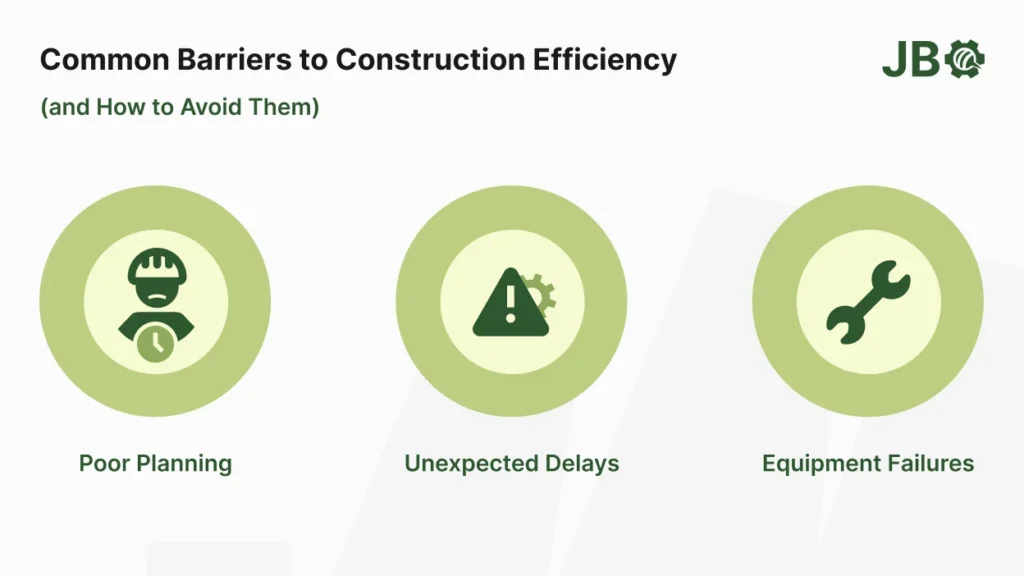
Even with a strong plan, several recurring obstacles can derail productivity. Understanding these pitfalls helps contractors stay proactive.
1. Lack of Transparency
One of the most common barriers in construction projects is the lack of transparency in progress and reporting. When data is siloed or inconsistently communicated, small problems like material shortages, minor delays, or unexpected cost increases often go unnoticed. By the time managers realize there’s an issue, the project may already be running behind schedule or exceeding the budget. This creates stress across teams, damages client trust, and often results in expensive last-minute adjustments.
To avoid this, construction firms should adopt tools and processes that make visibility a priority. Real-time dashboards can track budgets, timelines, and resource allocation, ensuring decision-makers always have access to up-to-date information. Additionally, requiring daily progress logs not only keeps team members accountable but also helps detect patterns before they grow into serious issues. When combined, these practices build a culture of transparency that minimizes surprises, strengthens collaboration, and keeps projects on track.
2. Outdated Equipment
Another significant barrier to construction efficiency is relying on outdated machinery. While older equipment may seem cost-effective in the short term, it often results in higher long-term expenses and operational headaches. Aging machines typically consume more fuel, require frequent repairs, and lack the precision, safety features, and digital integrations found in modern models. These issues not only slow down productivity but also increase the likelihood of project delays, unplanned downtime, and safety risks on-site.
Contractors should look beyond the purchase price and assess the total cost of ownership. This includes fuel usage, maintenance expenses, spare parts availability, operator downtime, and even the impact on project speed and accuracy. In many cases, upgrading to newer equipment—or renting when purchase isn’t feasible—provides better performance, reliability, and cost savings over time. Modern machines are also more energy-efficient and often equipped with smart technology, making it easier to track usage, predict maintenance needs, and maximize output. By making proactive investment decisions, construction firms can avoid inefficiencies caused by outdated equipment and maintain a competitive edge.
3. Poor Coordination Among Stakeholders
Construction projects typically involve a wide network of participants—general contractors, subcontractors, suppliers, architects, engineers, and clients. While each plays a critical role, misalignment between these groups can quickly spiral into scheduling chaos. For example, if a supplier misses a delivery date or a subcontractor completes their portion late, it can cause ripple effects across the entire project timeline. Miscommunication often leads to duplicated work, idle labor, and disputes over responsibilities, all of which undermine efficiency and increase costs.
A key solution is to establish a single point of accountability. Designating a central project manager ensures that someone is consistently monitoring progress, resolving conflicts, and keeping all stakeholders aligned with the overall schedule. Beyond leadership, technology plays an equally important role. Collaborative planning and scheduling software allows all parties to access the same real-time information, update their status, and anticipate upcoming tasks. This reduces guesswork, minimizes delays, and builds trust across the team.
When stakeholders are well-coordinated, resources are better allocated, schedules remain realistic, and unexpected changes can be managed without derailing the project. In short, effective coordination transforms a potentially fragmented process into a streamlined operation that keeps productivity high and conflict low.
4. Inadequate Training
Even with the best equipment and strongest project plans, construction efficiency suffers when workers are not fully trained to use the tools and technology available to them. Modern construction sites increasingly rely on advanced machinery, digital project management platforms, and automated systems. When crews are unfamiliar with these resources, productivity slows, errors increase, and safety risks rise. For instance, an operator unsure how to use a GPS-enabled grader may take longer to complete tasks, waste materials, or require repeated corrections. Similarly, employees who do not understand scheduling or reporting software may fail to provide accurate updates, reducing transparency and slowing down decision-making.
The solution lies in treating training as an ongoing investment rather than a one-time expense. Regular training sessions—covering both technical equipment operation and digital tool usage—help workers stay confident, efficient, and adaptable. Cross-disciplinary skill development is equally valuable, as it enables team members to step in across roles when needed, reducing downtime caused by absences or labor shortages. Training also boosts morale, showing employees that the company values their growth and safety, which in turn improves retention.
By building a culture of continuous learning, construction firms not only avoid costly mistakes but also unlock the full potential of their workforce. Skilled, versatile, and confident employees become an asset that consistently drives projects forward with greater speed, precision, and quality.
Building Smarter, Not Harder
Boosting efficiency in construction doesn’t require sweeping changes overnight. Instead, small, consistent improvements—whether through data analytics, lean workflows, or preventive maintenance—compound into major gains.
By applying these ten strategies, construction companies can control costs, protect margins, and finish projects ahead of schedule. The key is to view productivity as a continuous process rather than a one-time initiative.
Ready to put these ideas into practice? Explore JumboBee’s equipment selection and price insights to find the machinery that aligns with your productivity goals and budget.