


 Equipment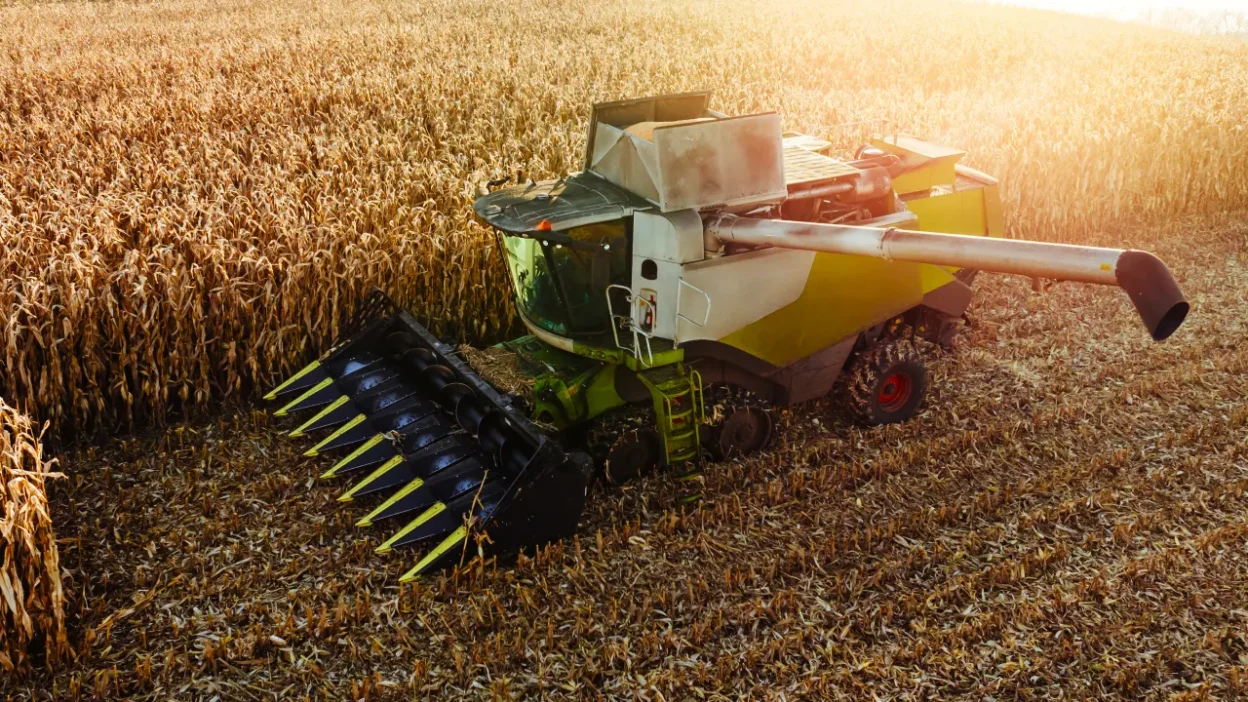
Corn is one of the most productive and widely grown crops on the planet. In the United States alone, farmers planted around 98 million acres of corn in 2025, according to USDA data. That scale of production doesn’t happen with hand tools and guesswork. It happens because of the right machinery, running at the right time, doing exactly what each stage of the crop cycle demands.
Whether you’re farming 200 acres in Iowa or managing a 5,000-acre operation in Nebraska, your profitability is tied directly to the equipment decisions you make. Get those decisions right, and your yields go up, your input costs go down, and your operation runs smoothly from spring planting through fall harvest. Get them wrong, and you’re losing money on every pass across the field.
This guide walks you through all the major categories of corn farm equipment — what each machine does, why it matters, and what to expect in terms of scale and investment. It’s practical, direct, and built around how modern corn farming actually works in 2026.
What Equipment Is Needed for Corn Farming
Corn production follows a clear seasonal cycle, and each stage requires different tools. Here’s a quick overview before we go deep:
| Stage | Primary Equipment |
|---|---|
| Soil Preparation | Tractors, plows, subsoilers, disc harrows, cultivators |
| Planting | Corn planters, precision seeders, fertilizer applicators |
| Crop Care | Boom sprayers, self-propelled sprayers, fertilizer spreaders |
| Harvesting | Combine harvesters, corn headers, grain carts |
| Drying and Storage | Grain dryers, storage bins, augers, conveyors |
Every one of these stages depends on reliable, properly sized equipment needed for corn farming. Miss one link in that chain and the entire season suffers.
Soil Preparation Equipment for Corn Farming
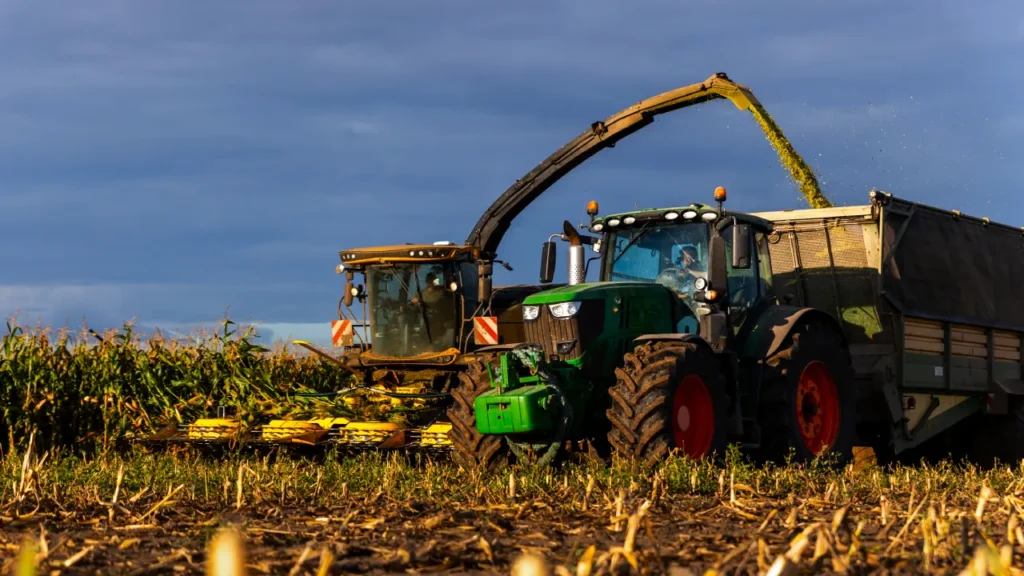
Soil preparation is where every corn crop begins. Poor seedbed preparation leads to uneven germination, shallow root growth, and inconsistent yield. Modern corn farms invest heavily in tillage equipment to set the crop up for success from day one.
Tractors Used in Corn Farming
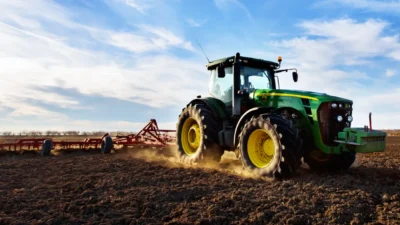
Tractors are the backbone of every farming operation. They power almost every implement used in corn production, from plows to planters to grain carts.
For corn farming, horsepower requirements depend directly on farm size:
- Small farms (under 500 acres): 150–250 HP tractors are common. A John Deere 6R 155 or a Case IH Maxxum 150 fits well here.
- Mid-size farms (500–2,000 acres): 250–370 HP range. The John Deere 8R series is very popular in this category.
- Large operations (2,000+ acres): 400–600+ HP four-wheel-drive tractors. The John Deere 9R 490 or Case IH Steiger 580 are typical choices.
A 400 HP tractor pulling a 40-foot field cultivator can cover roughly 200 acres per day at 6 mph working speed. That kind of throughput matters when your planting window is just 10–14 days in May.
Plows and Subsoilers
Plows break up the top layer of compacted soil and bury crop residue from the previous season. In heavy clay soils — common across Illinois and Indiana — a moldboard plow can flip soil 10–12 inches deep, exposing fresh, uncompacted layers to air and early-season sun.
Subsoilers go deeper, typically 16–24 inches, fracturing hardpan layers that block root penetration and trap water. On fields with a compaction layer sitting at 14 inches, a subsoiler can increase corn yield by 15–25 bushels per acre. That’s a measurable return on a one-pass investment.
Disc Harrows and Field Cultivators
Once the primary tillage is done, disc harrows and field cultivators create the final seedbed. Disc harrows chop and incorporate residue, while field cultivators level the surface and break up clods left behind by plowing.
A well-run field cultivator leaves a seedbed that’s firm enough to support seed-to-soil contact but loose enough for easy germination. For corn, you’re aiming for a tillage depth of 2–4 inches during final prep, which is roughly the same depth you’ll plant your seed.
Corn Planting Equipment
Planting is arguably the highest-stakes operation in corn farming. Every acre you plant with poor spacing, wrong depth, or inconsistent soil contact costs you at harvest. Corn planting equipment has evolved significantly, and modern precision systems can genuinely make the difference between 180 bu/acre and 220 bu/acre on the same field.
Corn Planters
A modern corn planter is a precision machine. It places each seed at a target depth — typically 1.5 to 2 inches — and at precise row spacing, usually 30 inches for most U.S. corn production.
Key features on current planters include:
- Individual row electric drive: Each row unit has its own drive motor, allowing seed rates to vary across the field based on soil type.
- Downforce control: Adjusts row unit pressure in real time to maintain consistent depth.
- Seed population control: Most fields target 32,000–36,000 seeds per acre, adjusted by hybrid and soil conditions.
A 24-row, 30-inch planter covers roughly 12 acres per hour at 5.5 mph. On a 3,000-acre corn operation, that’s a critical asset when you’re racing against weather in April and May.
Seed Drills and Precision Planters
Standard seed drills are better suited to small grains like wheat or soybeans. For corn, dedicated row-crop planters outperform drills on nearly every metric: seed spacing accuracy, depth consistency, and singulation rate.
Precision planting systems — like those offered by Precision Planting or integrated into John Deere’s ExactEmerge — use high-speed electric drives and sensors to place seeds at exact intervals even at 8–10 mph planting speeds. That’s a significant throughput gain for large operations without sacrificing accuracy.
Fertilizer Application Equipment
Most corn growers apply a starter fertilizer at planting — typically a liquid nitrogen-phosphorus blend placed 2 inches beside and 2 inches below the seed (the 2×2 placement). This gives seedlings an early nutrient boost in cold soils when natural nutrient availability is limited.
Planter-mounted fertilizer systems include a dedicated tank, pump, and row-unit applicator tubes. This corn farming equipment keeps the operation efficient by combining two passes — fertilizing and planting — into one.
Equipment for Crop Care and Field Maintenance
After planting, the crop needs protection and nutrition throughout a 120–150 day growing season. That means multiple passes with sprayers and spreaders, as well as cultivation in some systems.
Sprayers for Herbicides and Pesticides
Weed control is critical for corn. Uncontrolled weed pressure can reduce yield by 50% or more in severe cases, according to Iowa State University Extension.
Two main sprayer types dominate corn farming:
- Self-propelled sprayers: High-clearance machines with 100–130 foot booms and 1,200–1,500 gallon tanks. A machine like the John Deere R4038 or Case IH Patriot 4450 can cover 500+ acres per day. These are the workhorses for large corn operations.
- Pull-type boom sprayers: Tractor-pulled, usually with 60–90 foot booms. A solid mid-range option for farms in the 500–1,500 acre range.
GPS-guided section control systems on modern sprayers automatically shut off boom sections when overlapping, cutting product waste by 5–10% on average.
Choosing between self-propelled and pull-type sprayers often depends on farm size and budget. Many buyers review available models and specifications online before purchasing, comparing options across regions and sellers.
Fertilizer Spreaders
Side-dress nitrogen application is standard practice on most corn farms. Nitrogen is applied as the crop approaches the V6 stage (6th leaf visible), typically 4–6 weeks after planting. Liquid nitrogen (28% UAN or anhydrous ammonia) is injected directly into the soil using toolbar applicators pulled by high-horsepower tractors.
For broadcast applications of dry fertilizer — phosphorus, potassium, or lime — twin-spinner spreaders mounted on tractors or high-clearance floater trucks are widely used. A floater with a 40-foot spread pattern can cover 600–800 acres per day.
Cultivators for Row Crop Maintenance
Row crop cultivators are less common than they were 30 years ago — herbicide programs have largely replaced mechanical weeding on large farms. However, they remain valuable tools for organic corn producers and for any operation dealing with herbicide-resistant weeds, which have become a growing concern across the Corn Belt.
A modern 12-row cultivator running between 30-inch rows can cover 150–200 acres per day and does double duty by slightly mounding soil toward the base of corn plants, which supports root development and drainage.
Corn Harvesting Equipment
Harvest is the payoff of an entire season’s work. It’s also where equipment failure costs the most — a combine breakdown during peak harvest can mean significant loss if the weather turns or grain moisture climbs.
Combine Harvesters
Combines are the single most expensive and most critical piece of equipment in corn farming. A modern corn combine performs three operations simultaneously: cutting the standing crop, threshing the grain from the cob, and separating clean grain from chaff and stover.
Current high-capacity combines — like the John Deere S780 or the CLAAS Lexion 8900 — are equipped with rotary threshing systems that can process 70–100 bushels per minute. On a field averaging 200 bu/acre, that translates to roughly 5–7 acres per hour per combine.
Combine capacity is measured in engine horsepower (550–700+ HP on flagship models) and grain tank size (typically 400–450 bushels). A 450-bushel grain tank on a 200 bu/acre field needs to unload every 2.25 acres — which is why grain carts matter so much.
Corn Headers
A combine needs the right header to harvest corn efficiently. Corn headers are row-specific attachments — an 8-row, 12-row, or 16-row header guides individual corn stalks into the machine, snapping the ear from the stalk before feeding it into the threshing system.
In 2025–2026, 12-row and 16-row corn headers (on 30-inch row spacing) are standard for large farm combines. A 16-row, 30-inch corn header covers a 40-foot swath per pass. Some headers now include active stalk rolls and adjustable snapping plates to reduce grain loss, which can otherwise run 1–3% of total yield if equipment isn’t properly calibrated.
Grain Carts and Transport Equipment
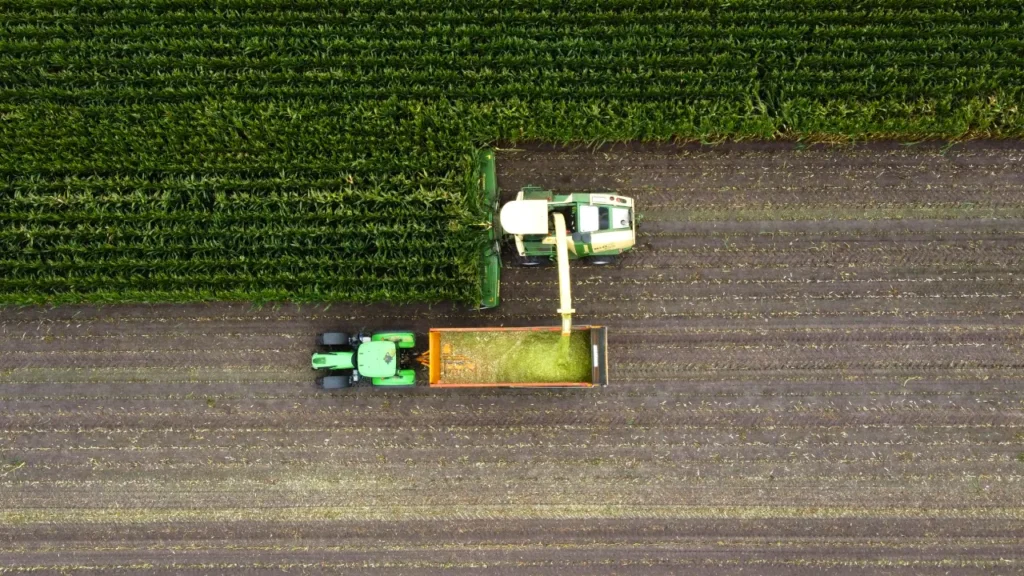
Grain carts allow combines to unload on the go — keeping harvesting continuous rather than stopping at the end of each pass. A tractor-pulled grain cart with a 1,000–1,500 bushel capacity follows the combine through the field, then hauls to a waiting semi-truck at the field edge.
On a 3,000-acre corn farm at 200 bu/acre, you’re moving 600,000 bushels of grain in roughly 3–4 weeks. That requires multiple grain carts, transport tractors, and semi-trucks running coordinated logistics around the clock.
Equipment for Corn Drying and Storage
Corn harvested in October often comes off the field at 20–25% moisture. Safe long-term storage requires 13–14% moisture. That gap is bridged by grain drying equipment.
Grain Dryers
Continuous-flow grain dryers are the industry standard for large corn operations. Natural gas or propane-fired, they remove moisture by circulating heated air through a column of moving grain. A mid-size tower dryer can process 3,000–5,000 bushels per hour, removing one point of moisture per pass.
Drying corn from 22% down to 14% costs approximately $0.04–0.06 per bushel per point of moisture removed, depending on fuel prices. On 100,000 bushels, that’s $32,000–$48,000 in drying costs for an 8-point reduction. It’s a major operating expense — and a reason many farmers invest in precision harvest timing to bring corn off as dry as possible.
Grain Bins and Storage Silos
On-farm grain storage gives farmers control over when they sell, avoiding the post-harvest price dip that hits every October when millions of bushels hit the market simultaneously.
Steel grain bins with aeration systems are standard. A 48-foot diameter bin holds roughly 50,000 bushels. A farm storing 300,000 bushels on-site needs 6 bins of that size, plus aeration fans, temperature cables, and bin monitoring systems.
Augers and Grain Conveyors
Moving grain between combines, carts, trucks, dryers, and bins requires augers and conveyors. Portable swing augers (8–10 inch diameter) handle loading and unloading individual bins. Permanent grain legs — vertical bucket elevator systems — move grain at 20,000–30,000 bushels per hour in large commercial setups.
For mid-size farms, a quality 10-inch, 70-foot portable auger running at 10,000 bu/hour is enough to keep bins filled during harvest.
Typical Cost of Corn Farming Equipment
Here’s a realistic price range for major equipment categories in 2026, covering both new and used machinery:
| Equipment | New Price Range | Used Price Range |
|---|---|---|
| Row crop tractor (250–400 HP) | $280,000–$500,000 | $120,000–$350,000 |
| Corn planter (12–24 row) | $150,000–$450,000 | $60,000–$220,000 |
| Self-propelled sprayer | $350,000–$700,000 | $120,000–$350,000 |
| Combine harvester | $500,000–$900,000 | $150,000–$550,000 |
| Corn header (12–16 row) | $60,000–$150,000 | $25,000–$80,000 |
| Grain cart (1,000 bu) | $40,000–$75,000 | $15,000–$40,000 |
| Grain dryer (continuous flow) | $80,000–$250,000 | $30,000–$100,000 |
| Grain bins (per 50,000 bu) | $70,000–$120,000 | Varies |
Used machinery is a smart path for smaller and growing operations. A well-maintained used combine with 1,000–1,500 hours can perform comparably to a new unit at 40–60% of the price.
How Farmers Choose Corn Farming Equipment
Farmers evaluate equipment based on several interconnected factors:
- Farm size: A 300-acre operation doesn’t need a 700 HP combine. Oversized equipment drives up ownership cost per acre.
- Field conditions: Wet, heavy soils need higher-horsepower tractors and larger-flotation tires. Sandy soils have different tillage requirements.
- Yield goals: Higher yield targets demand more planting precision and higher harvest capacity.
- Budget: Most operations finance major equipment over 3–7 years, weighing purchase price against annual cost per acre.
- Compatibility: New equipment needs to work with existing machinery. A new planter rated for 40 mph transport doesn’t help if your tractor tops out at 25 mph.
Many farmers now use online marketplaces to compare equipment specifications, pricing, and availability across multiple sellers before making purchasing decisions.
Common Mistakes When Buying Corn Farming Equipment
Even experienced farmers make costly equipment decisions. Watch out for these patterns:
- Buying too large for the operation: A 600 HP tractor on a 400-acre farm adds $50,000+ in annual ownership costs without increasing output.
- Ignoring maintenance costs: A cheap combine with worn rotor concaves or failing feeder house components can cost $20,000–$40,000 per season in downtime and repairs.
- Compatibility mismatches: A precision planter designed for 36-volt electrical systems won’t integrate cleanly with older tractors. Always verify compatibility before purchase.
- Underestimating storage needs: Many operations scale up corn acreage without scaling grain storage, forcing early sales at post-harvest low prices every year.
- Skipping inspections on used equipment: Hours on the meter don’t tell the whole story. A 500-hour combine that spent those hours harvesting green, wet corn may have more wear than a 1,200-hour machine harvesting dry wheat.
Final Thoughts: Building Right Equipment Fleet for Corn Farming
Building a functional, efficient equipment fleet for corn production is a long-term process. You don’t need to own everything from day one — many operations start with a core set of corn farming equipment and expand as acreage and cash flow grow.
The key is matching your equipment to your scale, your soil, and your production goals. A well-maintained 300 HP tractor, a 16-row planter, a self-propelled sprayer, and a reliable combine with the right corn header will get a 2,000-acre corn operation through the season efficiently. Add grain storage, and you control your own marketing timeline.
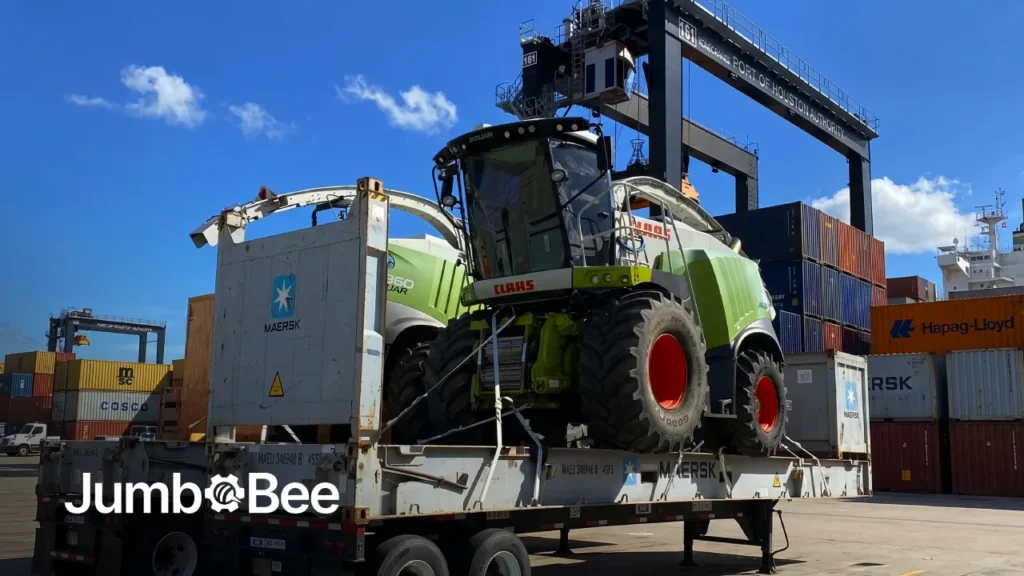
If you’re in the market for corn planting equipment, combines, tractors, or any other corn farm equipment, platforms like JumboBee let you browse verified listings from sellers across the U.S. and globally, compare specs side by side, and access full shipping and logistics support. Whether you’re sourcing locally or importing machinery internationally, having a marketplace that handles inspection, customs, and delivery in one place saves time and reduces risk significantly.


Be the first to leave a comment
There are no replies to this post yet. Share your thoughts and help start the conversation.