


 Trends
Navigating the machinery market requires more than just looking at sticker prices. As we move through 2026, global supply chains have stabilized, but tightening emission standards and shifting interest rates are creating a complex landscape for buyers and sellers. Understanding how heavy equipment values change over time is the ultimate key to maximizing your budget and protecting your investments.
Buying a tractor or an excavator is a massive financial commitment. If you buy at the peak of the market, you risk losing thousands of dollars the moment the market cools down. If you sell too late, you might miss out on peak demand. To trade smarter, you must learn to read the market, understand depreciation math, and evaluate machines like an expert.
This guide will break down the exact factors that drive price fluctuations. You will learn how to evaluate overpriced machines, spot undervalued gems, and time your transactions perfectly.
Core Mechanics of Value Loss
Before looking at external market forces, you must understand the internal math of machinery ownership. Machines are physical assets that wear down with every hour of use. Understanding exactly how equipment loses value is the foundation of smart fleet management.
Mechanics of Depreciation
Just like passenger vehicles, construction and agricultural machines drop in value the moment they leave the dealership. However, heavy equipment depreciation follows a specific curve. The steepest drop happens in the first twelve months. After this initial shock, the value decline slows down and becomes more predictable.
Most standard machines lose between 20 and 40 percent of their original retail price during the first year. Following that, the equipment depreciation rate usually settles between 10 and 15 percent per year, calculated on the remaining value, not the original price.
Let us look at a practical calculation. Imagine you purchase a brand-new wheel loader for $200,000.
- Year 1: The machine experiences a 25 percent initial drop. It loses $50,000 in value. The new value is $150,000.
- Year 2: The machine drops by a standard 12 percent equipment depreciation rate. It loses $18,000 (12 percent of $150,000). The new value is $132,000.
- Year 3: The machine drops by another 12 percent. It loses $15,840. The new value is $116,160.
By understanding how equipment loses value over a standard lifecycle, you can estimate what your machine will likely be worth three or five years from now. This lets you plan your eventual resale with far less guesswork.
Hours Versus Age
Calendar age is only half of the story. Heavy equipment values are heavily tied to operating hours. A three-year-old excavator with 6,500 hours will usually have a lower used value than a five-year-old excavator with only 1,500 hours.
Every machine category has an expected annual usage. For example, a standard farm tractor might average 400 to 600 hours per year. A construction excavator might run 1,000 to 1,500 hours per year. When a machine significantly exceeds these averages, buyers will demand a steep discount because major component overhauls are approaching faster than normal.
Macro Factors Driving Market Shifts in 2026
Internal math is important, but external forces dictate the broader heavy equipment market trends. The year 2026 brings specific economic conditions that directly impact what buyers are willing to pay and what sellers can demand.
Supply and Demand Dynamics
When manufacturers face production delays, new machines become scarce. Buyers who need equipment immediately are forced to look at the secondary market. This surge in demand pushes heavy equipment prices upward. We saw extreme versions of this a few years ago, where slightly used machines were selling for nearly the same price as new ones.
Today, OEM production lines are running smoothly. Dealership lots are full of new inventory. Because new machines are readily available, used equipment price trends are normalizing. Sellers can no longer demand premium prices for heavily used machines because buyers have alternative options.
Impact of Interest Rates
Financing costs dictate purchasing power. When central banks raise interest rates, borrowing money becomes expensive. For the same monthly payment, a buyer who could afford roughly a $300,000 loan at 4 percent might only manage around $265,000 at 8 percent – and the gap widens on shorter loan terms.
High interest rates generally put downward pressure on heavy equipment values. Buyers have less capital to spend, which forces sellers to lower their asking prices to close deals. Tracking national interest rate announcements is a useful way to anticipate short-term equipment value trends.
Environmental Regulations
Emission standards are a long-running pressure on equipment values. In the US, EPA Tier 4 Final has been the governing standard for off-road diesel engines since its full phase-in around 2015, and the EU’s Stage V has been fully enforced since 2021. A stricter US standard – California’s proposed CARB Tier 5 – is still working through rulemaking and is not expected to take effect until the late 2020s at the earliest. Many government infrastructure contracts now require Tier 4 Final–compliant (or cleaner) machinery, which steadily erodes demand for older, high-emission engines in regulated markets.
This regulatory shift creates a fascinating split in equipment value trends. Older, high-emission machines are rapidly losing value in strict regulatory zones like California or Western Europe. However, these same machines are highly sought after in regions with less strict regulations, such as parts of Africa, South America, or the Middle East. Buyers in these regions prefer older machines because they lack complex computer sensors and are easier to repair in the field.
Spotting Geographic Price Differences
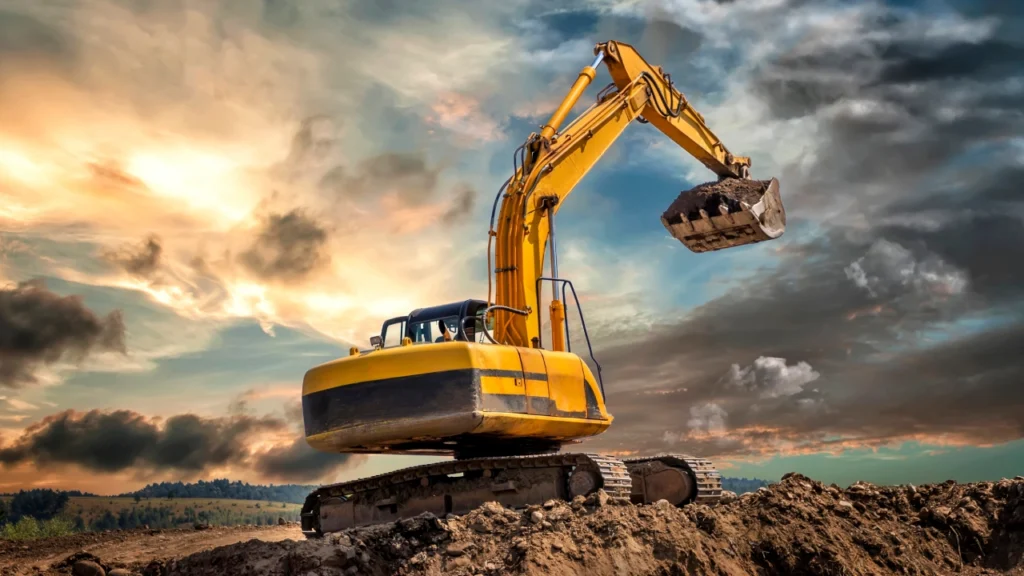
Location drastically changes equipment resale value. A machine sitting in the American Midwest might be priced completely differently than the exact same model sitting in Eastern Europe.
Regional Project Cycles
Heavy equipment prices fluctuate based on local economic booms. If a specific state announces a massive highway infrastructure bill, the demand for bulldozers, graders, and excavators in that region will skyrocket. Local sellers will raise their prices because they know contractors are desperate for machines to start their newly awarded government contracts.
Conversely, if a region experiences a severe agricultural drought, farmers will delay purchasing new tractors or combine harvesters. The local market will flood with used inventory as struggling farms liquidate assets. This oversupply will crush local used equipment value.
Importance of Global Benchmarking
Because regional prices vary so wildly, looking only at your local dealership gives you a distorted view of heavy equipment market trends. To understand true market value, you must compare listings globally.
By looking at international marketplaces, you might discover that selling your used machinery to a buyer overseas yields a 15 percent higher profit, even after factoring in export logistics. Similarly, a buyer in Egypt might find that importing a used John Deere tractor from the United States is cheaper than buying locally, thanks to abundant, competitively priced US inventory — even after accounting for a weak local currency that makes dollar-denominated purchases more expensive.
Evaluating Overpriced and Undervalued Machines
Anticipating heavy equipment values requires hands-on inspection skills. You must know how to look at a listing and immediately tell if the seller is asking too much or if they have priced it for a quick sale.
Signs of Overpriced Machinery
Sellers often price their machines based on emotional attachment or the amount of money they still owe the bank, rather than actual market reality. Here is how to spot an overpriced machine:
- Ignored depreciation: The seller is asking 90 percent of the original retail price for a machine that is three years old. They are ignoring standard heavy equipment depreciation rules.
- Cosmetic masking: The machine has a brand-new, cheap paint job, but the undercarriage is completely worn out. The seller is trying to inflate the equipment resale value using cheap cosmetics.
- Missing maintenance logs: The seller demands a premium price but cannot provide service records. Without proof of regular oil changes and hydraulic fluid flushes, you must assume the machine was neglected.
Signs of Undervalued Machinery
Sometimes, you can find incredible deals if you know what to look for. Undervalued machines usually happen when sellers prioritize speed over maximum profit.
- Fleet liquidations: A large construction company is upgrading its entire fleet and needs to clear yard space immediately. They will often price machines 10 to 15 percent below current used equipment price trends just to move them fast.
- Cosmetic damage only: A machine runs perfectly and has low hours, but it has dented body panels, a torn seat, and faded paint. Many buyers skip these ugly machines, driving the price down. If you only care about performance, these are massive bargains.
- Off-season sales: Buying a combine harvester in the dead of winter or a snowplow in the middle of July usually guarantees a lower price.
Hands-On Evaluation Checklist
Use this simple framework when inspecting a machine or reviewing detailed photos from an online listing.
| Component | Wear Indicator | Impact on Value |
|---|---|---|
| Undercarriage | Pointy sprocket teeth, sagging tracks | Major value drop. Replacement costs thousands. |
| Hydraulics | Weeping fluid around cylinder seals | Moderate value drop. Indicates upcoming maintenance. |
| Engine Exhaust (blue) | Blue smoke on startup or under load | Severe value drop. Indicates oil burning from worn rings or valve seals – likely internal wear. |
| Engine Exhaust (black) | Persistent thick black smoke | Moderate to high value drop. Points to fuel/air problems (injectors, air filter, turbo) – sometimes repairable, sometimes serious. |
| Articulation Joints | Excessive play or clunking sounds | High value drop. Requires line boring and new pins. |
| Cab Interior | Ripped seats, broken gauges, heavy dirt | Minor value drop. Easy to fix but shows poor care. |
Timing Your Next Buy or Sell Decision

Understanding the math and the market is useless if you execute your trade at the wrong time. Timing is everything in the machinery business.
Sell Strategy
If you are planning to sell, you want to list your machine just before peak seasonal demand begins. For construction equipment, late winter or early spring is ideal. Contractors are securing summer project bids and need to expand their fleets quickly. They have fresh budgets and are willing to pay top dollar.
You must also watch your machine’s hour meter closely. Every machine has a psychological threshold. For many tractors, it is 5,000 hours. For some excavators, it is 10,000 hours. Once a machine crosses these round numbers, its equipment resale value drops significantly because buyers perceive it as old. The smartest sellers list their machines at 4,500 hours or 9,500 hours to capture maximum return before the psychological threshold is crossed.
Furthermore, keep an eye on how equipment loses value across different regions. If you notice that heavy equipment prices for your specific model are surging in South America due to a mining boom, consider using a global platform to list your machine internationally rather than trading it in locally.
Buy Strategy
If you are buying, patience is your greatest tool. The best time to buy is during the off-season or at the end of the financial year. Many large dealerships and fleet owners want to clear inventory off their books before December 31st for tax purposes. You can often negotiate aggressive discounts during the last two weeks of the year.
Monitor equipment value trends closely over a few months before pulling the trigger. If you see that inventory levels for a specific model are rising globally, do not rush. High inventory means sellers will eventually panic and lower their prices.
Always calculate the equipment depreciation rate before buying a nearly new machine. Often, buying a machine that is one to two years old is the smartest financial move. The first owner has already absorbed the steep first-year hit – roughly 25 percent, plus the start of the second year’s decline – yet the machine still has plenty of reliable life and may still carry some factory or powertrain warranty.
Calculating True Cost of Acquisition
When evaluating heavy equipment values, you must calculate the total landed cost, not just the purchase price. A machine listed for $50,000 in another country might seem like a steal compared to a local machine listed for $65,000.
However, you must factor in the total logistics. You need to calculate inland transport, ocean freight, customs duties, and import taxes. You also need to budget for a professional third-party inspection to ensure the machine matches the listing. If the shipping and import fees cost $20,000, that cheap international machine is suddenly more expensive than the local option. Smart buyers use transparent platforms that calculate these logistics costs upfront, eliminating nasty surprises.
Leveraging Global Marketplaces for Accurate Benchmarking
The days of relying on a single local dealer to tell you what your machine is worth are over. Today, successful fleet managers act like global commodities traders.
To truly understand used equipment price trends, you need access to real-time, global data. You need to see what a 2021 John Deere 8R 370 is selling for in the United States, in Europe, and in Australia simultaneously.
Global marketplaces provide this exact visibility. By browsing international listings, you can immediately spot market anomalies. You might notice that heavy equipment market trends in the agricultural sector are softening in North America, leading to lower prices, while demand remains rigid in Africa. This knowledge allows you to buy low in one region and deploy the equipment where it is needed most.
Benchmarking against global used equipment value also gives you massive negotiation power. If a local seller is asking $100,000 for a machine, and you can show them five identical listings from verified international sellers priced at $80,000, you force them to adjust their price to reality or lose the sale.
Trade Smarter with JumboBee
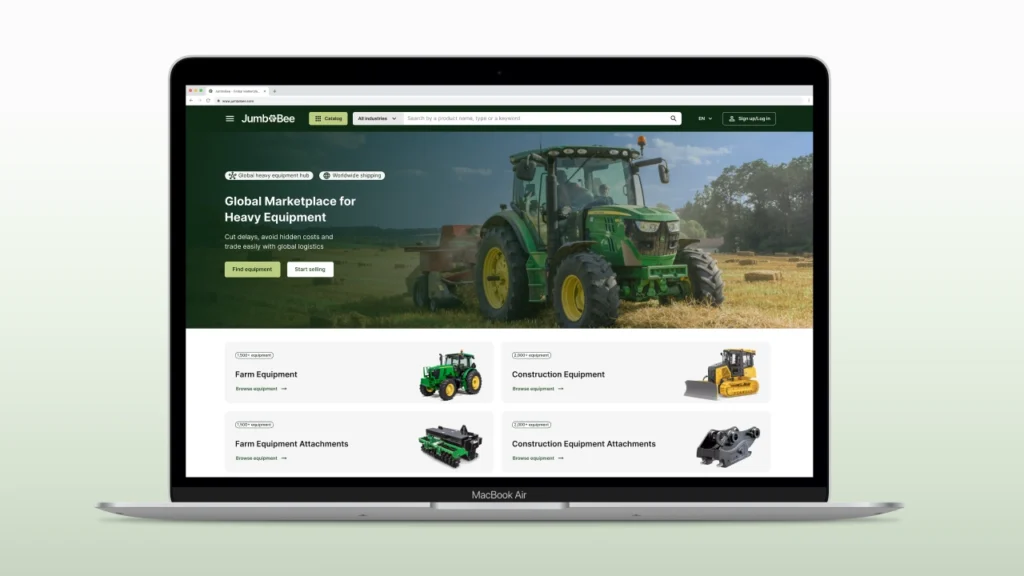
Understanding heavy equipment values is the first step. Executing a secure, profitable trade is the next. Whether you are upgrading an agricultural fleet in Egypt or liquidating construction machinery in the United States, JumboBee is your dedicated global marketplace.
We eliminate the guesswork from equipment depreciation rate calculations by giving you access to thousands of real-time listings worldwide. You can easily benchmark prices, compare models, and spot the best deals across borders.
JumboBee is built for serious buyers and sellers who want transparency and security.
- Pay only for what you buy: We charge zero hidden platform fees. You pay only the cost of the equipment and the shipping.
- Know the full cost instantly: Our platform calculates shipping, customs, and inspection fees upfront. You see the total landed cost before you commit.
- Buy from verified sellers: Every seller on JumboBee is strictly screened, ensuring you trade safely without fear of fraud.
- Global shipping with full support: We manage the entire logistics chain. From disassembly and loading to customs clearance and door-to-door delivery, we ensure your machinery arrives ready to work.
- Inspect before you pay: Gain total confidence with our optional professional pre-sale inspection services. Know exactly what you are buying before funds are released.
Do not let shifting heavy equipment values catch you off guard. Take control of your machinery investments today. Search our global listings, find the exact equipment your business needs, and experience seamless, secure international trading.





Be the first to leave a comment
There are no replies to this post yet. Share your thoughts and help start the conversation.