


 Trends
Spring planting is underway across the Northern Hemisphere, and heavy equipment markets are responding accordingly. If you plan to upgrade your agricultural fleet in the second quarter, understanding current valuation trends is mandatory. Supply chains have fully normalized since the disruptions of the early 2020s, but new environmental regulations, fluctuating crop yields, and high interest rates are creating a unique pricing environment for used tractors, combines, and attachments.
This report breaks down exactly what you can expect to pay for used agricultural machinery in Q2 2026. We will look at real market numbers, calculate depreciation step-by-step, and review cross-border trade rules so you can buy smart and avoid hidden fees.
Macro Factors Driving Heavy Equipment Values in 2026

Global agricultural markets are experiencing a stabilization phase in early 2026. The global farm equipment market size is projected to reach $199.1 billion in 2026, up from $186.9 billion in 2025, growing at a 6.5% CAGR according to Global Market Insights. Commodity prices have leveled out, meaning farmers are budgeting carefully for large capital expenditures. Instead of buying brand-new machinery and waiting for factory delivery, many operations are turning to late-model used equipment. This high demand for low-hour used machinery keeps prices firm, especially for units under 1,000 hours with active factory warranties.
Tier 5 Emissions Standards Transition
Emissions regulations are tightening across major markets. In the United States, the California Air Resources Board (CARB) is leading the push with its proposed Tier 5 standards, while the federal EPA may follow. In Europe, EU Stage V is already in force, and other regions are progressively adopting equivalent frameworks.
While Tier 4 Final has been the standard for years, the California Air Resources Board released its draft potential Tier 5 emission regulations for off-road engines in February 2026, aiming to phase in as early as 2029 for the largest engine categories, with full implementation across all affected power bands extending to 2036. According to industry tracking by DieselNet, these new rules aim to reduce NOx emissions by up to 90% compared to Tier 4 Final.
These looming regulations are pushing buyers of large, high-horsepower equipment toward pre-owned Tier 4 machinery. It is important to note that under the current CARB proposal, engines below 175 hp used in farm equipment are explicitly excluded from Tier 5 requirements, as CARB lacks federal authority to regulate these smaller engines without EPA cooperation. The Tier 5 impact is therefore most relevant for buyers of large articulated tractors and combines with engines above 175 hp, who prefer the known reliability of 2021–2024 Tier 4 machines over unproven first-generation Tier 5 technology.
Interest Rates and Financing Costs
Central banks have adjusted rates slightly downward in early 2026, but borrowing costs remain higher than the historical lows seen five years ago. According to the USDA Farm Service Agency (FSA), effective April 1, 2026, the Farm Operating Direct loan interest rate sits at 4.750%, while the Farm Ownership Direct loan rate is 5.750%. Buyers are highly sensitive to total acquisition costs. Cash buyers possess massive leverage in private negotiations, while financed buyers are looking for heavy equipment that offers the highest immediate return on investment to justify these borrowing costs.
Global Export Demand
International demand for American used farm equipment provides consistent support for secondary-market prices. Buyers in regions like Egypt and Mongolia are actively modernizing their agricultural sectors and frequently source high-quality used machinery from the United States because American farmers tend to trade in their equipment early.
Price Projections for Major Machinery Categories
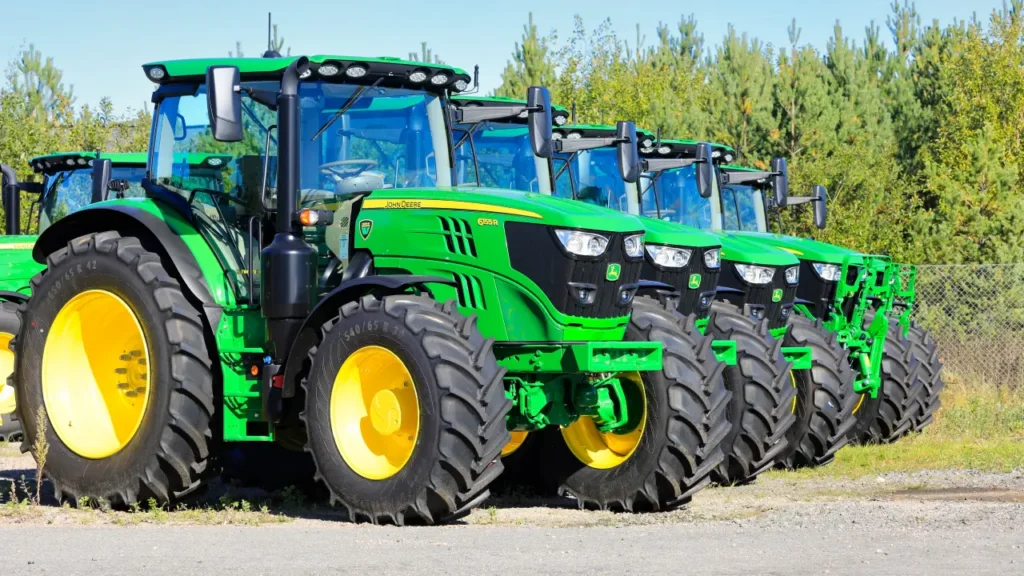
Let us look at specific equipment types and their expected Q2 2026 market values. We base these figures on recent global sales data and current inventory levels of top brands like John Deere, Case IH, CLAAS, FENDT, and New Holland.
High-Horsepower 4WD Tractors
Massive articulated machines like the John Deere 9R series remain incredibly popular for broadacre farming. A 2023 John Deere 9R 490 with around 1,150 hours currently sits near $429,900. A slightly smaller but lower-hour 2023 John Deere 9R 440 with just 350 hours is trading around $459,900. By Q2, expect these low-hour units to hold their value tightly, perhaps depreciating only 1% to 2% as planting season demand peaks. High-horsepower tractors equipped with advanced automation features, large dual hydraulic pumps, and ultimate comfort cabs command top dollar.
Row-Crop Tractors
Versatile row-crop tractors are the backbone of most mixed-farming operations. Recent auction data and dealer listings compiled by Tractor Zoom show that a lightly used 2021 John Deere 8RX 370 with 1,317 hours cleared at auction for $340,000, while average dealership list prices for an 8R 410 (1,000–1,500 hours) hover around $444,775. Moving down the horsepower scale, a 2023 John Deere 8R 230 with 430 hours is priced near $288,095. Prices for these units will likely remain flat through Q2. They offer the perfect balance of power and maneuverability, making them highly sought after in both domestic and export markets.
Combines and Harvesters
Harvest equipment follows a different seasonal price curve. Buying a combine in late winter or early spring – well before harvest season demand peaks – often yields better deals than waiting until late summer. A 2024 John Deere S770 with 600 hours is currently priced around $462,200. We project a slight price softening of 2% to 3% in Q2 before values spike again in Q3 ahead of the autumn harvest. Smart buyers secure their harvesters in the spring.
Skid Steers and Compact Track Loaders
Construction-crossover equipment is essential on the modern farm. A 2018 John Deere 333G with 1,821 hours runs about $46,900. These utility machines tend to hold their value reasonably well compared to specialized field equipment, thanks to their year-round usefulness – though high-hour older units still reflect significant accumulated depreciation from their original purchase price. Wide rubber tracks and high-flow hydraulics are the most requested features, pushing prices up for machines equipped with them.
Q2 2026 Machinery Value Forecast Table
Here is a clear breakdown of expected price movements for popular heavy equipment models heading into Q2 2026.
| Equipment Model | Year | Current Hours | Q1 2026 Average Price | Q2 2026 Projected Price | Expected Trend |
|---|---|---|---|---|---|
| John Deere 9R 440 | 2023 | 359 | $459,900 | $455,000 | Stable |
| John Deere 9R 490 | 2023 | 1,152 | $429,900 | $421,000 | Slight Decrease |
| John Deere 8RX 370 | 2021 | 1,317 | $340,000 | $338,500 | Stable |
| John Deere 8R 230 | 2023 | 432 | $288,095 | $285,500 | Stable |
| John Deere S770 | 2024 | 606 | $462,200 | $450,000 | Seasonal Drop |
| John Deere 333G | 2018 | 1,821 | $46,900 | $46,500 | Highly Stable |
Calculating Heavy Equipment Depreciation
Understanding how machines lose value helps you decide whether to buy a one-year-old unit or a five-year-old unit. Heavy equipment depreciation is not linear. Machines lose the most value in their first two years of life, after which the depreciation curve flattens out significantly.
Standard Depreciation Formula
Farm machinery typically loses 20% to 25% of its original purchase price in the first year, and 6% to 8% each subsequent year. Hours of use also play a massive role. The agricultural industry standard assumes 400 to 500 hours of use per year for a primary tractor. If a machine has significantly more hours, deduct an additional 1% to 2% from its value. If it has fewer hours, add a premium.
Real-World Math Example
Imagine a brand-new 370-horsepower tractor costs $500,000 in 2024. Let us calculate its value in 2026.
- Year 1 (2025): 20% value loss. ($500,000 x 0.80 = $400,000 remaining value)
- Year 2 (2026): 7% value loss on the remaining balance. ($400,000 x 0.93 = $372,000 remaining value)
A two-year-old machine purchased new in 2024 would therefore be valued at approximately $372,000 in 2026 – consistent with late-model low-hour listings in that price bracket.
Extending the same formula further illustrates why five-year-old machines trade at deeper discounts. Continuing the calculation through years three, four, and five at 7% per year produces approximately $346,000, $322,000, and $299,000 respectively. This aligns with our market data showing a 2021 model with over 1,300 hours clearing near the $340,000 mark – reflecting both age and higher hour accumulation.”
Cross-Border Trade Regulations for 2026
Buying equipment internationally is standard practice today, but regulations change constantly. In 2026, several new compliance rules impact how you import and export heavy machinery. Whether you are shipping to Ukraine, Egypt, or South America, you must follow strict protocols.
EPA Import Declarations
When bringing agricultural machinery into the United States, filing EPA Form 3520-21 is strictly enforced. Equipment must meet the emissions standards applicable to its year of manufacture. In 2026, customs agents utilize automated digital screening. Any paperwork errors will result in immediate cargo holds at the port, costing you daily storage fees.
Phytosanitary Certificates
Used farm equipment must be completely free of soil, plant debris, and seeds before crossing international borders. Agricultural departments globally have tightened biosecurity in 2026 to prevent the spread of soil-borne pathogens and invasive weeds. If your imported combine arrives with dirt packed in the tracks or chaff in the feeder house, it will face mandatory pressure washing at the port. This port cleaning costs thousands of dollars and delays delivery by weeks. Always ensure your seller or logistics partner performs a certified pre-export cleaning.
Import Duties and Tariffs
Most agricultural tractors classified under Harmonized System Code (HS Code) 8701.90 enjoy duty-free status in many countries. However, attachments, GPS receivers, and construction equipment like skid steers often face tariffs ranging from 2% to 10%. Always classify your machinery components correctly. Sometimes shipping a tractor and its attachments on separate bills of lading can simplify customs processing and reduce tax liabilities.
Uncovering Hidden Costs in Machinery Purchases
The sticker price of a tractor is rarely the final cost. When planning your Q2 budget, you must calculate the total landed cost. Many buyers fail to account for the complex logistics of moving a 40,000-pound machine across the globe.
Inland Freight and Ocean Shipping
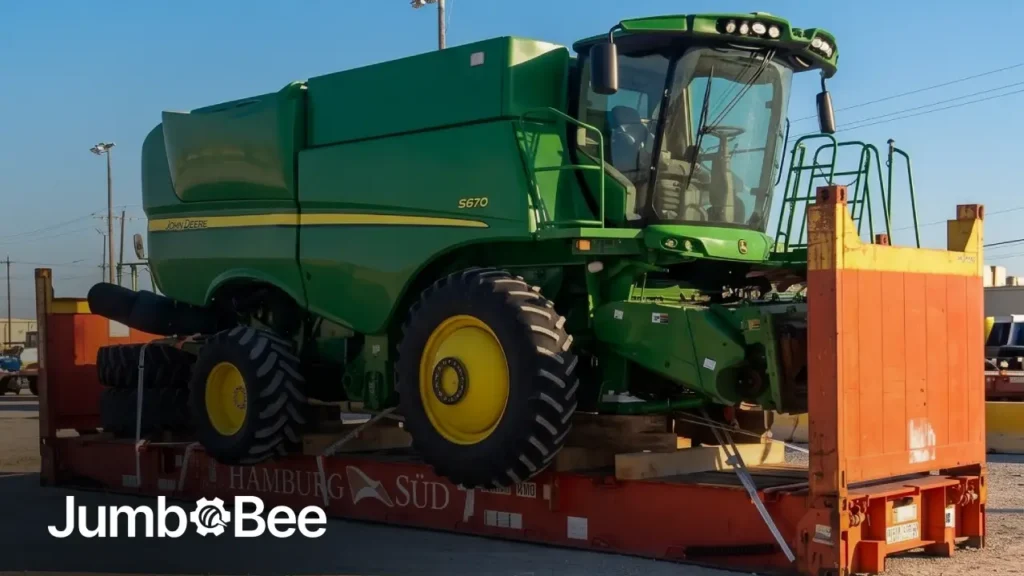
Moving a combine harvester from a farm in the American Midwest to a port in Texas or Maryland requires specialized flatbed transport, oversize load permits, and sometimes escort vehicles. This inland journey alone can cost $3,000 to $7,000, depending on fuel prices and distance.
Ocean freight adds another massive variable. Roll-on/Roll-off shipping is standard for drivable equipment. The machine is simply driven onto the cargo ship. However, Roll-on/Roll-off rates fluctuate based on global port congestion and vessel availability.
Disassembly and Containerization
To save on ocean freight, many international buyers choose to dismantle machinery and ship it in standard 40-foot shipping containers. According to 2026 forecasts from SeaRates, basic container freight costs for a 40′ HC sit between $2,200 and $3,200, but can spike dramatically to $9,500+ during periods of heavy geopolitical tension or port backlogs. Removing wheels, cabs, and axles requires expert labor and heavy lifting equipment. You must calculate whether the cost of disassembly at the origin and reassembly at your destination is cheaper than paying the premium Roll-on/Roll-off shipping rates. For mid-size utility tractors, containerization is almost always the most cost-effective method.
Inspection Fees
Never wire hundreds of thousands of dollars without verifying the equipment condition. Hiring an independent mechanic to perform fluid analysis, check transmission pressures, and verify engine hours costs between $500 and $1,200. This is not an expense; it is vital insurance against buying a machine with a failing hydrostatic drive or hidden structural cracks.
Total Landed Cost Calculation
Let us map out a realistic scenario for an international buyer purchasing a used tractor from the USA and shipping it overseas. Knowing these numbers instantly allows you to compare the imported price against local dealership prices.
- Purchase price of tractor: $288,095
- Independent pre-sale inspection: $800
- Inland transport to export port: $3,500
- Export customs clearance document preparation: $250
- Ocean freight via Roll-on/Roll-off: $6,500
- Cargo insurance covering total loss: $1,440
- Destination port handling and unloading fees: $800
Total Landed Cost: $301,385
Even with over $13,000 in logistics and inspection costs, importing often saves buyers 10% to 20% compared to buying from a local dealer who has already baked massive profit margins into their retail price.
Strategic Buying Advice for Q2 2026
How do you secure the best machinery deals in the upcoming quarter? Follow these practical steps to maximize your agricultural investment and avoid common purchasing mistakes.
Leverage Seasonal Demand Shifts
Buy counter-cyclically whenever your cash flow allows. Purchase your harvesting equipment in the spring and your planting equipment in the winter. Dealerships and private sellers are eager to clear out off-season inventory to make room for high-demand seasonal machines. A seller holding a combine in April is much more willing to negotiate on price than a seller holding the same combine in August.
Focus on Warranty Transferability
Late-model machines often carry extended powertrain warranties. For example, a 2021 John Deere 8R 370 might have a PowerGard protection plan valid until 2027. Always verify with the manufacturer that the warranty transfers to secondary owners. If you are exporting the machine, you must double-check if the warranty remains valid in your specific country. Some manufacturers void warranties once a machine crosses specific borders, while others offer global support.
Prioritize High-Flow Hydraulics and Automation
Modern farming implements require massive hydraulic flow and precise GPS integration. When evaluating a used tractor, check the hydraulic pump capacity. A high-flow dual hydraulic pump (typically 110 GPM on larger models), five rear selective control valves, and a modern digital display will hold its resale value much longer than a base-model tractor. Technology ages faster than heavy iron. Always buy the highest technology specification your budget allows, as this ensures compatibility with next-generation smart planters and seeders.
Inspect Articulation Points and Wear Parts
When reviewing inspection reports, look beyond the engine. For 4WD tractors, the articulation hinge is a major wear point. Replacing center pins and bushings is highly expensive. For combines, focus on the rotor, concaves, and feeder house chain. Excessive wear in these areas indicates a machine that worked in harsh conditions. Always ask the seller for a video of a cold engine start to check for excessive exhaust smoke or abnormal knocking sounds.
Global Marketplace for Heavy Equipment
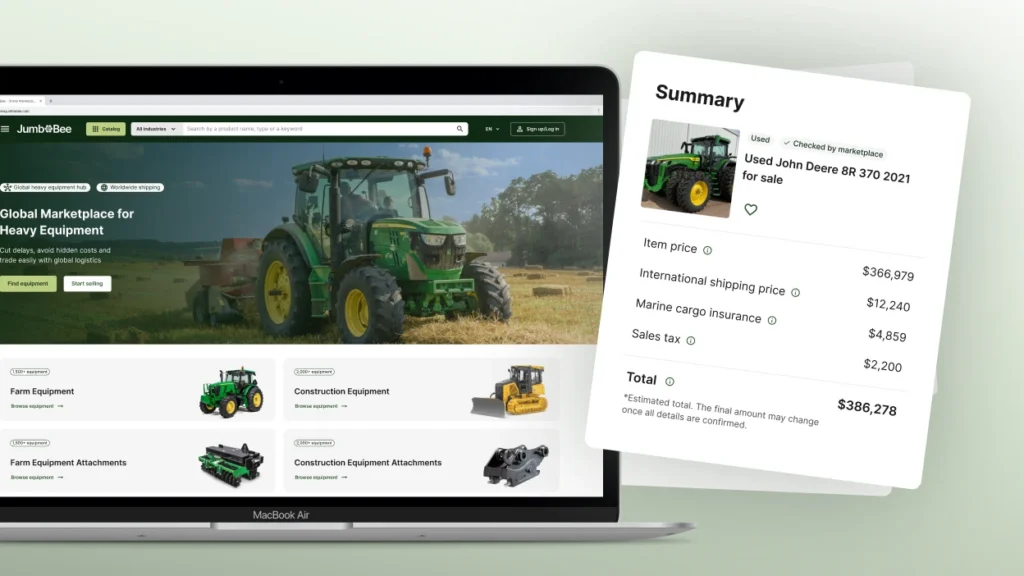
Navigating global equipment markets, arranging independent inspections, and handling complex logistics can overwhelm even experienced buyers. Managing multiple vendors for inland freight, ocean shipping, and customs clearance takes time away from running your actual farming business. This is where JumboBee transforms the way you trade heavy machinery.
We provide a transparent, centralized hub where you can search thousands of global listings for top brands like John Deere, Case IH, MacDon, AGCO, and New Holland. Our platform eliminates hidden fees and platform charges. You pay only for what you buy. You see the full cost instantly, including equipment, shipping, inspections, and customs fees, before you make a commitment.
Every seller on our platform undergoes strict verification, ensuring you shop with total confidence and pay securely. If you need capital, we offer flexible financing options, including short-term and long-term loans, plus currency exchange programs tailored for international buyers.
From personalized equipment sourcing to custom shipping solutions, we handle the heavy lifting. Our Premium Services include step-by-step trade assistance, expert disassembly and loading, cargo insurance, and complete import/export compliance management. We ensure your equipment arrives ready for use, whether you need it shipped whole via Roll-on/Roll-off or consolidated into standard containers.
Whether you are upgrading your farm in the American Midwest or importing a fleet of tractors to modernize agriculture in Egypt or Mongolia, our built-in logistics make borderless trade simple. Search our global listings on JumboBee today, find your next machine, and let us deliver it straight to your farm. Trade smarter, avoid hidden fees, and go global with confidence.



Be the first to leave a comment
There are no replies to this post yet. Share your thoughts and help start the conversation.