


 Equipment
Choosing the right heavy equipment is rarely about picking the biggest machine on the lot. In earthmoving, bigger isn’t always better — it is just heavier, harder to transport, and thirstier for fuel. Success depends on matching machine capability to job site reality.
This guide breaks down bulldozer sizes into actionable data. You will find comprehensive charts, specific John Deere comparisons, and real-world scenarios to help you decide between a nimble 18,000 lb finish grader and a 100,000 lb earthmover.
Whether sourcing equipment locally or using a global marketplace like JumboBee to import machinery, understanding these specs prevents costly mistakes.
Why Dozer Size Matters More Than Brand Alone
Brand loyalty is common in construction. Operators love their Cat high-drives or their John Deere hydrostatic transmissions. However, sizing errors kill project profitability faster than mechanical issues.
If you bring a D8-sized machine to a residential finish grading job, you will crush underground utilities and destroy the soil structure. Conversely, bringing a small 75 HP dozer to strip hard-packed clay overburden will result in excessive undercarriage wear and blown project timelines.
Common Mistakes When Choosing Bulldozer Sizes
- Underestimating soil density: Wet clay requires significantly more horsepower per yard than loose loam.
- Ignoring transport width: A machine might fit the budget, but if the blade width requires a pilot car and special permits, logistics costs explode.
- Overlooking undercarriage costs: Larger dozers have exponentially more expensive track replacements.
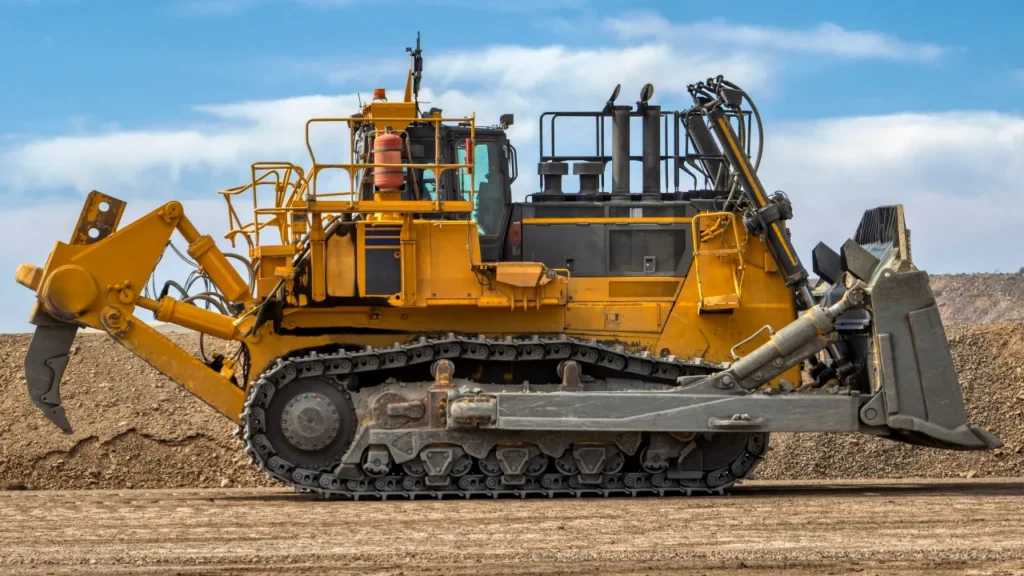
- Focusing only on horsepower: Traction (weight) pushes dirt, not just the engine. A high HP machine with low weight will just spin its tracks.
What This Guide Includes
- Specs: Detailed weight and horsepower breakdowns.
- Comparisons: Side-by-side analysis of size classes.
- Use cases: Which machine fits mining, forestry, or landscaping.
- John Deere breakdown: Deeply detailed look at John Deere dozer sizes.
How Dozer Sizes Are Classified
Manufacturers don’t always use the same terminology. One brand’s medium is another’s small. To navigate the market, you must understand the four technical pillars of classification.
What Defines Dozer Size
Operating Weight
This is the single most important metric. Operating weight determines traction. A dozer pushes by transferring engine power to the ground through the tracks. If the machine is too light, it cannot utilize its horsepower. It simply floats and slips.
Horsepower
Horsepower (HP) dictates the speed at which the machine can work and its ability to lift and roll heavy loads in front of the blade. We generally look at Net Flywheel Power—the usable power available to do work.
Blade Capacity and Width
Blade capacity is measured in cubic yards or cubic meters. It dictates how much material you move per pass. Blade width determines transport requirements and pass overlap.
Ground Pressure and Track Type
Ground pressure is measured in PSI (pounds per square inch).
- LGP (low ground pressure): Wide tracks for swamps, soft soil, and finish grading.
- Standard/XLT: Narrower tracks for hard ground, rock, and aggressive pushing.
Standard Dozer Size Categories Explained
Small Dozers
- Weight: Under 25,000 lbs
- Horsepower: Under 105 HP
- Role: Speed, finish grading, residential work.
Medium Dozers
- Weight: 25,000 – 60,000 lbs
- Horsepower: 105 – 250 HP
- Role: The workhorses. Road building, site clearing, sloping.
Large Dozers
- Weight: 60,000 – 150,000 lbs
- Horsepower: 250 – 600 HP
- Role: Heavy ripping, bulk earthmoving, quarry work.
Extra-Large and Mining Dozers
- Weight: Over 150,000 lbs
- Horsepower: 600+ HP
- Role: Mining operations, massive reclamation projects.
Dozer Size Chart Overview
This section provides a quick reference to align your project needs with industry standards.
Standard Dozer Size Chart by Weight and Horsepower
| Size Class | Operating Weight (lbs) | Horsepower Range (HP) | Typical Blade Width |
|---|---|---|---|
| Small | 10,000 – 24,000 | 70 – 105 | 8 ft – 10 ft |
| Medium | 25,000 – 60,000 | 105 – 250 | 10 ft – 13 ft |
| Large | 60,000 – 150,000 | 250 – 600 | 13 ft – 16 ft |
| Mining | 150,000+ | 600 – 900+ | 18 ft+ |
Small Dozer Size Range
These machines are built for finesse. They often feature 6-way blades (PAT blades) that allow the operator to angle, tilt, and lift the blade for precise contouring.
Medium Dozer Size Range
This class offers the best balance of push power and transportability. Most medium dozers can be moved on a standard lowboy trailer without requiring escort vehicles (depending on blade width).
Large Dozer Size Range
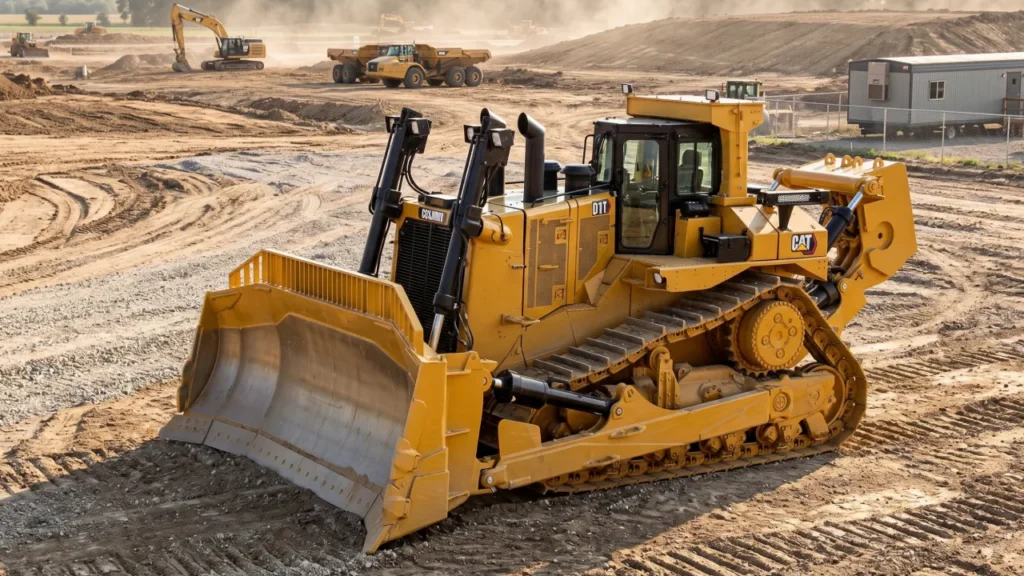
These are production machines. They are designed to push in a straight line or rip hard ground. They sacrifice agility for raw force.
Dozer Size Chart by Job Type
| Job Application | Recommended Dozer Size | Blade Type |
|---|---|---|
| Residential Landscaping | Small (70-90 HP) | 6-Way (PAT) |
| Driveway Grading | Small (80-100 HP) | 6-Way (PAT) |
| Site Prep (Commercial) | Medium (130-170 HP) | Semi-U or PAT |
| Forestry / Land Clearing | Medium (150-250 HP) | Semi-U or Root Rake |
| Road Construction | Medium/Large (200-350 HP) | Semi-U |
| Quarry / Mining | Large/Mining (400+ HP) | U-Blade |
Landscaping and Light Grading
For spreading topsoil or grading a backyard, you need low ground pressure to avoid compacting the soil. A small dozer is essential here.
Construction and Site Prep
This involves stripping topsoil, cutting pads for buildings, and backfilling foundations. A medium dozer (D5/D6 or Deere 700/850 equivalent) is the standard choice.
Heavy Earthmoving and Mining
When moving thousands of yards of overburden, cycle times matter. Large dozers move 3x to 5x more material per pass than medium dozers.
Dozer Size Comparison Chart
Choosing between two sizes often comes down to specific trade-offs.
Small vs Medium Dozers
| Feature | Small Dozer | Medium Dozer |
|---|---|---|
| Productivity | Low volume, High precision | High volume, Moderate precision |
| Transport | Tag trailer | Lowboy semi-trailer |
| Fuel Usage | 3 – 5 Gallons/Hour | 6 – 12 Gallons/Hour |
Productivity Differences
A medium dozer will strip a site 50% faster than a small dozer. However, a small dozer can finish grading around a manhole cover; a medium dozer cannot.
Transport and Maneuverability
Small dozers fit into tight urban lots. Medium dozers need room to turn. If your job site is in a dense city center, the physical footprint limits you to small dozer sizes.
Medium vs Large Dozers
Push Capacity and Blade Performance
Large dozers use the weight of the machine to drive the cutting edge into hard ground. A medium dozer might skate over hard-packed haul roads, whereas a large dozer will cut right through.
Fuel Consumption and Maintenance
Large dozers burn fuel at an aggressive rate (15+ gallons per hour). Furthermore, undercarriage components for large dozers are massive and require heavy equipment just to service them.
Choosing Right Size Based on Project Scale
- < 1 acre: Small dozer
- 1 – 10 acres: Medium dozer
- 10+ acres: Large dozer fleet
Detailed Breakdown of Bulldozer Sizes
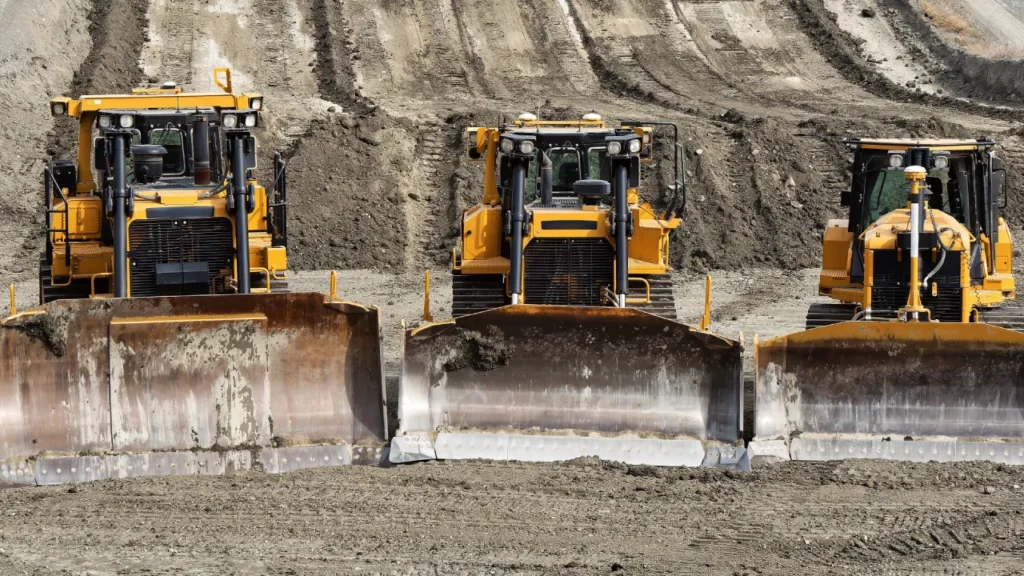
Let’s dive deeper into the specifics of each category.
Small Bulldozer Sizes
- Typical specs: Weight: 17,500 lbs | Power: 80 HP | Blade: 2.5 yd³ capacity
- Common applications: Spreading gravel, backfilling trenches, and final trim work for golf courses.
- Advantages and limitations: Unmatched visibility and control (GPS often integrated). However, they cannot push large stumps or boulders due to a lack of mass.
Medium Bulldozer Sizes
- Power-to-weight balance: This is the most competitive segment. Manufacturers fight to provide the highest drawbar pull while keeping the machine light enough to transport easily.
- Most versatile use cases: If you only own one dozer, it should be a medium size (approx. 130-150 HP). It is small enough to finish grade but big enough to clear trees and slot doze.
Large Bulldozer Sizes
- Maximum productivity: These machines are measured in Cost Per Yard. In mining and highway projects, the goal is to move dirt as cheaply as possible through sheer volume.
- Infrastructure, mining, and large-scale projects: Used for ripping rock (using a rear ripper attachment) and push-loading scrapers.
John Deere Dozer Sizes Explained
John Deere is a dominant player in the North American market. They are famous for their hydrostatic drive systems, which provide infinite speed control and power turns (tracks don’t lock up during a turn, maintaining power to both sides).
John Deere Dozer Size Classes
Small John Deere Bulldozers
The K-Series and P-Tier models dominate here. They are favorites for residential contractors.
- Models: 450, 550, 650.
Medium John Deere Bulldozers
The L-Series introduced significant cab upgrades and visibility improvements. These are staple machines for site development.
- Models: 700, 750, 850.
Large John Deere Bulldozers
Deere has aggressively entered the large mining and production class recently with the 950 and 1050 models, challenging traditional competitors.
- Models: 950, 1050.
John Deere Dozer Sizes Chart
Below is a breakdown of current and popular recent John Deere dozer sizes.
| Model | Class | Net Power (HP) | Operating Weight (lbs) | Blade Width (Range) |
|---|---|---|---|---|
| 450 P-Tier | Small | 71 HP | 17,500 – 19,000 | 97″ – 115″ |
| 550 P-Tier | Small | 92 HP | 18,853 – 20,115 | 105″ – 124″ |
| 650 P-Tier | Small | 104 HP | 21,165 – 22,484 | 105″ – 128″ |
| 700 L | Medium | 135 HP | 30,000 – 32,000 | 120″ – 132″ |
| 750 L | Medium | 175 HP | 37,000 – 41,000 | 128″ – 156″ |
| 850 L | Medium | 225 HP | 48,000 – 54,000 | 134″ – 168″ |
| 950 K | Large | 265 HP | 65,300 – 73,700 | 148″ – 175″ |
| 1050 K | Large | 350 HP | 95,400 – 96,100 | 160″ – 190″ |
Operating Weight
Notice the jump between the 650 and 700. This marks the transition from finish dozer to production dozer.
Engine Horsepower
Deere engines are tuned for high torque at lower RPMs, which helps with fuel efficiency in the hydrostatic drive system.
Blade Options
Deere offers PAT (Power-Angle-Tilt) blades even on their larger medium dozers (850L), which is a unique selling point for operators who need versatility in a heavy machine.
Popular John Deere Bulldozers by Size
Entry-Level and Compact Models
The John Deere 450 is legendary. It is widely considered the industry standard for small finish dozers. It retains high resale value and is easy to transport.
Mid-Size Construction Models
The John Deere 700L is the Swiss Army Knife of John Deere bulldozers. It is heavy enough for serious pushing but balanced enough for soft ground.
Heavy-Duty and Production Models
The 1050K is designed to compete directly with the Cat D8. It features a suspended double-bogie undercarriage, which smooths out the ride on rocky terrain, reducing operator fatigue.
Bulldozer Size Chart by Blade Type
The blade changes the effective size of the dozer. A large dozer with a small blade is underutilized; a small dozer with a massive blade will stall.
Straight Blade (S-Blade) Dozers
- Shape: Flat, no side wings.
- Best dozer sizes: Small and Medium.
- Application: Grading fine materials. It doesn’t carry much dirt but allows for high precision.
Universal Blade (U-Blade) Dozers
- Shape: Highly curved with large side wings (looks like a U).
- Best dozer sizes: Large and Mining.
- Application: Moving huge piles of loose material (coal, woodchips, overburden) over long distances. The wings trap the material so it doesn’t spill out the sides.
Semi-Universal Blade (SU-Blade) Dozers
- Shape: Slight curve with smaller side wings.
- Best dozer sizes: Medium and Large.
- Application: The industry standard. It combines the penetration of an S-blade with the carrying capacity of a U-blade.
How to Choose the Right Dozer Size
You have the charts and the specs. Now, apply them to your reality.
Job Requirements and Material Type
- Loose earth: Horsepower is king. You want speed.
- Hardpan/rock: Weight is king. You need down-pressure to penetrate the surface.
- Wet clay: You need LGP (Low Ground Pressure) tracks. A heavy machine with narrow tracks will sink.
Terrain and Ground Conditions
- Soft ground vs hard surfaces: If you are working in swamps or reclamation, look for LGP in the model name (e.g., John Deere 650K LGP). These have extra-wide track shoes (pads) to float over mud.
- Slope and stability considerations: Smaller, lower-center-of-gravity machines are generally safer on steep slopes. Large mining dozers can be top-heavy and are risky on extreme grades.
Transport, Access, and Logistics
This is the hidden budget killer.
- Under 8.5 ft width: Legal on most roads without permits (Small Dozers).
- 8.5 ft – 12 ft: Oversize permit required (Medium Dozers).
- 12 ft – 16 ft: Pilot cars (escorts) required in many states/countries. For example, New York requires pilot cars for loads over 12 feet wide on two-lane roads, while Ohio requires them for loads over 13 feet wide. (Large Dozers).
- Over 16 ft: “Superload” designation in many states; may require route pre-approval, police escort, or temporary road closures (Large Dozers).
Site Accessibility
Can a lowboy trailer even turn into your job site? If the access road is narrow and winding, you may be forced to use a smaller dozer simply because you cannot deliver a large one.
New vs Used Dozers by Size Category
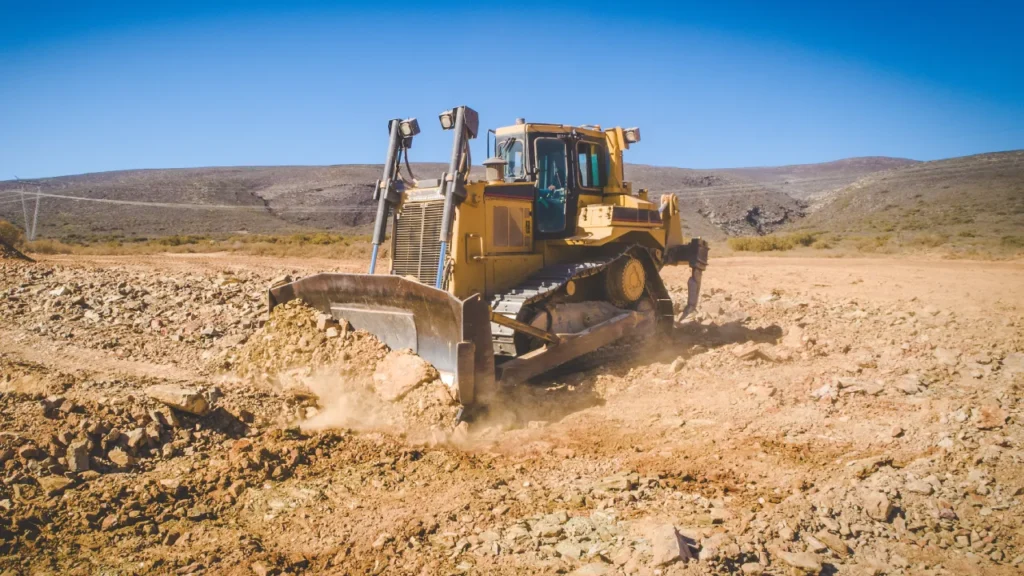
JumboBee offers access to both markets globally.
When Buying a New Dozer Makes Sense
- Technology: New machines come with integrated 3D Grade Control (Topcon, Trimble, or proprietary). This allows a less experienced operator to grade perfectly.
- Efficiency: Tier 4 Final engines burn less fuel.
- Warranty: Essential for high-production environments where downtime costs thousands per hour.
When a Used Dozer Is the Better Choice
- Depreciation: Heavy equipment depreciates fastest in the first 3 years. Buying a 5-year-old John Deere 850 gives you 80% of the capability for 60% of the price.
- Simplicity: Older machines (pre-Tier 4) lack complex DEF (Diesel Exhaust Fluid) systems and DPF (Diesel Particulate Filters), making them easier to maintain in remote areas.
Size-Specific Inspection Tips
Undercarriage Wear
This is critical. The undercarriage represents 50% of the total repair cost of a dozer over its life.
- Small dozers: Check for chain stretch.
- Large dozers: Check the rollers. Heavyweight crushes rollers if the operator has been abusive.
Blade and Hydraulic Condition
Check the trunnion balls (where the blade arms attach to the machine). On large dozers, these wear out from constant heavy pushing. If they are loose, the blade will wobble, making grading impossible.
Dozer Sizes and Operating Costs
Fuel consumption by dozer size
- Small (80 HP): 3 – 4 gallons/hour.
- Medium (150 HP): 6 – 8 gallons/hour.
- Large (300 HP): 12 – 16 gallons/hour.
Calculation: Over a 2,000-hour work year, the difference between a Medium and Large dozer is roughly 16,000 gallons of diesel. At $4.00/gallon, that is a $64,000 annual difference.
Maintenance and Undercarriage Costs
Larger tracks cost more. A set of tracks for a D6 might cost $15,000. A set for a D10 could exceed $100,000.
Ownership Cost Comparison by Size
When calculating hourly rates to charge clients, you must factor in size.
- Small dozer rate: $100 – $150 / hour.
- Medium dozer rate: $180 – $250 / hour.
- Large dozer rate: $350+ / hour.
Conclusion
Selecting the correct bulldozer size is a calculation of weight, horsepower, transport logistics, and soil conditions.
- Small dozers: Precision, finish work, tight spaces.
- Medium dozers: The versatile backbone of construction.
- Large dozers: Bulk earthmoving and mining.
Using the dozer size comparison chart and John Deere dozer sizes data provided here ensures you don’t pay for power you don’t use, or struggle with a machine too weak for the task.
Ready to Find Your Machine?
Whether you need a nimble John Deere 450K for local grading or a massive 1050K for a mining project, sourcing globally can save you thousands.
JumboBee connects you with verified sellers worldwide. We handle the inspections, logistics, and secure payments, ensuring the machine you see on the screen is the machine that arrives at your site.
- No hidden fees: You pay the equipment cost and shipping. That’s it.
- Global logistics: We handle the complex import/export paperwork.
- Verified equipment: Shop with confidence using our inspection services.
The D6 size class (roughly 40,000 – 50,000 lbs, 170-200 HP) is the global standard. This includes the Caterpillar D6 and the John Deere 750/850. It is big enough for heavy pushing but small enough to transport easily.
For clearing heavy timber and stumps, you generally need at least a Medium dozer (130+ HP, 30,000+ lbs). Small dozers will struggle to uproot large trees and can damage their transmissions trying to push immobile objects.
In terms of volume, yes. In terms of finish quality, no. A large dozer cannot perform fine grading as well as a small dozer. If you use a D10 to grade a house pad, you are wasting money and time.
They align closely:
Deere 450 = Cat D3
Deere 550/650 = Cat D4
Deere 700 = Cat D5
Deere 750 = Cat D6
Deere 850 = Cat D6/D7
Deere 1050 = Cat D8


Be the first to leave a comment
There are no replies to this post yet. Share your thoughts and help start the conversation.