


 Buying
  Equipment
Introduction to Construction Equipment
The demand for construction is increasing alongside the growth of the industry itself. By 2027, the overall value of construction put in place in the United States – including residential, non-residential, and infrastructure segments – is forecast to reach nearly 2.24 trillion U.S. dollars.
Construction projects rely on heavy equipment to move earth, lift materials, and prepare sites. Each machine has a specific role, and understanding these differences helps to plan more effectively, avoid delays, and control costs.
Read about 40 construction equipment names and their uses in this guide. Machines are grouped by purpose – earthmoving, lifting and hauling, road construction, concrete work, and specialized or mining. Learn what the machine does, how it is used, and the advantages it brings to a project.
Classification of Construction Machines
Construction vehicles can be grouped in several ways. Machines are often classified by their main purpose, by how they move on the ground, or by how versatile they are in handling different tasks.
By purpose
- Earthmoving equipment – excavators, bulldozers, loaders, scrapers, graders;
- Lifting and material-handling machines – cranes, forklifts, telehandlers, truck cranes;
- Road construction equipment – compactors, asphalt pavers, milling machines, stabilizers;
- Specialized machinery – pile drivers, tunneling machines, drilling rigs, mining shovels.
By undercarriage type
- Crawler (tracked) – excavators, bulldozers, crawler loaders, crawler cranes;
- Wheeled – wheel loaders, dump trucks, motor graders, mobile cranes.
By versatility
- Multi-purpose – backhoe loaders, skid steer loaders, telehandlers;
- Specialized – concrete pumps, slipform pavers, tunnel boring machines.
40 Construction Equipment Names and Their Uses
Earthmoving Equipment
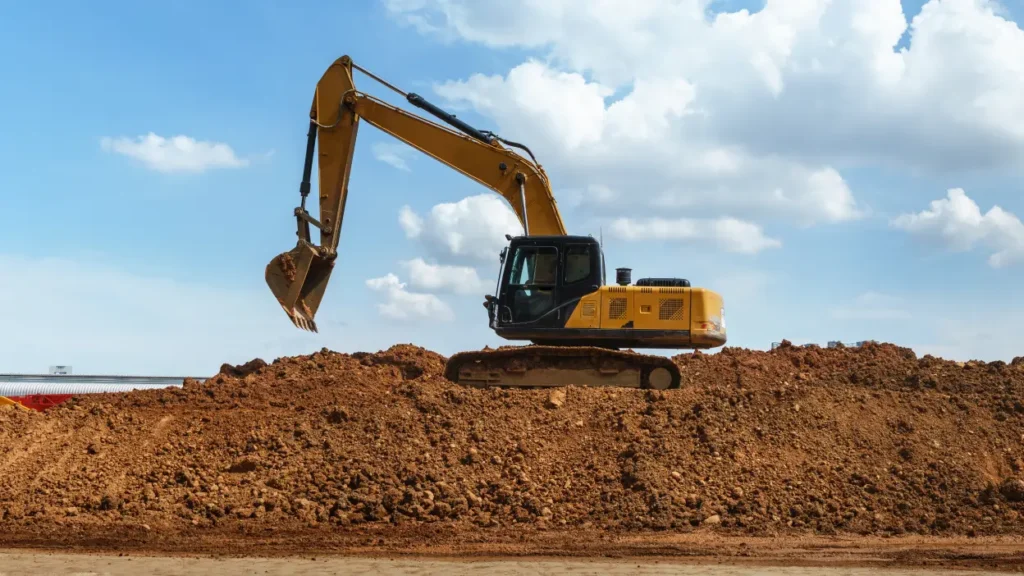
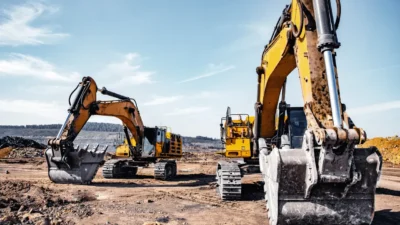
An excavator is a heavy machine for digging, lifting, and moving large amounts of material. It has a boom, stick, bucket, and cab mounted on a rotating house. The undercarriage can have wheels or tracks. This design gives the machine strength, stability, and 360-degree movement.
How excavators work:
- Dig trenches, holes, and foundations;
- Lift and place heavy materials like pipes;
- Handle demolition when fitted with breakers or shears;
- Dredge rivers or ponds in water projects;
- Remove snow in winter work;
- Support mining, landscaping, and road projects.
Advantages of excavators as heavy construction equipment:
- Powerful digging and lifting capacity saves time on site prep;
- Flexible, with many types available such as crawler, wheeled, mini, and long-reach;
- Supports many attachments like augers, grapples, and drills for added versatility;
- Delivers precise control for trenching and grading;
- Enclosed cab protects the operator and improves safety;
- One excavator can replace several smaller machines, lowering equipment costs.
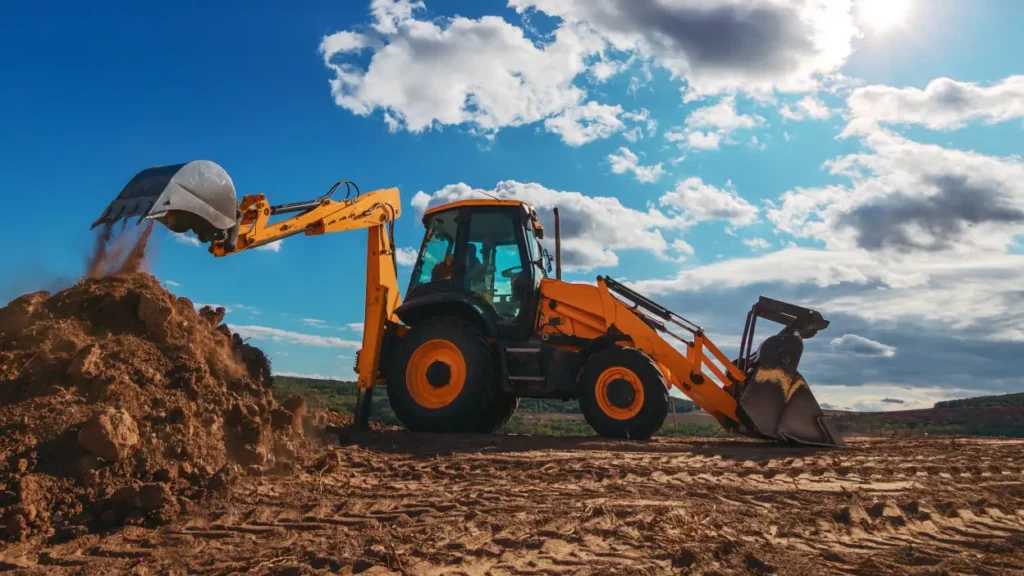
A backhoe loader is a multi-purpose machine with a loader bucket in the front and a digging arm in the rear. It combines the functions of a loader and an excavator in one machine. Backhoes can dig to depths of 12 to 14 feet and deliver between 20 and 100 horsepower, depending on the model. Stabilizer legs keep the machine steady during digging.
How backhoe loaders work:
- Dig trenches, ponds, and foundations;
- Uproot trees and move boulders, dirt, or gravel;
- Perform small demolition tasks and break pavement with hammer attachments;
- Backfill and transport materials on job sites;
- Support road paving, parking lot construction, and landscaping projects;
- Handle farming tasks like trenching, moving feed, or digging irrigation channels;
- Clear snow with blades, buckets, or snow blowers.
Advantages of backhoe loaders as heavy construction equipment:
- Two-in-one design combines front loader and rear digger for high versatility;
- Works with augers, hammers, rippers, grapples, and sweepers;
- Suitable for many terrains, from rocky soil to soft ground;
- Available in sizes from compact to large for small to medium projects;
- Stabilizers increase safety and prevent tipping during operation;
- Can travel on roads between sites, saving on transport costs;
- Strong resale value with easy-to-find Cat, John Deere, and JCB attachments.
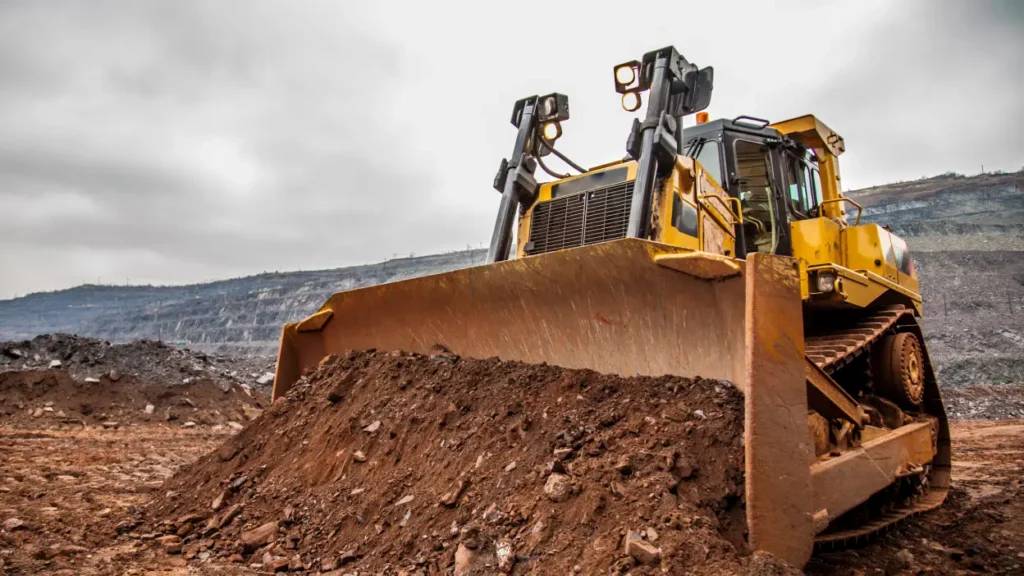
A bulldozer is a strong machine for pushing, digging, and leveling heavy material. It has a large front blade that moves soil, rock, and debris. Some models also have rippers at the back to break tough ground. Dozers use either tracks or wheels, depending on the terrain.
How dozers work:
- Push and spread soil, gravel, or debris;
- Level construction sites before building;
- Break up dense ground with rear rippers;
- Clear land of trees and brush;
- Support road building and mining projects;
- Assist in demolition by moving large volumes of material.
Advantages of dozers as heavy construction equipment:
- High pushing power makes them ideal for heavy earthmoving;
- Tracks provide excellent traction on rough or uneven ground;
- Many types available, including crawler, wheeled, mini, and hybrid;
- Different blades increase flexibility for grading, hauling, or fine soil work;
- Rear rippers allow ground preparation for construction or agriculture;
- Durable build ensures long service life on tough projects.
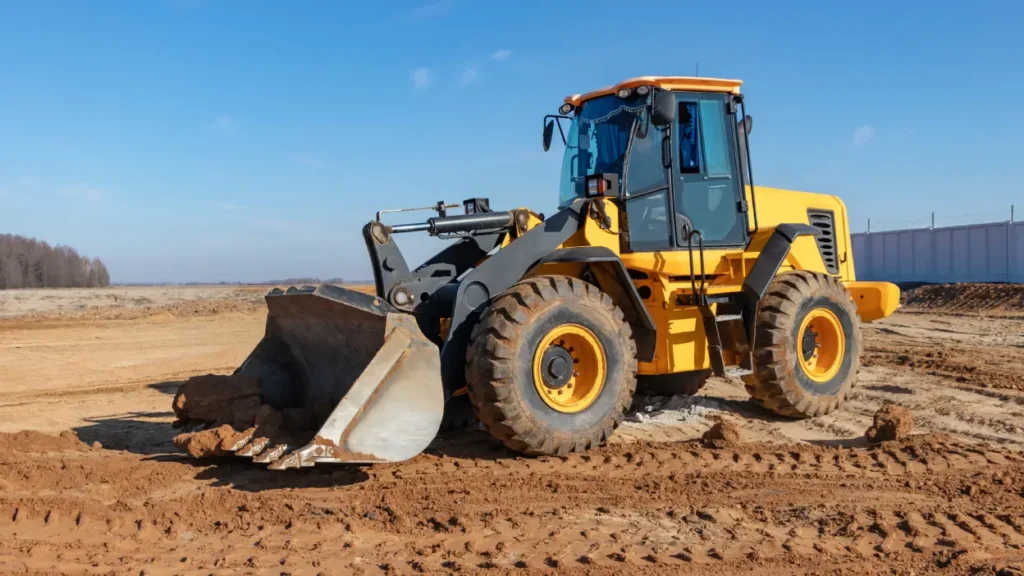
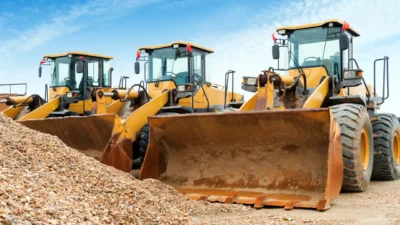
A wheel loader is a four-wheeled machine with a front bucket for scooping, carrying, and dumping loose materials. The lift-arm system raises and lowers the bucket, making it easy to move soil, sand, gravel, and debris. Wheel loaders come in compact, small, medium, and large classes with different engine power and bucket capacity.
How wheel loaders work:
- Load and transport soil, sand, gravel, and minerals;
- Remove debris and waste from construction sites;
- Carry bricks, stones, and other heavy materials;
- Helps with moving hay, carrying feed, and cleaning livestock areas;
- Work in logging, quarrying, and demolition projects;
- Handle specialized jobs with attachments such as forks, grapples, or blades.
Advantages of wheel loaders as heavy construction equipment:
- Fast and efficient at loading and moving material;
- Highly mobile with four-wheel drive for easy site access;
- Wide range of sizes makes them useful for small and large projects;
- Attachments increase versatility for agriculture, construction, and industrial use;
- Saves time on cleanup and transport compared to manual handling;
- Reliable performance across industries, from farming to quarrying.
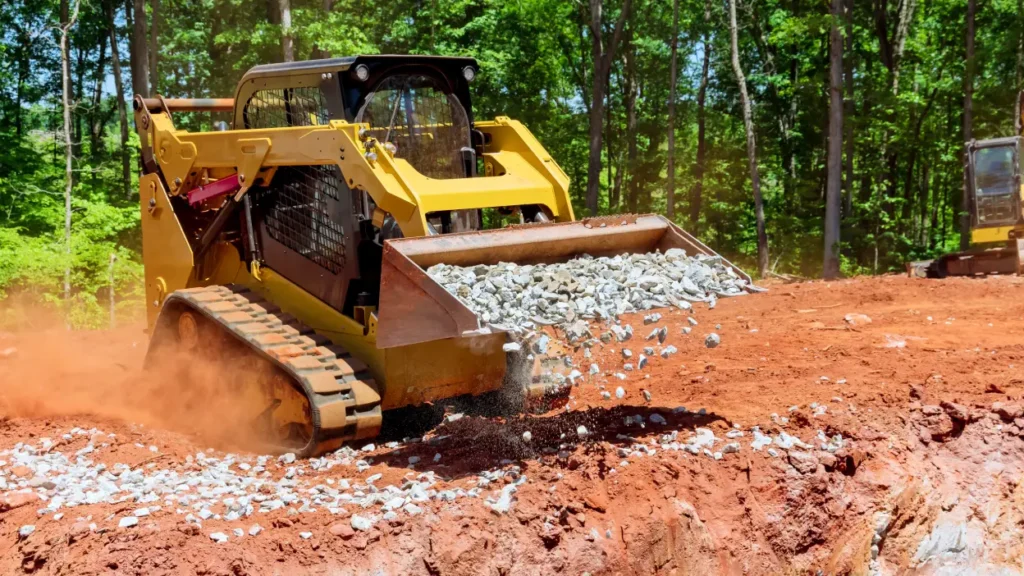
A skid steer loader is a compact, agile machine with lift arms that can support many attachments. It is for lifting, digging, and moving material in tight spaces. With zero-radius turning, skid steers operate where larger equipment cannot. Models are available with wheels or tracks, depending on the terrain.
How skid steer loaders work:
- Lift and transport soil, gravel, debris, and pallets;
- Dig trenches and prepare foundations with bucket or auger attachments;
- Remove snow with blowers, blades, or pushers;
- Clean and maintain sites with broom and bucket attachments;
- Support farming by moving feed, clearing fields, and handling bales;
- Perform small-scale demolition and utility work in urban projects;
- Assist in mining, quarrying, and forestry through material handling and land clearing.
Advantages of skid steer loaders as heavy construction equipment:
- Compact size and zero-radius turning allow work in confined spaces;
- Wide attachment options like forks, grapples, augers, and sweepers add versatility;
- Tracked models reduce ground pressure for work on soft or sensitive surfaces;
- Cost-effective for small and medium projects compared to larger machines;
- Easy to transport between job sites due to smaller size and lighter weight;
- Agile design allows faster task execution and improved efficiency;
- Indoor usability makes them valuable in warehouses, greenhouses, and other enclosed environments.
Trenchers
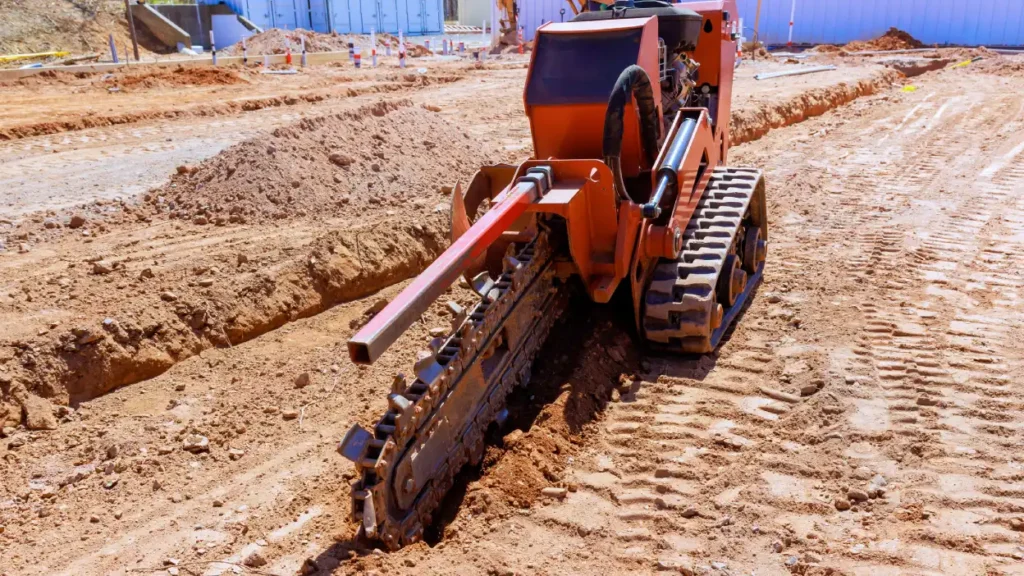
A trencher is a machine designed to dig narrow, straight trenches for utility lines. It uses a digging chain or wheel with teeth to cut through soil, rock, or asphalt. Trenchers come in walk-behind and ride-on models, depending on project size.
How trenchers work:
- Dig trenches for water pipes, gas lines, and electrical cables;
- Cut through hard surfaces like asphalt and compacted soil;
- Prepare drainage systems and irrigation lines;
- Support landscaping projects by laying underground utilities.
Advantages of trenchers as heavy construction equipment:
- Faster and more precise trenching compared to manual digging;
- Can cut through tough surfaces with minimal effort;
- Many sizes available for small residential or large industrial projects;
- Reduces labor costs and project timelines;
- Improves accuracy in depth and width of trenches.
Dragline excavators
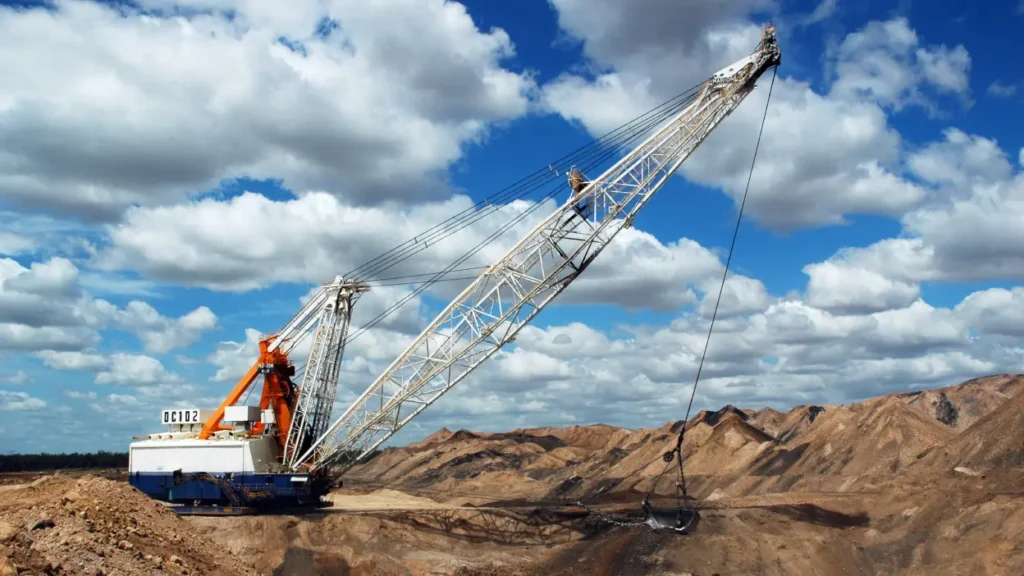
A dragline excavator is a large machine built for deep excavation and dredging. It uses a long boom with a bucket suspended on cables. The bucket is dragged across the ground or underwater to collect material.
How dragline excavators work:
- Perform deep digging for canals, ports, and waterways;
- Remove overburden in surface mining operations;
- Support dredging projects in rivers, lakes, and harbors;
- Excavate foundations for large industrial projects.
Advantages of dragline excavators as heavy construction equipment:
- Handles deep excavation beyond the reach of standard excavators;
- Large bucket capacity moves high volumes of material;
- Essential for mining, dredging, and large-scale earthmoving;
- Long boom design allows work from safe distances;
- High efficiency on massive projects where precision digging is less critical.
Scrapers
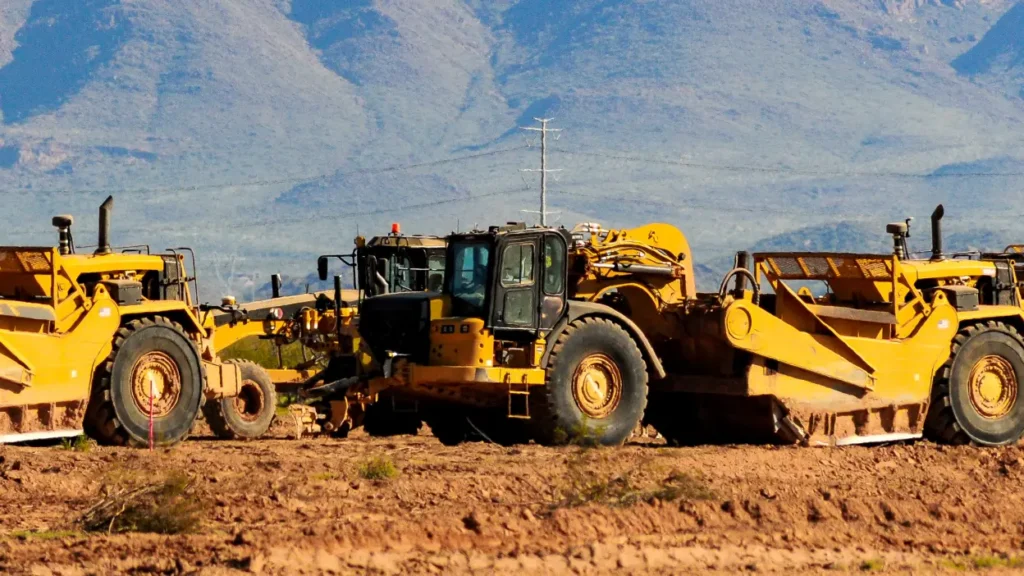
A scraper is a machine designed to cut, collect, and transport soil across a job site. It features a sharp front blade and a bowl (hopper) that collects material as it moves forward. Once full, the bowl is lifted, carried, and unloaded at a designated location.
How scrapers work:
- Cut and move large volumes of soil in road and site preparation;
- Transport earth over medium distances on construction sites;
- Level ground before paving or foundation work;
- Support mining operations by removing overburden.
Advantages of scrapers as heavy construction equipment:
- Combines cutting, loading, hauling, and dumping in one machine;
- Speeds up large-scale earthmoving projects;
- Reduces the need for many machines for soil transport;
- Works on flat or sloping terrain;
- Cost-effective for projects requiring mass excavation and relocation.
Mini excavators
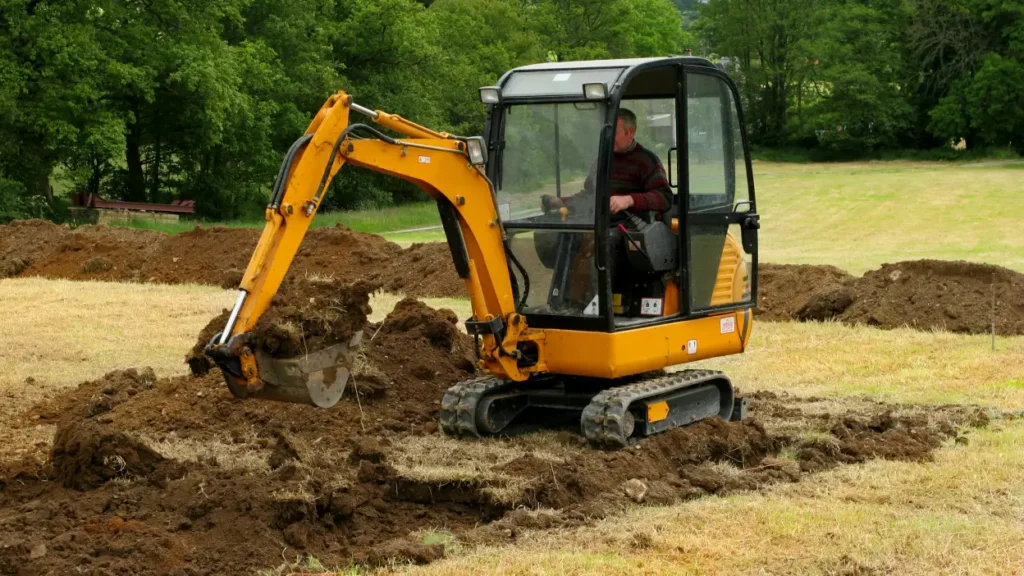
A mini excavator is a compact version of a standard excavator. It has the same boom, stick, and bucket design but is smaller in size and weight for urban or residential projects.
How mini excavators work:
- Dig trenches and foundations in small or confined spaces;
- Perform utility installation in urban areas;
- Landscape and reshape small plots of land;
- Support light demolition tasks;
- Clear snow and debris with attachments.
Advantages of mini excavators as heavy construction equipment:
- Compact size allows access to tight spaces;
- Lighter weight reduces ground damage on sensitive surfaces;
- Versatile with attachments for digging, grading, and lifting;
- Easy to transport between job sites;
- Cost-effective option for smaller projects with limited space.
Long-reach excavators
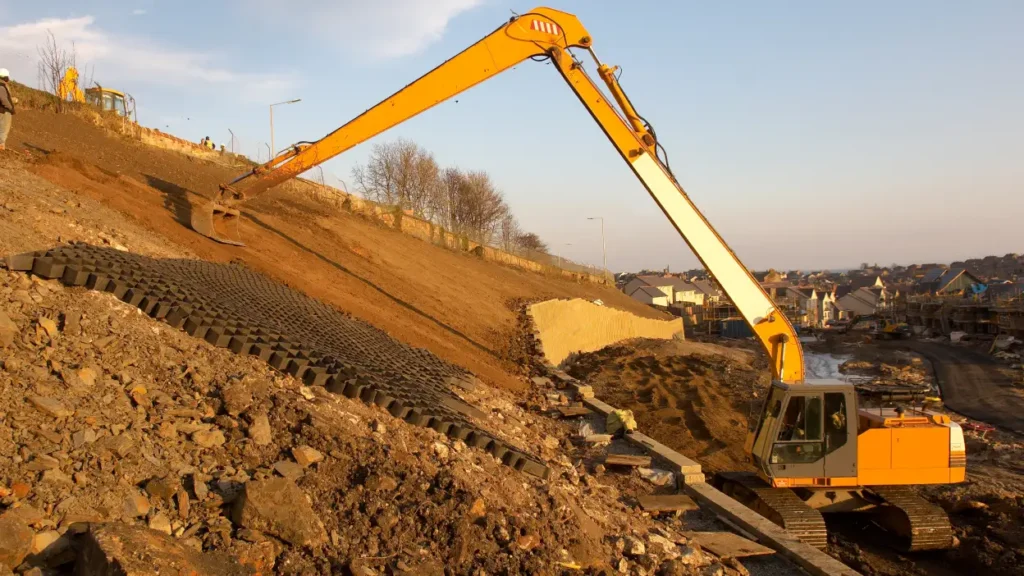
A long-reach excavator is a specialized excavator with an extended boom and arm. It is for tasks that need a wide reach or deep digging beyond the capacity of standard excavators.
How long-reach excavators work:
- Excavate riverbanks, canals, and waterways;
- Perform demolition on tall structures from a safe distance;
- Dredge ponds, lakes, and reservoirs;
- Load and move material from hard-to-reach areas.
Advantages of long-reach excavators as heavy construction equipment:
- Extended boom allows work in areas inaccessible to standard machines;
- Increases safety by keeping operators away from unstable terrain or structures;
- Reduces the need for repositioning due to wide reach;
- Useful in both construction and environmental projects, like dredging;
- Maintains versatility with attachments such as buckets, shears, or grapples.
Lifting & Hauling Equipment
Tower cranes
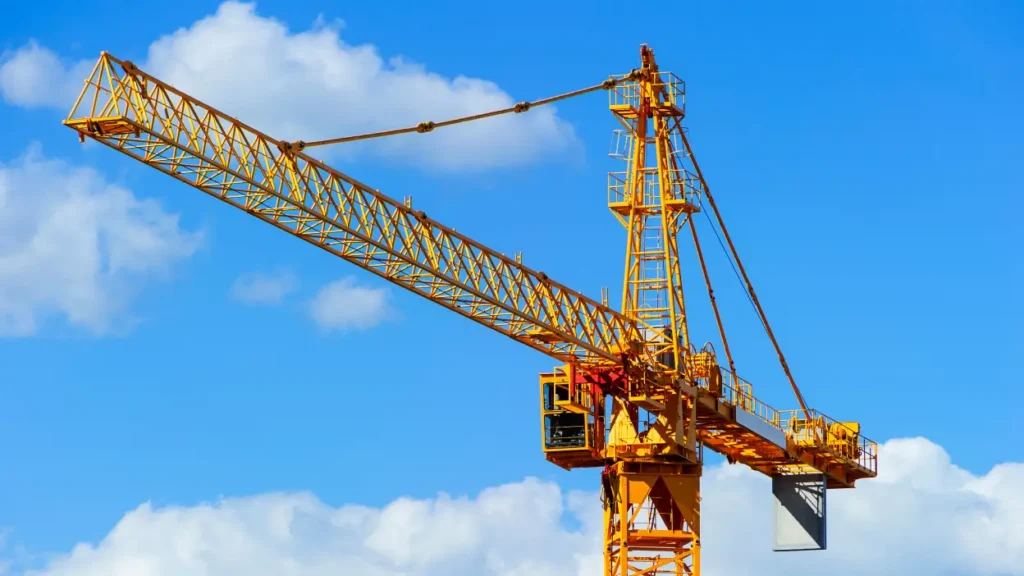
A tower crane is a fixed crane for vertical lifting on tall construction projects. It has a tall mast, a horizontal jib, and a counterweight system for balance. Tower cranes are assembled on-site and can lift heavy loads to great heights.
How tower cranes work:
- Lift and place beams, panels, and heavy materials in skyscraper construction;
- Support bridge and large infrastructure projects;
- Move materials in a horizontal direction across construction sites with trolley systems;
- Handle repetitive lifting tasks in high-rise building projects.
Advantages of tower cranes as heavy construction equipment:
- Exceptional height and lifting capacity for tall structures;
- Can lift materials both in vertical and horizontal directions;
- Stable and reliable for long-term use on large sites;
- Reduces labor effort by handling the heaviest loads;
- Essential for urban construction where vertical reach is critical.
Mobile cranes
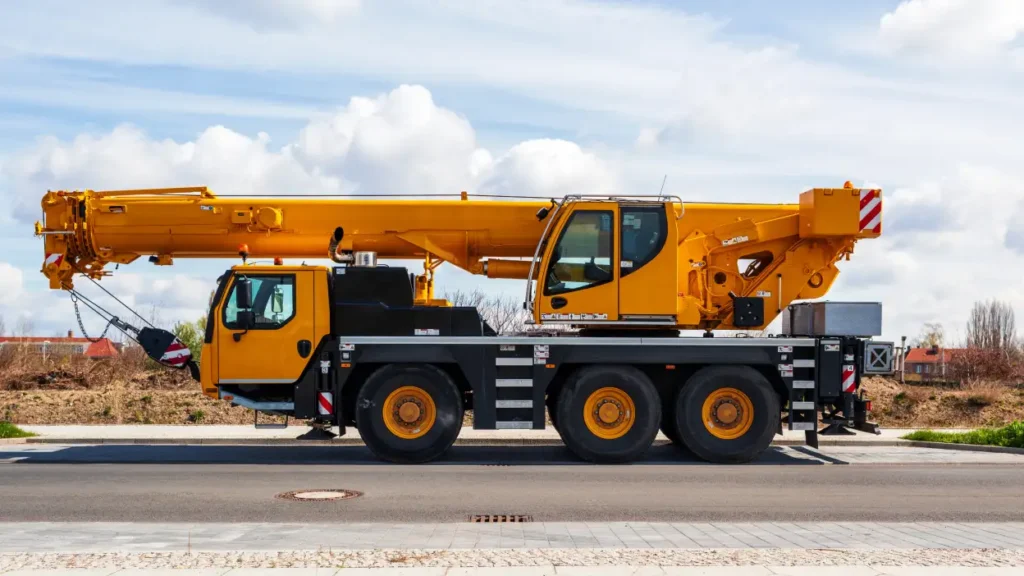
A mobile crane is a crane mounted on wheels or tracks, giving it high mobility across job sites. It uses a telescopic or lattice boom and can be driven to different locations without extra transport.
How mobile cranes work:
- Lift and move heavy materials at many job sites;
- Support construction projects requiring quick setup and relocation;
- Perform lifting tasks in industrial plants and utility projects;
- Assist in emergency and disaster recovery operations.
Advantages of mobile cranes as heavy construction equipment:
- High flexibility due to road mobility;
- Quick setup compared to fixed cranes;
- Wide range of lifting capacities for light to heavy loads;
- Can access urban sites or remote areas with ease;
- Reduces project costs by serving several sites.
Telescopic handlers (telehandlers)
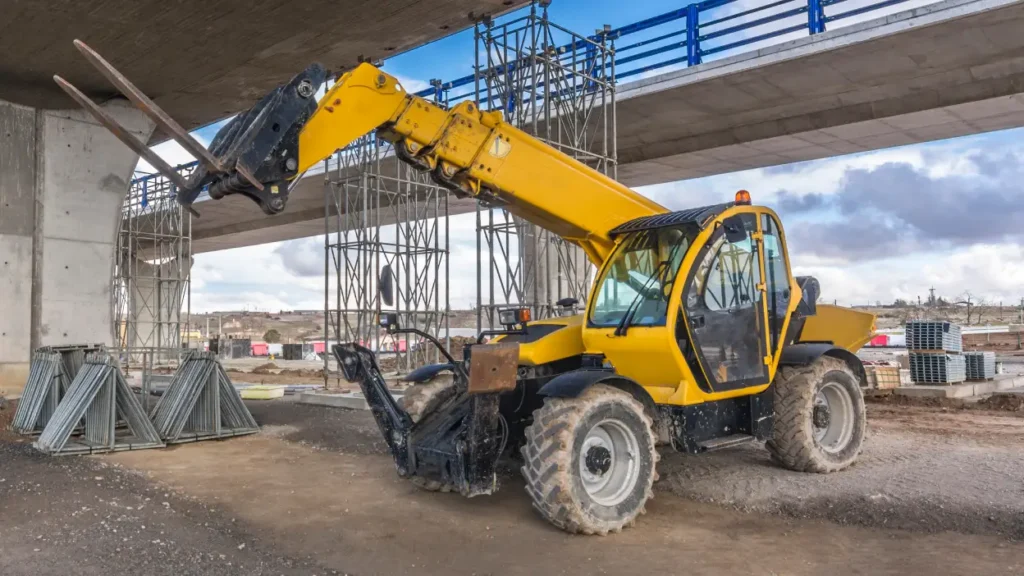
A telehandler is a lifting machine with an extendable telescopic boom. It combines features of a forklift and a crane, making it versatile for construction and agricultural projects.
How telehandlers work:
- Lift and place pallets of bricks, timber, or steel;
- Reach high levels for placing materials on scaffolding or roofs;
- Handle agricultural loads like hay bales or feed;
- Operate with attachments such as buckets, winches, or platforms.
Advantages of telehandlers as heavy construction equipment:
- High reach combined with strong lifting capacity;
- Versatile with several attachment options;
- Compact design for maneuverability on busy job sites;
- Suitable for both construction and farming applications;
- Increases efficiency compared to forklifts on uneven ground.
Forklifts
A forklift is a compact vehicle with two front forks to lift and transport pallets or materials. It is mostly used in warehouses, factories, and construction sites.
How forklifts work:
- Move pallets of bricks, tiles, or building supplies;
- Load and unload trucks at warehouses or construction sites;
- Transport heavy goods over short distances;
- Support logistics and storage operations.
Advantages of forklifts as heavy construction equipment:
- Efficient for lifting and moving palletized loads;
- Available in electric, diesel, and gas-powered models;
- Compact design makes them suitable for indoor and outdoor use;
- Easy to operate and maintain compared to larger machines;
- Increases productivity in material handling tasks.
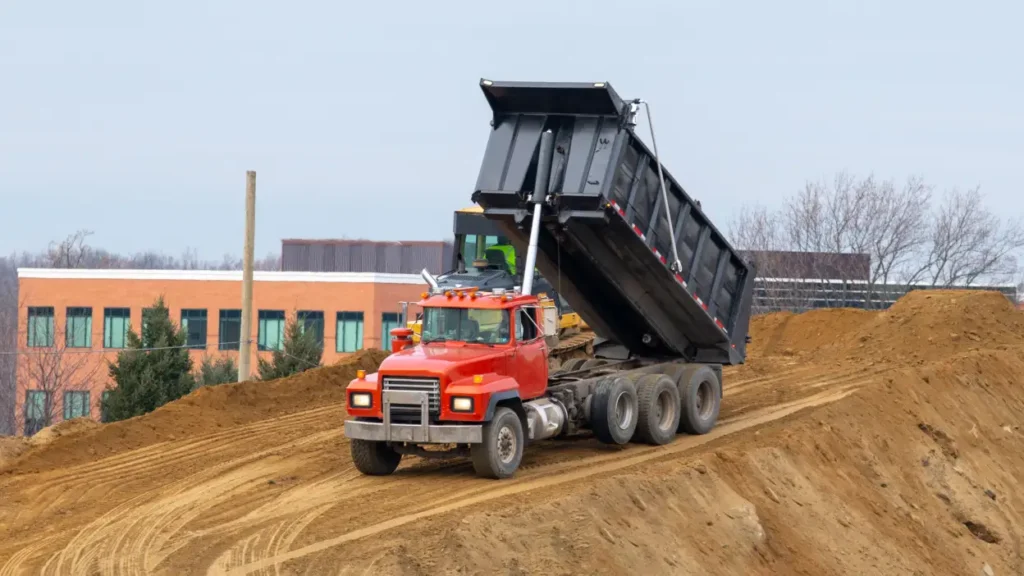
A dump truck is a heavy-duty vehicle used to haul and unload loose materials such as soil, sand, gravel, and debris. Its hydraulic system tilts the dump body so material can be emptied without manual labor. Dump trucks come in many sizes and configurations to handle different job requirements.
How dump trucks work:
- Transport and unload soil, gravel, and sand on construction sites;
- Move rocks, ore, and overburden in mining and quarry operations;
- Clear debris from demolition projects;
- Support municipal work like road maintenance and snow removal;
- Handle waste removal in residential and industrial projects;
- Spread materials such as salt or combine with specialized attachments.
Advantages of dump trucks as heavy construction equipment:
- Large hauling capacity compared to standard vehicles;
- Fast unloading with hydraulic dump bodies increases efficiency;
- Versatile for construction, mining, landscaping, and municipal work;
- Built for durability and able to handle rough terrain and heavy use;
- Reduces labor and safety risks by eliminating manual unloading;
- Compatible with accessories like tarp systems, tailgate extensions, and snowplows;
- Improves productivity by cutting transport and unloading time.
Articulated haulers
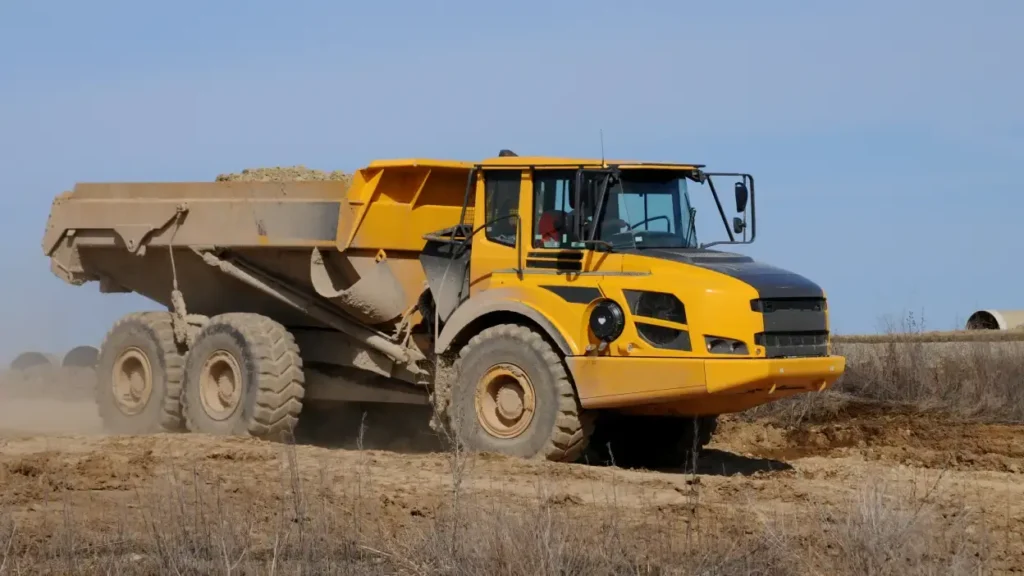
An articulated hauler, also called an articulated dump truck (ADT), is a heavy-duty vehicle with a pivot joint between the cab and dump body. This design gives it excellent maneuverability and stability on rough or uneven terrain.
How articulated haulers work:
- Haul large volumes of soil, rock, or debris in mining and quarrying;
- Transport material across muddy or steep job sites;
- Support large-scale earthmoving in road and dam construction;
- Operate in remote and difficult-to-access areas.
Advantages of articulated haulers as heavy construction equipment:
- Pivot joint provides strong maneuverability on rough terrain;
- High payload capacity for moving bulk materials;
- Excellent traction and stability in challenging conditions;
- Durable design reduces downtime in heavy-duty work;
- More efficient than rigid trucks in off-road hauling.
Rough terrain cranes
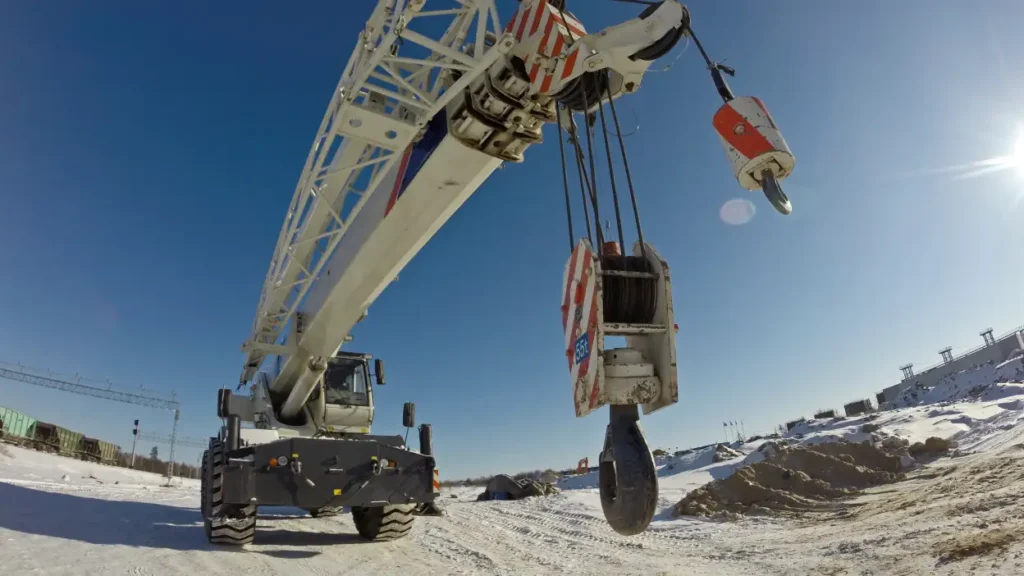
A rough terrain crane is a mobile crane mounted on four large tires with a powerful suspension system. It is for lifting heavy loads on uneven or soft ground.
How rough terrain cranes work:
- Lift materials on off-road construction projects;
- Support oil and gas field operations;
- Handle lifting tasks in industrial and energy projects with rough terrain;
- Work in areas where standard truck cranes cannot operate.
Advantages of rough terrain cranes as heavy construction equipment:
- Strong lifting power with stability on soft or uneven ground;
- Compact design compared to larger cranes;
- Quick to set up and operate in remote sites;
- Ideal for off-road and limited-access projects;
- Durable construction for harsh conditions.
Carry deck cranes
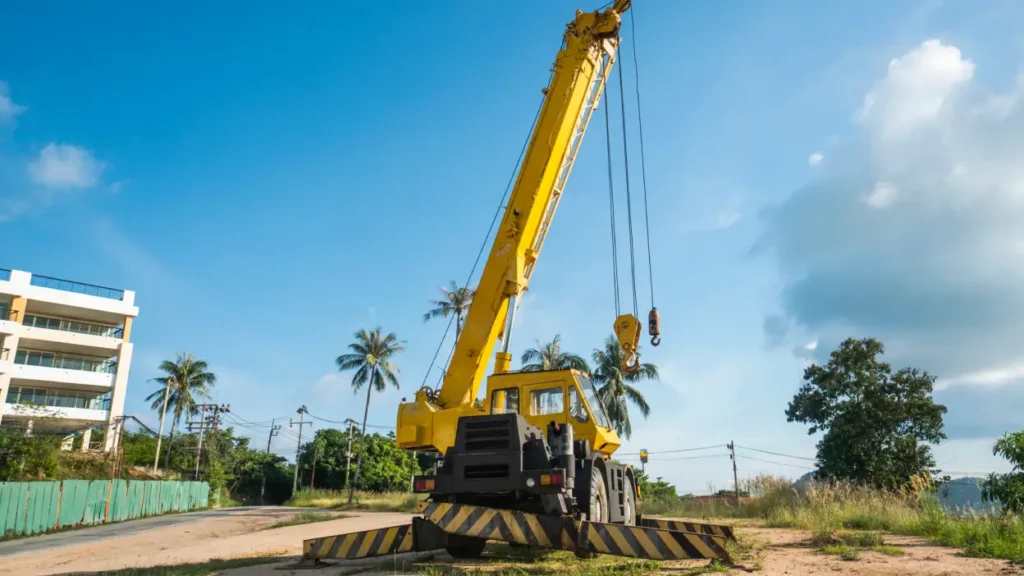
A carry deck crane is a small, four-wheeled crane with a 360-degree rotating boom. It is compact and designed for lifting in confined spaces. It also has a flat deck that can carry loads.
How carry deck cranes are used:
- Lift and move materials in industrial plants and warehouses;
- Operate in urban construction sites with limited access;
- Handle light-to-medium lifting in utility and maintenance projects;
- Transport loads short distances on the built-in deck.
Advantages of carry deck cranes as heavy construction equipment:
- Compact size and full rotation allow lifting in tight areas;
- Deck surface provides added load transport capacity;
- Easy to move between job sites due to small size;
- Ideal for indoor and urban projects where larger cranes cannot fit;
- Efficient for light lifting tasks with quick setup.
Road Construction Equipment
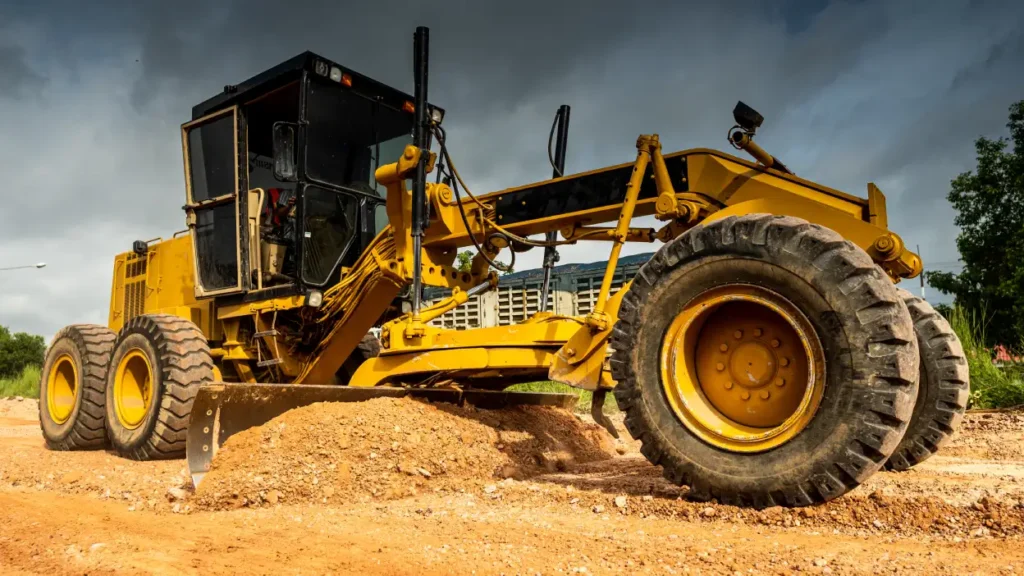
A motor grader is a precision earthmoving machine with a long, adjustable blade. It is built to create flat surfaces and fine grades in road and site preparation. Graders can tilt, lift, and angle the blade for accurate shaping.
How motor graders work:
- Final grading for roadbeds before paving;
- Shaping slopes, ditches, and drainage channels;
- Maintaining unpaved rural or mining roads;
- Supporting snow removal with plow attachments.
Advantages of motor graders as heavy construction equipment:
- Delivers high precision in grading and leveling;
- Versatile blade control for many applications;
- Improves road quality and long-term durability;
- Suitable for both large infrastructure and smaller road projects.
Road rollers/compactors
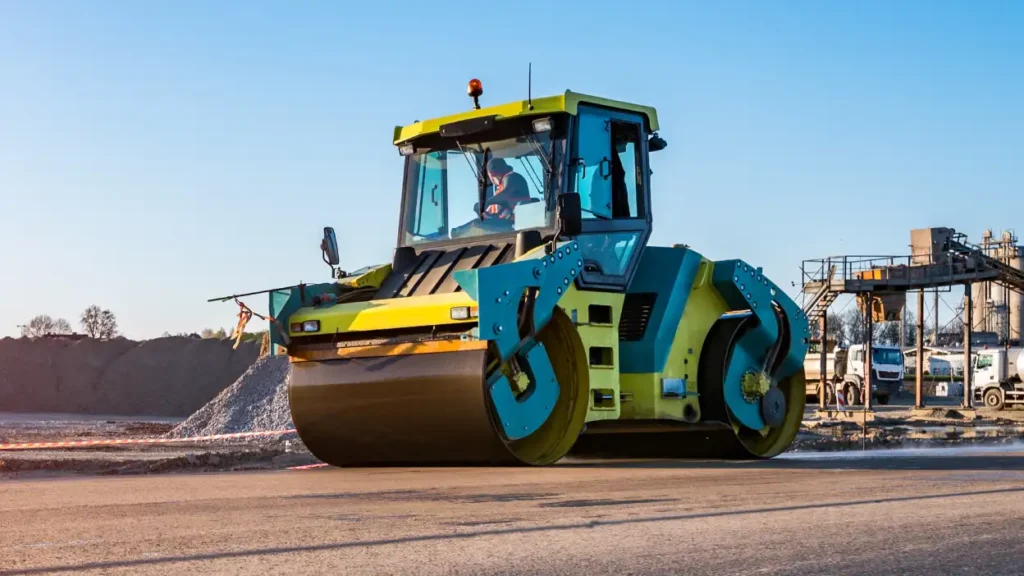
A road roller, also known as a compactor, uses heavy drums or pneumatic tires to compress soil, gravel, or asphalt. It applies static or vibratory force to create stable, smooth surfaces.
How road rollers are used:
- Compact soil layers for roadbeds and foundations;
- Flatten asphalt layers during paving projects;
- Seal gravel and reduce air pockets in sub-bases;
- Support landfill and embankment construction.
Advantages of road rollers as heavy construction equipment:
- Ensures long-lasting pavement by increasing material density;
- Different models available, including single drum, tandem, and pneumatic;
- Vibratory rollers compact deeper layers;
- Enhances road stability and prevents surface failure.
Asphalt pavers
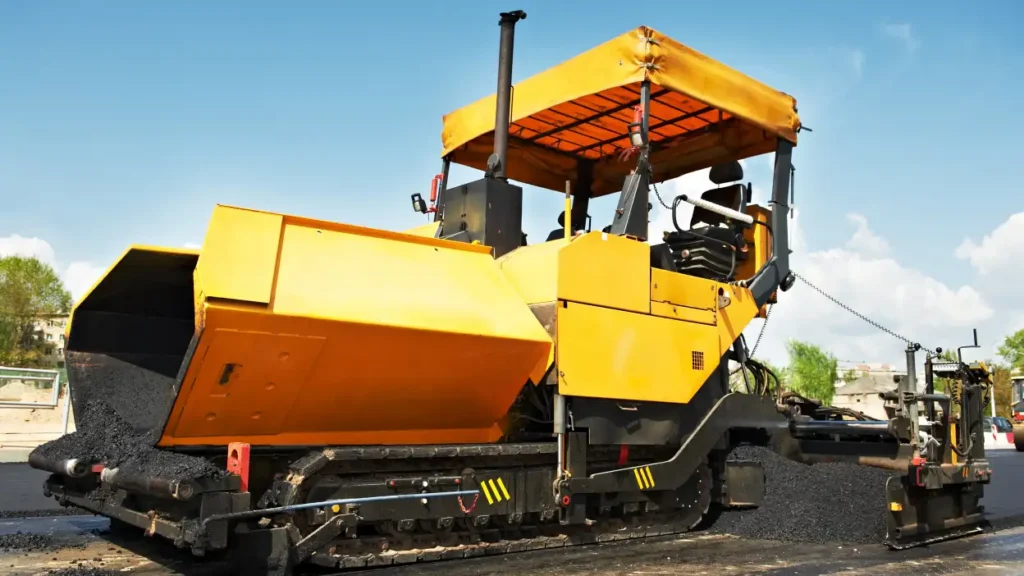
An asphalt paver is a machine that lays hot asphalt mix across prepared surfaces. It features a hopper, conveyors, and a screed that spreads and levels the asphalt to the desired thickness.
How asphalt pavers work:
- Lay asphalt for highways, city streets, and parking lots;
- Resurface old pavements with new asphalt layers;
- Build airport runways and large industrial yards;
- Support residential and commercial paving projects.
Advantages of asphalt pavers as heavy construction equipment:
- Delivers smooth and even asphalt distribution;
- Adjustable screed ensures correct thickness and width;
- Tracked models provide stability on uneven ground;
- Increases paving speed and efficiency compared to manual methods.
Cold planers (milling machines)
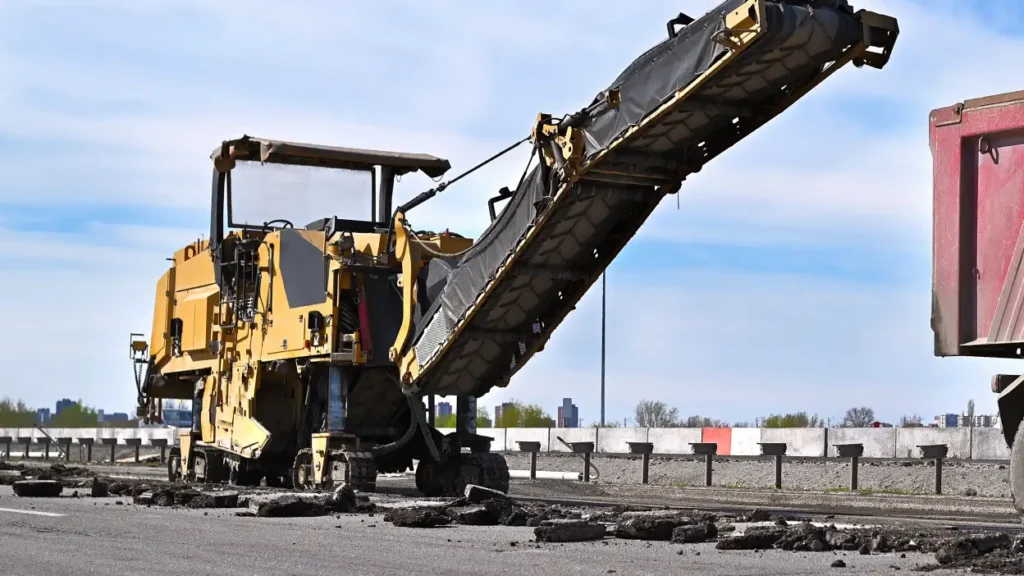
A cold planer, or milling machine, removes old pavement layers using a rotating drum with cutting teeth. It grinds asphalt or concrete and transfers the material via conveyor to trucks for recycling.
How cold planers work:
- Mill damaged asphalt before resurfacing roads;
- Correct road slopes and surface irregularities;
- Remove rutted or worn pavement without disturbing the base;
- Prepare highways and runways for overlays or reconstruction.
Advantages of cold planers as heavy construction equipment:
- Provides controlled, precise pavement removal;
- Allows recycling of milled asphalt, reducing waste;
- Speeds up road rehabilitation with less disruption;
- Improves bonding for new pavement layers.
Road reclaimers
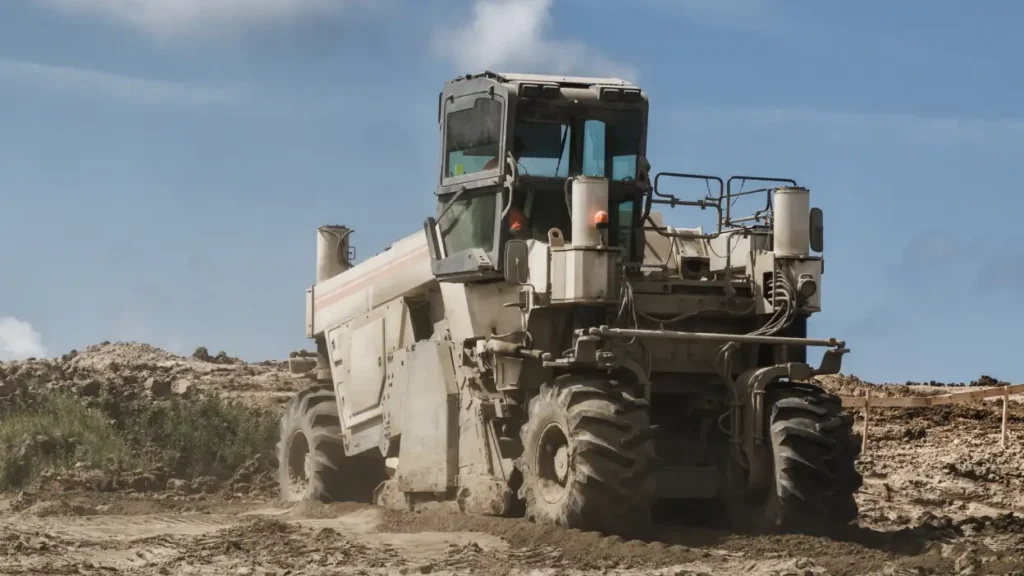
A road reclaimer pulverizes existing asphalt and mixes it with base material to stabilize and rebuild roads. It uses a rotating drum and often adds cement, lime, or asphalt emulsion.
How road reclaimers work:
- Rehabilitate deteriorated roads without full reconstruction;
- Mix stabilizing agents into base layers for strength;
- Recycle old asphalt into new road foundations;
- Support rural road upgrades and municipal projects.
Advantages of road reclaimers as heavy construction equipment:
- Cuts costs by reusing existing road material;
- Strengthens road foundations for longer service life;
- Reduces environmental impact by minimizing waste;
- Creates durable sub-bases for overlays or paving.
Slipform pavers
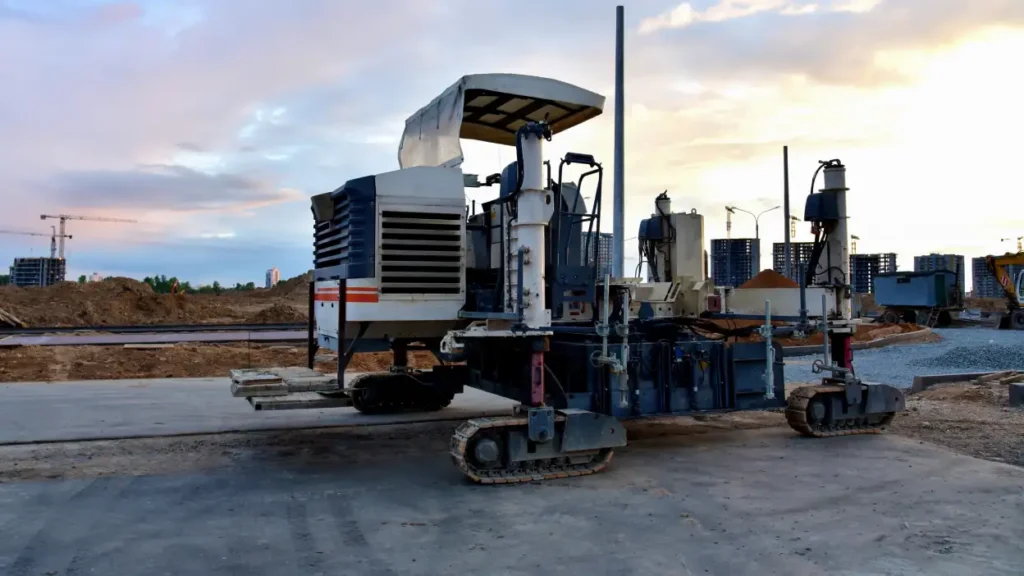
A slipform paver forms and lays concrete pavement without stopping. It extrudes concrete through a mold while moving, shaping roads, curbs, or barriers without fixed side forms.
How slipform pavers work:
- Lay continuous concrete highways and runways;
- Construct curbs, gutters, and median barriers;
- Create industrial pavements and large concrete slabs;
- Deliver rapid paving in large infrastructure projects.
Advantages of slipform pavers as heavy construction equipment:
- Produces consistent, high-quality concrete surfaces;
- Eliminates costly manual formwork;
- Increases paving speed with continuous operation;
- Adapts to different widths and thicknesses.
Soil stabilizers
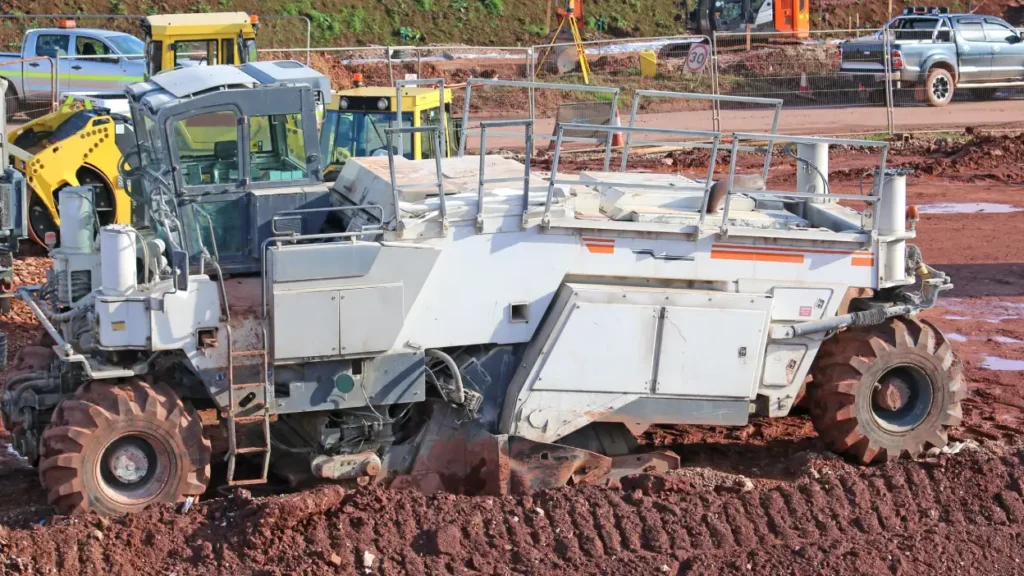
A soil stabilizer improves ground conditions by mixing stabilizing agents into the soil. It uses a rotating drum to blend lime, cement, or asphalt emulsion into weak or expansive soils.
How soil stabilizers work:
- Prepare unstable soil for foundations and roadbeds;
- Treat sub-grade before road or runway construction;
- Strengthen clay-rich or moisture-sensitive soils;
- Rehabilitate failed pavement sections.
Advantages of soil stabilizers as heavy construction equipment:
- Improves soil strength and compaction results;
- Reduces the need for importing high-quality fill material;
- Increases load-bearing capacity of foundations;
- Saves costs and time by stabilizing soil in place.
Concrete & Building Equipment
Concrete mixer trucks
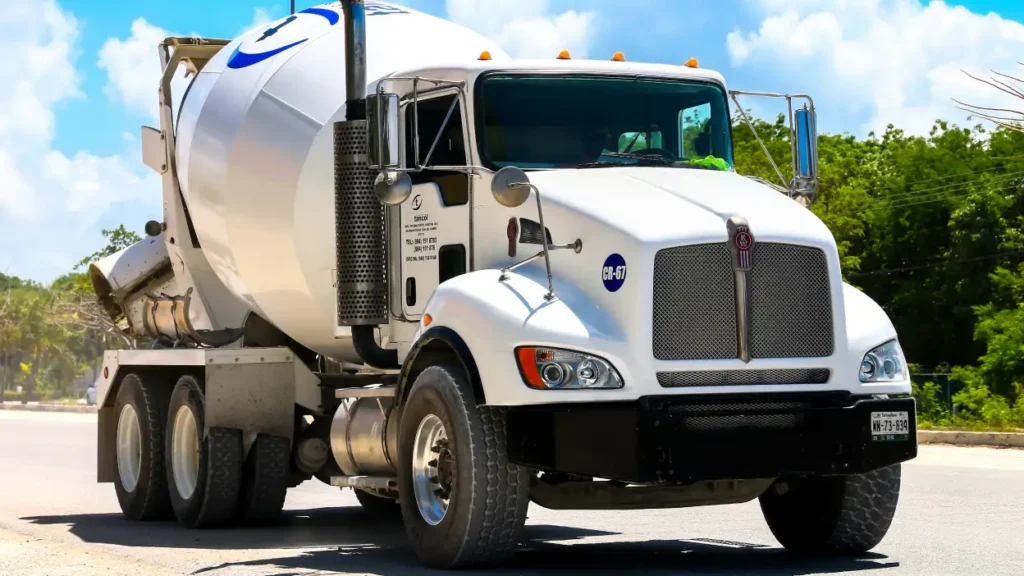
A concrete mixer truck is a vehicle with a rotating drum that mixes and transports ready-mix concrete. The drum keeps turning during transport, preventing the concrete from setting before it reaches the site. Mixer trucks come in various sizes to match project needs.
How concrete mixer trucks work:
- Deliver fresh concrete to construction sites;
- Mix concrete on the move for consistent quality;
- Supply small or large batches for foundations, slabs, and pavements;
- Support road construction, high-rise buildings, and residential projects.
Advantages of concrete mixer trucks as heavy construction equipment:
- Keeps concrete fresh during long transport times;
- Reduces labor by mixing and transporting in one unit;
- Available in small, medium, and large drum capacities;
- Ensures uniform mix and reduces material waste;
- Essential for projects where on-site mixing is impractical.
Concrete pump trucks
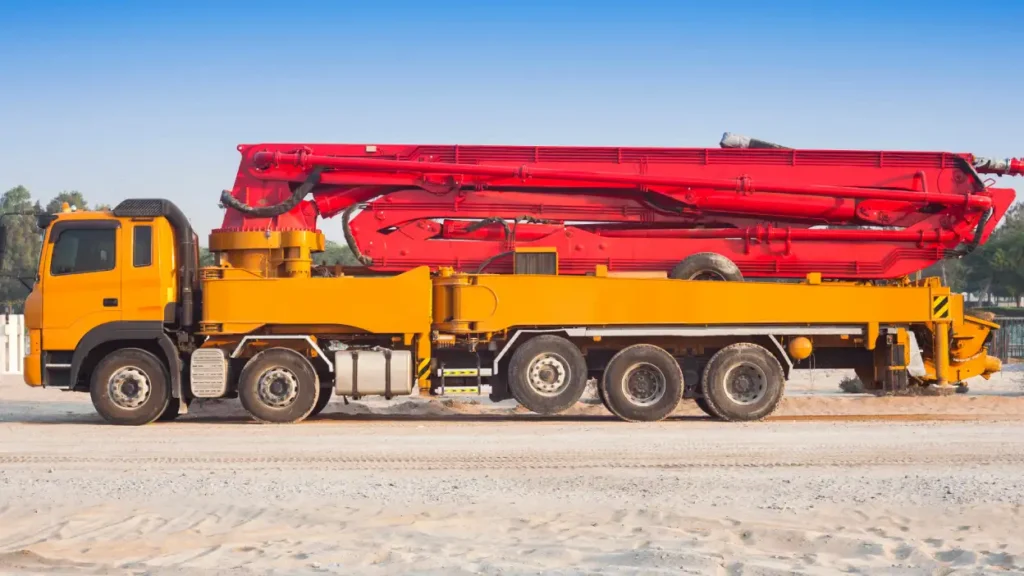
A concrete pump truck combines a truck chassis with a powerful pump and an extendable boom. It delivers concrete directly from the mixer truck to the exact placement location, even at great heights or distances.
How concrete pump trucks work:
- Pump concrete into high-rise buildings;
- Deliver concrete to hard-to-reach foundations or tunnels;
- Place concrete in bridge or dam projects;
- Handle large pours for slabs and industrial floors.
Advantages of concrete pump trucks as heavy construction equipment:
- Places concrete faster and more accurately than manual methods;
- Reduces labor requirements and improves safety on site;
- Extendable booms reach tall or confined areas;
- Keeps concrete quality consistent by reducing delays;
- Essential for large or complex structures requiring continuous pouring.
Boom lifts (cherry pickers)
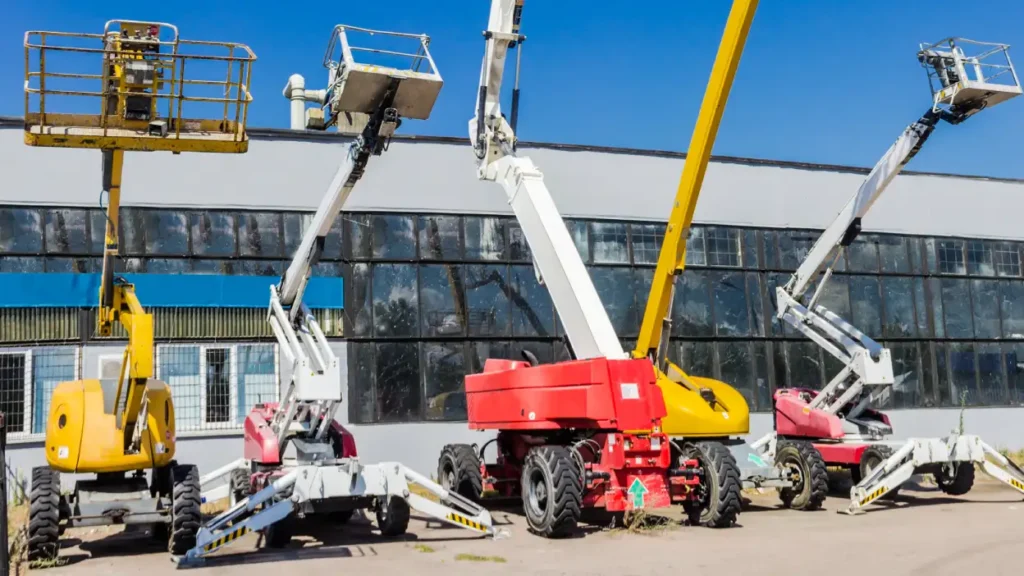
A boom lift, also known as a cherry picker or an aerial work platform, is a vehicle with a hydraulic arm and platform. It allows workers to reach elevated work areas safely.
How boom lifts work:
- Provide access for installing windows, facades, and cladding;
- Support electrical, painting, and maintenance work at height;
- Reach tall structures in industrial plants or warehouses;
- Assist construction crews with safe elevation access.
Advantages of boom lifts as heavy construction equipment:
- Safer than ladders or scaffolding for working at height;
- Extendable arms provide flexibility and range of motion;
- Compact models can work in tight indoor or urban spaces;
- Improves efficiency in maintenance and installation tasks;
- Available in electric or diesel models for indoor and outdoor use.
Pile driving machines
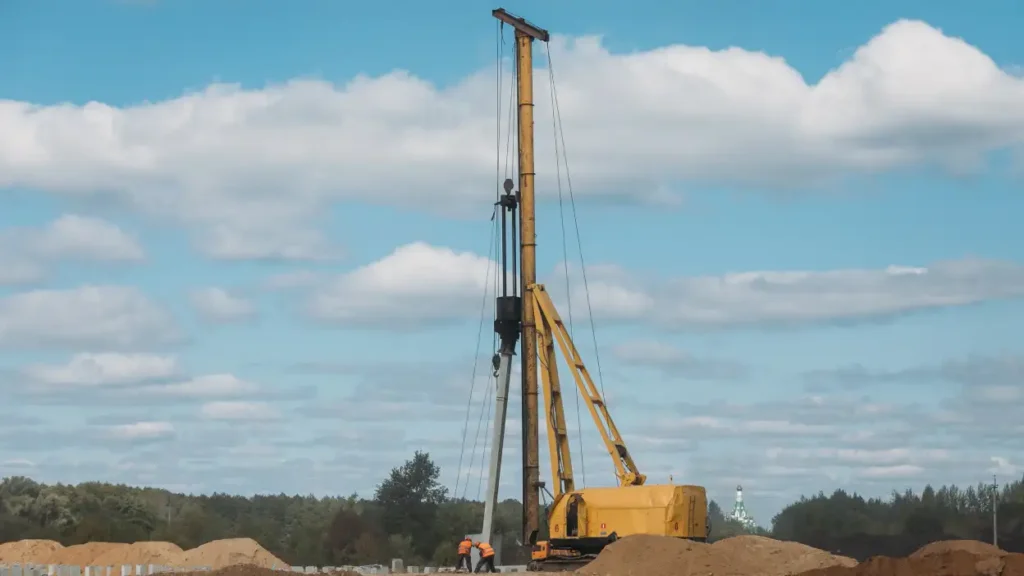
A pile driving machine is used to drive piles—long columns of steel, wood, or concrete—into the ground to support foundations. It uses heavy hammers or vibratory systems to embed piles deep into the soil.
How pile driving machines work:
- Install foundation piles for bridges, ports, and skyscrapers;
- Stabilize soil in weak or unstable areas;
- Build marine structures like piers and docks;
- Support wind turbine and offshore platform installations.
Advantages of pile driving machines as heavy construction equipment:
- Provides strong, stable foundations for heavy structures;
- Handles deep foundation work in poor soil conditions;
- Suitable for both onshore and offshore projects;
- Modern hydraulic and vibratory systems reduce noise and vibration;
- Increases speed and precision in foundation installation.
Boring machines
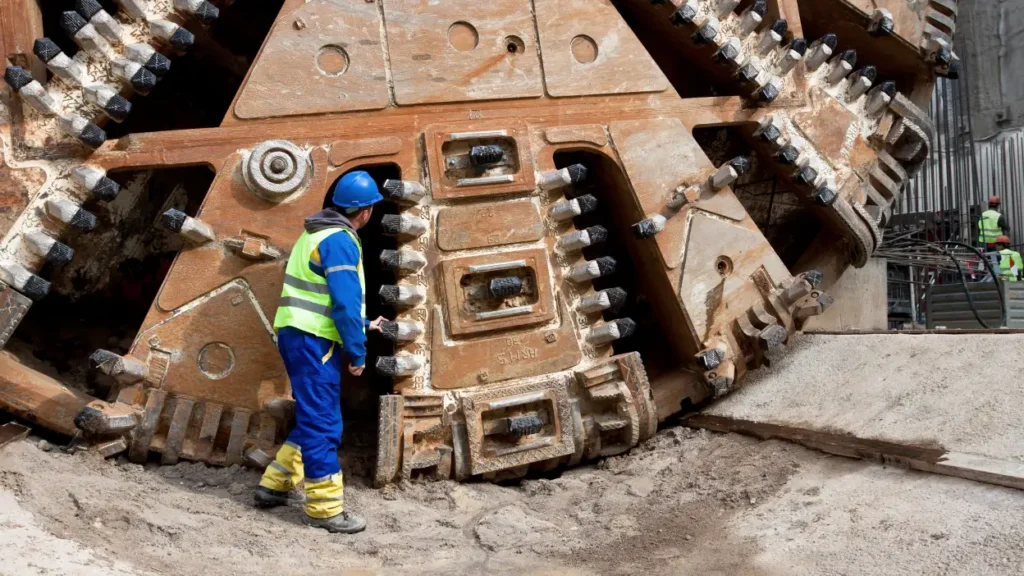
A boring machine drills holes into the ground for foundations, tunnels, or utility installations. It uses rotating cutting tools to penetrate soil, rock, or concrete.
How boring machines work:
- Drill foundation piles for high-rise buildings;
- Install underground utilities like water or gas pipelines;
- Create shafts for tunnels or mining operations;
- Support soil investigation and geotechnical studies.
Advantages of boring machines as heavy construction equipment:
- Capable of drilling large-diameter, deep holes;
- Reduces manual excavation in difficult soil or rock;
- Improves speed and accuracy in foundation preparation;
- Versatile across construction, utility, and mining projects;
- Modern models offer automation for better efficiency.
Tunnel boring machines (TBM)
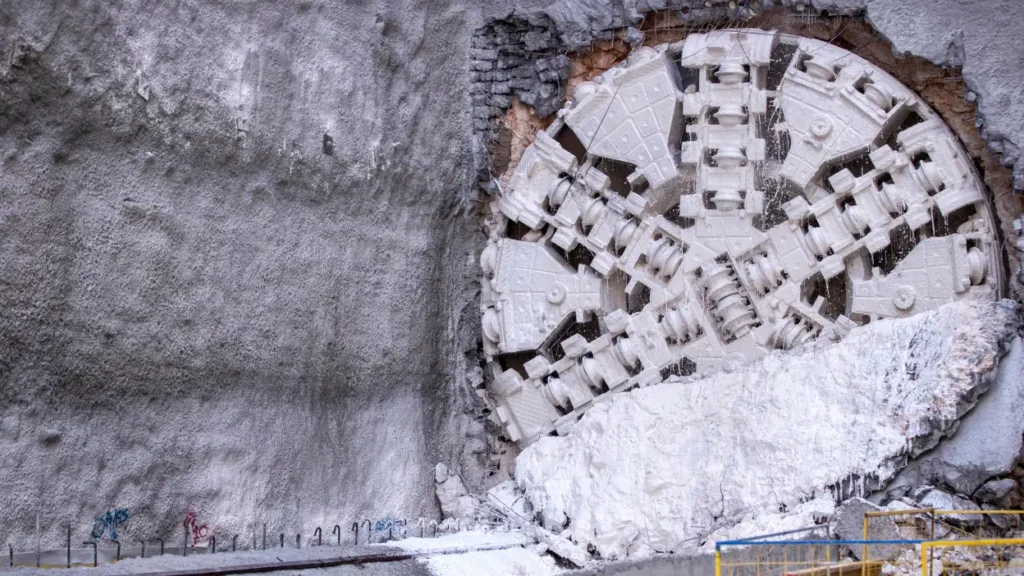
A tunnel boring machine (TBM) is a massive machine used to excavate tunnels through soil and rock. It has a rotating cutting head at the front and a conveyor system that removes excavated material.
How TBMs work:
- Construct metro systems, railway tunnels, and highway tunnels;
- Bore through mountains or urban areas with minimal disruption;
- Create underground passages for water and utility projects;
- Support mining and hydroelectric projects.
Advantages of TBMs as heavy construction equipment:
- Provides safe, continuous excavation with minimal ground disturbance;
- Produces smooth tunnel walls, reducing the need for extra lining;
- Faster and more efficient than the drill-and-blast methods;
- Reduces noise and vibration, ideal for urban tunneling;
- Capable of working in varying soil and rock conditions.
Shotcrete machines (concrete sprayers)
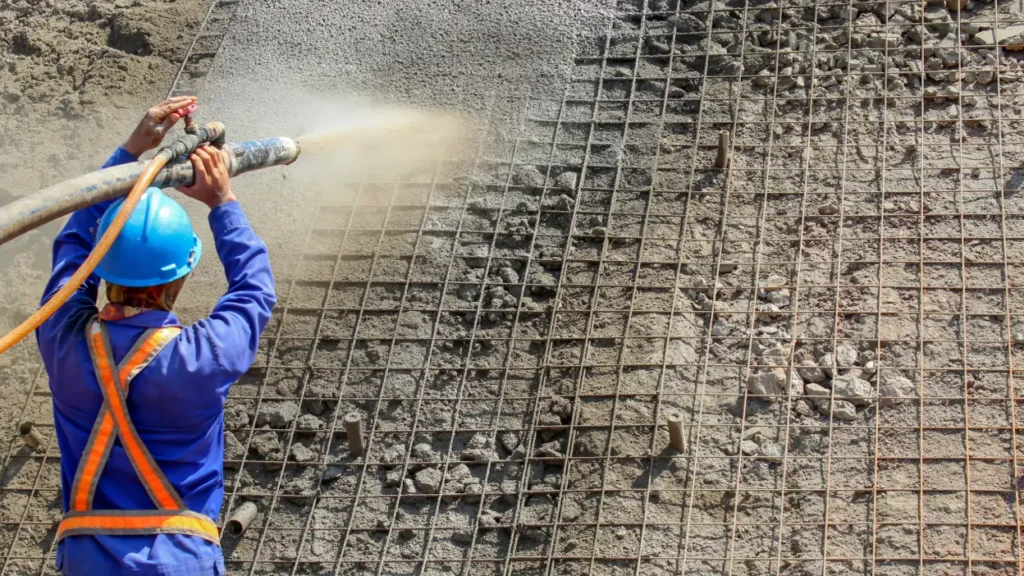
A shotcrete machine, or concrete sprayer, pushes concrete through a hose and nozzle. The mix sprays onto surfaces with force, which speeds up placement and improves adhesion.
How shotcrete machines work:
- Apply concrete in tunneling and mining projects;
- Stabilize slopes and embankments;
- Line reservoirs, canals, and swimming pools;
- Provide structural support in underground works.
Advantages of shotcrete machines as heavy construction equipment:
- Allows fast application of concrete in hard-to-reach areas;
- Adheres to uneven or vertical surfaces without formwork;
- Reduces labor costs by spraying large areas;
- Provides structural reinforcement for tunnels and slopes;
- Versatile for construction, mining, and landscaping.
Concrete buckets
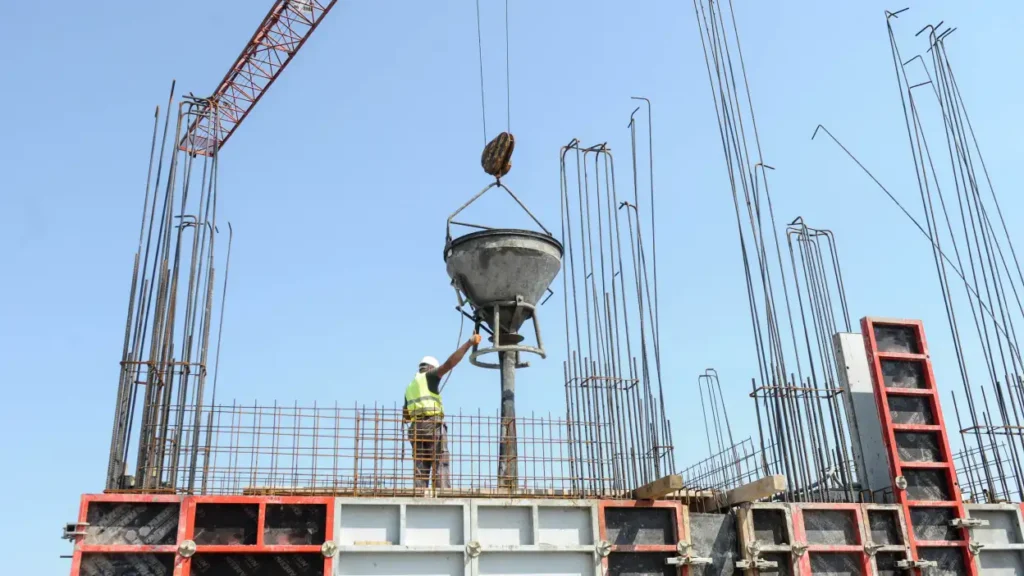
A concrete bucket is an attachment used with cranes to lift and pour concrete. It holds wet concrete and features a gate or chute for controlled release.
How concrete buckets work:
- Lift concrete to elevated sites like bridges and high-rises;
- Pour concrete into columns, walls, and formwork;
- Support projects where pumps cannot work;
- Work with tower cranes for precise placement.
Advantages of concrete buckets as heavy construction equipment:
- Simple and cost-effective for vertical concrete placement;
- Easy to attach and operate with cranes;
- Provides controlled pouring into specific areas;
- Suitable for both small and large construction projects;
- Durable and reusable across several worksites.
Specialized & Mining Equipment
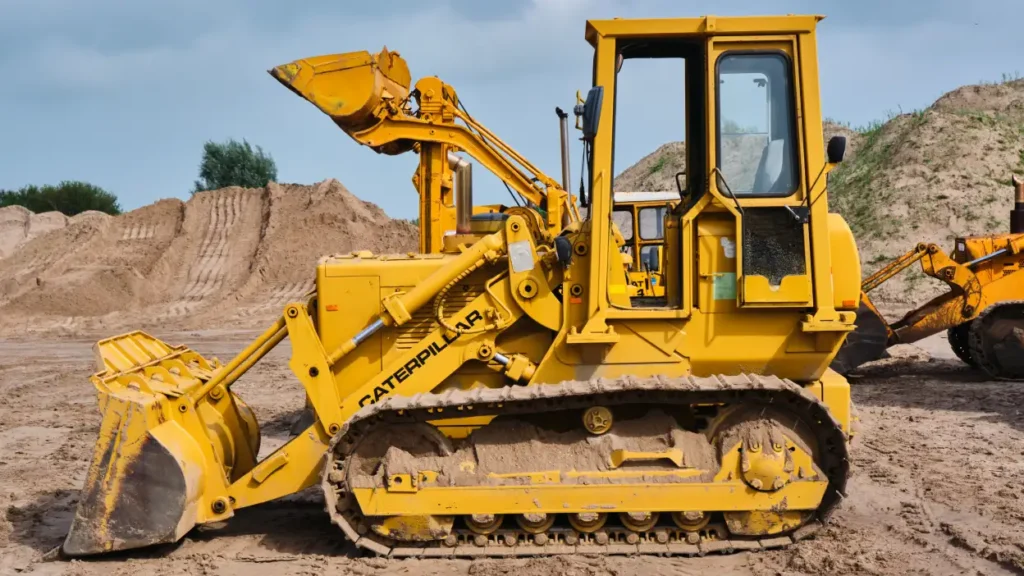
A crawler loader is a tracked machine for digging, lifting, and transporting materials. Its tracks distribute weight evenly for excellent stability and traction on soft or uneven terrain.
How crawler loaders work:
- Dig and load soil, gravel, and demolition debris;
- Move materials across muddy or sloped sites;
- Grade surfaces with buckets or blade attachments;
- Support mining, forestry, and agricultural projects.
Advantages of crawler loaders as heavy construction equipment:
- Tracks reduce ground pressure and improve stability;
- Strong traction allows work on rough landscapes;
- Handles many tasks with attachments like forks, blades, and grapples;
- Durable and reliable in heavy-duty conditions;
- Modern models feature GPS and telematics for efficient operation.
Hydraulic breakers (hammers)
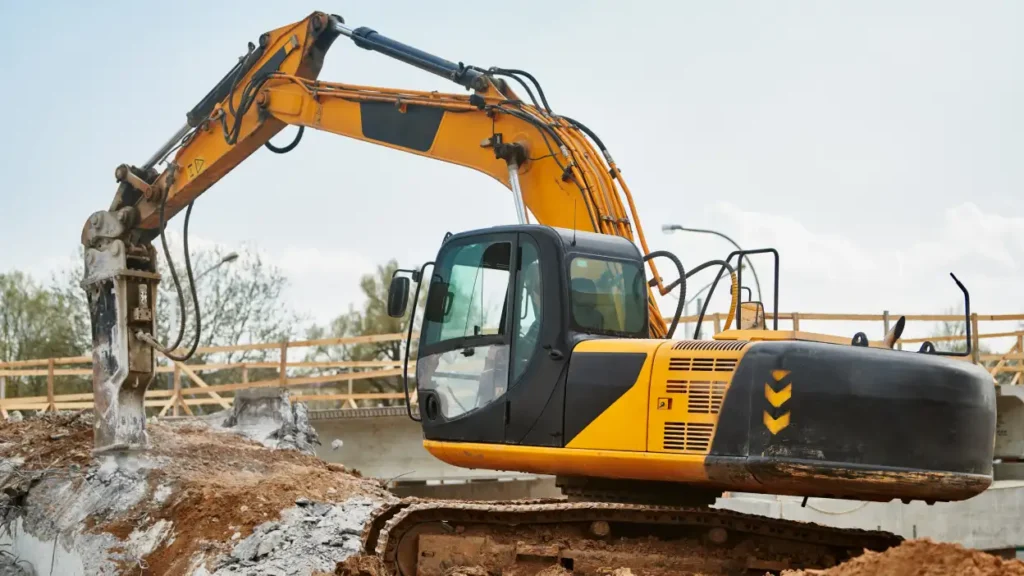
A hydraulic breaker, also known as a hydraulic hammer, is an attachment that delivers powerful blows with hydraulic pressure. It is mounted on excavators, skid steers, or backhoes for demolition.
How hydraulic breakers are used:
- Break rock, concrete, and asphalt in demolition projects;
- Clear obstacles on the road and mining operations;
- Prepare foundations by breaking hard surfaces;
- Support quarry work by splitting large stones.
Advantages of hydraulic breakers as heavy construction equipment:
- Delivers high-impact force for tough demolition tasks;
- Reduces the need for explosives in controlled environments;
- Attaches to multiple carriers for flexibility;
- Speeds up removal of hard materials;
- Durable design withstands continuous heavy use.
Drilling rigs
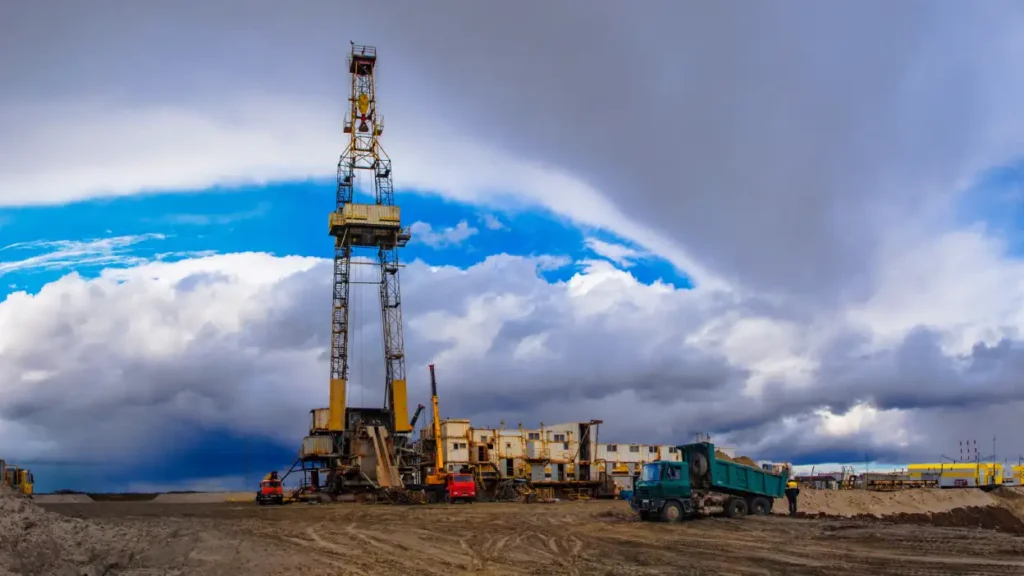
A drilling rig is a machine designed to drill holes into soil or rock. It uses rotating drill bits and powerful engines to create boreholes for foundations, mining, or exploration.
How drilling rigs work:
- Drill foundation piles for buildings and bridges;
- Bore wells for water, oil, or gas extraction;
- Create blast holes in mining operations;
- Support soil sampling and geotechnical studies.
Advantages of drilling rigs as heavy construction equipment:
- Capable of drilling deep, precise holes in varied terrain;
- Available in crawler, truck-mounted, or portable designs;
- Handles several applications from construction to mining;
- Improves speed and accuracy compared to manual drilling;
- Essential for modern infrastructure and resource exploration.
Tracked carriers
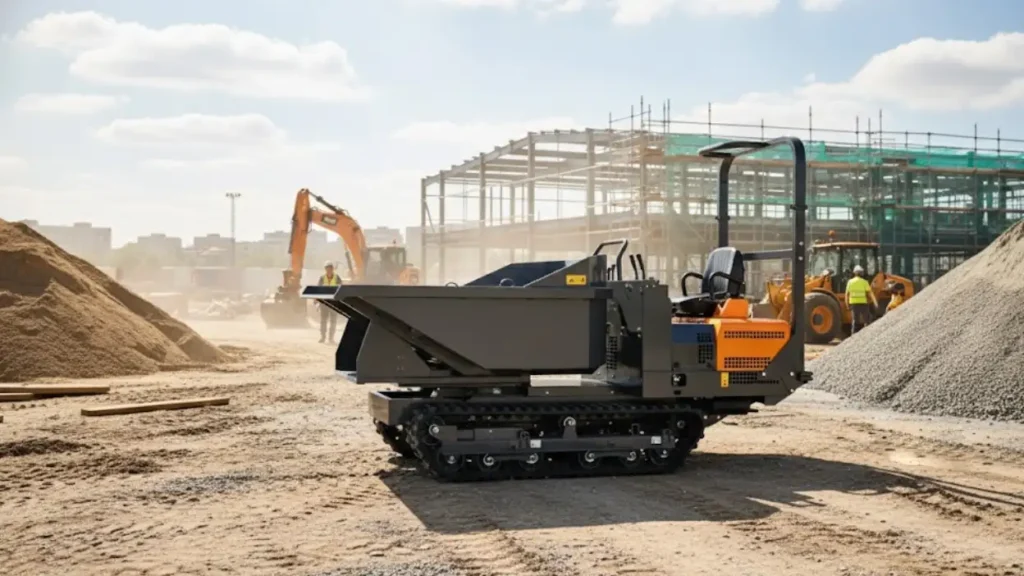
A tracked carrier is a crawler vehicle to haul heavy materials across rough or sensitive terrain. It has a flat bed or dump body for carrying loads.
How tracked carriers work:
- Transport soil, gravel, or debris on muddy or uneven sites;
- Haul material in forestry, mining, or pipeline projects;
- Work in areas with low ground pressure requirements;
- Carry equipment and supplies across off-road sites.
Advantages of tracked carriers as heavy construction equipment:
- Low ground pressure prevents sinking in soft soil;
- Excellent maneuverability on steep or unstable terrain;
- Compact size allows access to confined work areas;
- Versatile payload options, from dump beds to flatbeds;
- Reliable in conditions where wheeled trucks cannot operate.
Mining shovels (hydraulic shovels)
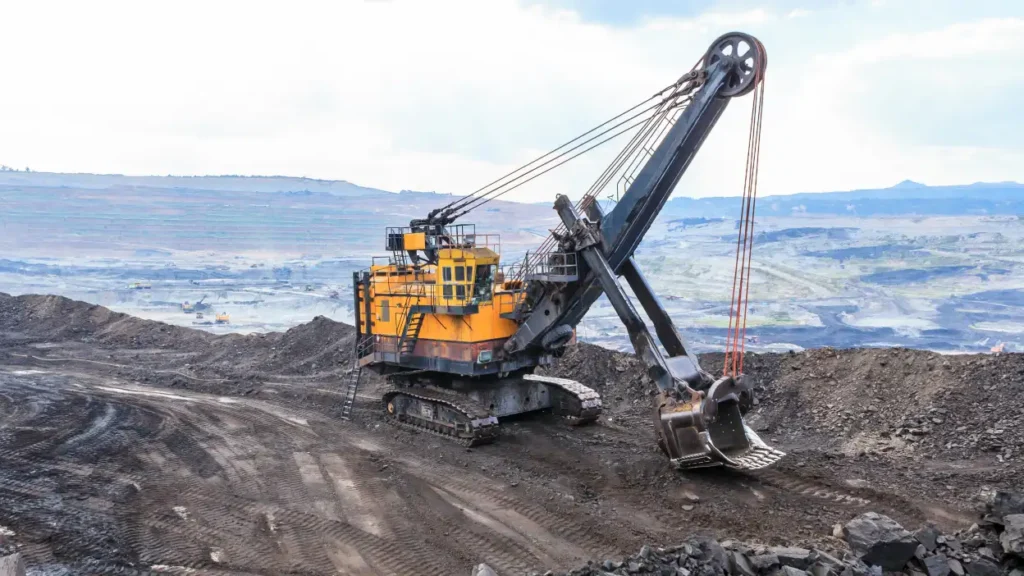
A mining shovel is a large hydraulic excavator designed for loading massive amounts of rock and ore. It features a large front bucket and powerful hydraulic arms.
How mining shovels work:
- Load trucks in open-pit mining operations;
- Move overburden and blasted rock;
- Support large-scale quarrying and material extraction;
- Handle heavy-duty excavation in mining projects.
Advantages of mining shovels as heavy construction equipment:
- High bucket capacity for large volumes;
- Strong hydraulics provide efficient digging power;
- Built for continuous operation in harsh mining environments;
- Matches with haul trucks for the most productivity;
- Long service life and durability reduce downtime.
Surface miners
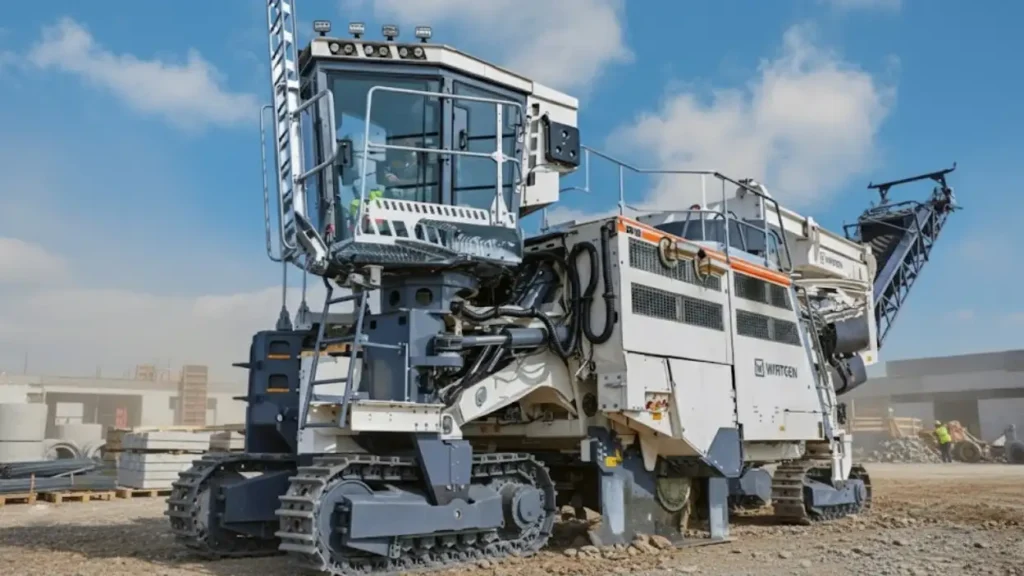
A surface miner is a specialized machine for cutting and extracting minerals without drilling or blasting. It uses a rotating drum with cutting tools to mill the ground directly.
How surface miners work:
- Extract coal, limestone, gypsum, or iron ore;
- Cut and crush rock in open-pit mining;
- Prepare surfaces for road or foundation work;
- Reduce the need for blasting in populated areas.
Advantages of surface miners as heavy construction equipment:
- Produces uniform-sized material without extra crushing;
- Reduces dust, noise, and vibration compared to blasting;
- Improves worker safety and environmental compliance;
- Cuts operational costs by combining excavation and crushing;
- Increases efficiency in selective mining applications.
Dragline excavators (harvesters)
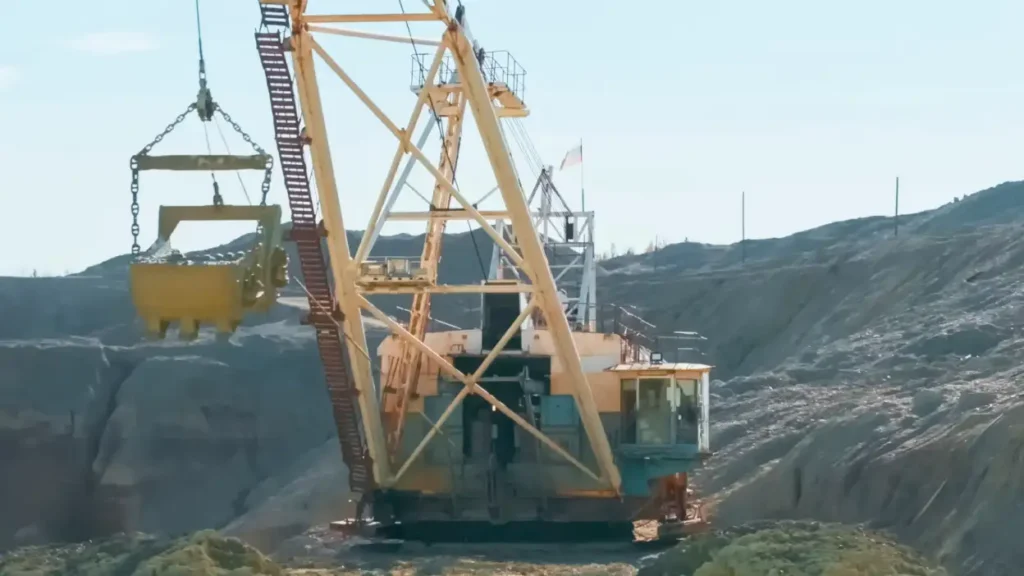
A dragline excavator, sometimes called a dragline harvester, is a massive machine with a large bucket suspended on cables. It uses a hoist and drag system to excavate material.
How dragline excavators work:
- Perform deep excavation in open-pit mining;
- Remove overburden layers above coal seams;
- Dredge rivers, lakes, and canals;
- Support large-scale earthmoving projects.
Advantages of dragline excavators as heavy construction equipment:
- Capable of reaching great depths and long distances;
- Moves enormous volumes of material;
- Reduces the need for many machines in mining operations;
- Durable and built for continuous, heavy-duty work;
- Essential for large-scale excavation in mining and dredging.
Quick Comparison Table of Construction Equipment Names and Uses
| Equipment Name | Category | Main Use | Example Brands |
|---|---|---|---|
| Excavator | Earthmoving | Digging trenches, foundations, and demolition | CAT, Komatsu |
| Backhoe Loader | Earthmoving | Digging, loading, and material handling | JCB, John Deere |
| Dozer | Earthmoving | Pushing and leveling soil and debris | CAT, Liebherr |
| Wheel Loader | Earthmoving | Scooping and transporting loose materials | Volvo, Hitachi |
| Skid Steer Loader | Earthmoving | Compact earthmoving in tight spaces | Bobcat, Case |
| Trencher | Earthmoving | Cutting trenches for utilities | Vermeer, Ditch Witch |
| Dragline Excavator | Earthmoving | Deep excavation and dredging | Bucyrus, Marion |
| Scraper | Earthmoving | Cutting and hauling soil across sites | Caterpillar |
| Mini Excavator | Earthmoving | Compact digging for urban or small projects | Kubota, Takeuchi |
| Long Reach Excavator | Earthmoving | Extended reach for canals and rivers | Komatsu, CAT |
| Tower Crane | Lifting & Hauling | Vertical lifting for tall structures | Potain, Terex |
| Mobile Crane | Lifting & Hauling | Flexible lifting across multiple sites | Grove, Liebherr |
| Telehandler | Lifting & Hauling | Lifting with telescopic reach | Manitou, JLG |
| Forklift | Lifting & Hauling | Material handling in warehouses and sites | Toyota, Hyster |
| Dump Truck | Hauling | Transporting soil, gravel, debris | Volvo, Caterpillar |
| Articulated Hauler | Hauling | Quarry and mining transport | Volvo, Bell |
| Rough Terrain Crane | Lifting | Lifting on uneven or rough terrain | Terex, Grove |
| Carry Deck Crane | Lifting | Compact lifting in confined spaces | Broderson |
| Motor Grader | Road Construction | Fine grading and leveling surfaces | CAT, CASE |
| Road Roller / Compactor | Road Construction | Soil and asphalt compaction | Bomag, Hamm |
| Asphalt Paver | Road Construction | Laying asphalt layers | Vögele, Caterpillar |
| Cold Planer | Road Construction | Removing old pavement | Wirtgen, Roadtec |
| Road Reclaimer | Road Construction | Road rehabilitation and base mixing | Caterpillar |
| Slipform Paver | Road Construction | Continuous concrete paving | GOMACO |
| Soil Stabilizer | Road Construction | Preparing soil foundations | Wirtgen, CAT |
| Concrete Mixer Truck | Concrete & Building | Mixing and transporting concrete | Schwing Stetter, Mack |
| Concrete Pump Truck | Concrete & Building | Delivering concrete to heights | Putzmeister, Schwing |
| Boom Lift | Concrete & Building | Aerial access for construction tasks | JLG, Genie |
| Pile Driving Machine | Concrete & Building | Driving piles for foundations | Liebherr, Junttan |
| Boring Machine | Concrete & Building | Drilling for foundations | Herrenknecht |
| Tunnel Boring Machine (TBM) | Concrete & Building | Large-scale tunneling | Robbins, Herrenknecht |
| Shotcrete Machine | Concrete & Building | Spraying concrete on surfaces | Normet, Aliva |
| Concrete Bucket | Concrete & Building | Crane attachment for lifting concrete | CAT, Terex |
| Crawler Loader | Specialized & Mining | Digging and loading on rough terrain | CAT, Liebherr |
| Hydraulic Breaker (Hammer) | Specialized & Mining | Demolition of rock and concrete | Atlas Copco, Furukawa |
| Drilling Rig | Specialized & Mining | Boreholes for foundations and mining | Bauer, Soilmec |
| Tracked Carrier | Specialized & Mining | Hauling materials on rough terrain | Morooka, Yanmar |
| Mining Shovel | Specialized & Mining | Large-scale mining and excavation | Hitachi, Komatsu |
| Surface Miner | Specialized & Mining | Cutting and extracting minerals | Wirtgen |
How to Choose the Right Construction Equipment
Selecting the right construction equipment keeps projects on schedule and within budget. The wrong machine can slow progress, increase costs, or even compromise safety. These are the main points to consider when making a decision:
Key factors to check
- Project size – large-scale jobs like highway construction need heavy-duty machines, while smaller projects may only need compact or multi-purpose equipment.
- Budget – factor in not just the purchase price but also fuel, maintenance, operator training, and resale value.
- Terrain and conditions – choose tracked machines for soft or uneven ground, and wheeled machines for speed and mobility on firm surfaces.
When to buy new vs. used
- Buy new construction equipment if you need the latest technology, fuel efficiency, and lower risk of breakdowns. New equipment also comes with warranties and longer service life, which is valuable for long-term use.
- Buy used construction equipment if you want to reduce upfront costs. Used machines can be cost-effective if inspected properly and sourced from trusted sellers.
Tips for contractors
Contractors should always match a machine’s capacity to the actual workload, as using equipment that is too small can cause delays, while overloading a larger machine can shorten its lifespan.
Choosing multi-purpose equipment such as backhoe loaders or skid steers is often a smart way to reduce fleet size and costs, since one machine can handle many tasks.
It’s also important to consult with suppliers or dealers before making a purchase, as their expertise can help ensure the equipment fits the specific requirements of the project.
Finally, operator training and safety should never be overlooked; investing in proper instruction and enforcing safety standards helps protect workers, extend machine life, and improve efficiency on site.
Conclusion
Choosing the right equipment is about more than knowing the names. It means assessing project size, budget, and site conditions, then deciding whether to invest in new equipment for reliability and long-term use or used equipment for cost savings. The wrong choice can lead to delays, higher costs, or wasted resources.
Search listings, compare machines, and find both new and used options in one place, JumboBee. This way, you can save time, cut risk, and get more control over costs.



Be the first to leave a comment
There are no replies to this post yet. Share your thoughts and help start the conversation.